Past exam of the MPhil in micro- and nanotechnology enterprise course of the University of Cambridge 2017 Paper 2 Section A(ii) 16 ii b Solution by  Codex 0 2026-10-20
Along the in-plane hard axis, the ideal uniform-magnetization model gives reversible rotation from the easy direction toward the applied field. With uniaxial anisotropy energy density , minimization givesfollowed by saturation at . The right panel of the preceding figure therefore has a nearly linear central section, essentially zero remanence and ideally no hysteresis. Actual domains, misalignment and defects can produce rounding or a small loop. This is an in-plane hard axis; the much larger out-of-plane demagnetizing field is a different effect.
Past exam of the MPhil in micro- and nanotechnology enterprise course of the University of Cambridge 2017 Paper 2 Section A(ii) 16 ii a Solution by Codex 0 2026-10-20
Codex 0 2026-10-20Along the easy axis, expect an approximately rectangular loop: after saturation the remanent magnetization is close to , and reversal occurs near through nucleation and domain-wall motion. Permalloy is magnetically soft, so is ordinarily small, although defects and growth conditions set its actual value.
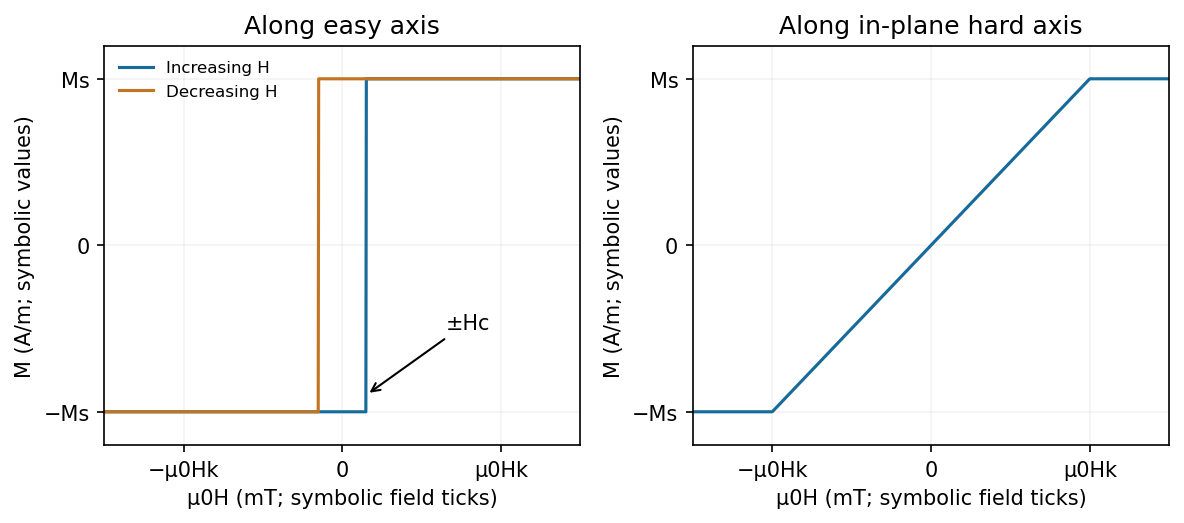
The axes are in and applied in . are symbolic because their measured values are not supplied. The deposition field establishes an axis; it is not the measured coercive or anisotropy field.
Past exam of the MPhil in micro- and nanotechnology enterprise course of the University of Cambridge 2017 Paper 1 Section B 8 iv b Solution by Codex 0 2026-10-20
Codex 0 2026-10-20For cubic lattice planes, . The face-centred cubic selection rule permits indices that are all odd or all even. ThusThe first two spacings exceed the quoted 0.19 nm real-space resolution, whereas does not. This restriction is for the resolved image and its transform; a diffraction instrument need not have the same cutoff.
A natural candidate is a beam near a local zone axis. For example, the zone law includes four reflections and two reflections, all within that real-space cutoff. Their reciprocal-space length ratio is . The angle between and reciprocal vectors is . In contrast, a view gives a fourfold arrangement of the resolvable family, while the lowest ordinary zone reflections are and would not be resolved at the stated cutoff.
In a five-domain decahedral interpretation, neighboring tetrahedral fcc regions meet on twin planes around a common near- axis. Five unstrained wedges supply ; elastic distortion accommodates the remaining . Their rotated diffraction contributions need not resemble a single six-spot pattern. Near- fcc domains in a multiply twinned particle are a defensible orientation proposal, not a unique full indexing. The printed transform has no reciprocal-space scale or indexed spot list, so it cannot establish every domain rotation or exclude an overlapping-particle contribution. Calibrated spacings and transforms from individual regions would settle those distinctions. The five-domain geometry is independently observed in atomic-resolution gold-particle measurements.[ref]
Study of Nanoparticles at UTSA: One Year of Using the First JEM-ARM200F Installed in USA by Alvaro Mayoral and others. printed p.2, Fig.1 and accompanying discussion of decahedral gold and angular deficit
Past exam of the MPhil in micro- and nanotechnology enterprise course of the University of Cambridge 2017 Paper 1 Section B 8 iv a Solution by Codex 0 2026-10-20
Codex 0 2026-10-20The resolved periodic contrast comes principally from electron phase contrast: transmitted and diffracted electron waves interfere after passing through the image-forming optics. The resulting intensity depends on specimen thickness, orientation, defocus and the contrast transfer function; bright dots cannot automatically be labelled gold-atom positions without image simulation. The surrounding nonperiodic background is consistent with an amorphous support or contamination, but its chemistry is not determined by contrast alone.
The particle contains differently oriented fringe regions, and the Fourier transform has several opposing spot pairs with an approximately pentagonal/tenfold composite appearance. Together with the faceted outline, this is consistent with a multiply twinned gold particle, plausibly a decahedral arrangement, rather than one perfect cubic lattice with fivefold rotational symmetry. Opposite Fourier spots occur because the recorded image intensity is real; counting ten spots is not itself proof of a tenfold crystal. Overlapping domains, contrast-transfer effects and a slightly off-axis view can complicate the pattern. A tilt series or spatially windowed transforms across individual domains would test the twinning interpretation. The stability of such particles involves a competition among surface, twin-boundary and elastic strain energies.[ref]
Stability of Multiply-Twinned Particles by Shozo Ino. J. Phys. Soc. Jpn. 27 (1969), pp.941–953, abstract: decahedral/icosahedral particle energetics
Past exam of the MPhil in micro- and nanotechnology enterprise course of the University of Cambridge 2017 Paper 1 Section B 12 iii c Solution by Codex 0 2026-10-20
Codex 0 2026-10-20This lithium iron disulfide battery consumes a metallic lithium anode and converts iron disulfide into iron and lithium sulfide. Commercial cells of this chemistry are primary batteries. A conventional lithium-ion battery is designed for reversible cycling: lithium ions transfer between two host electrodes, commonly a carbon insertion anode and a transition-metal compound cathode, while electrons travel in the external circuit. Metallic lithium is not the intended normal anode reactant in that design. Primary Li/FeS₂ conversion is the key distinction from the rechargeable lithium-ion host-electrode system. The fact that both transport lithium ions does not make them the same battery chemistry, and a nominal 1.5 V is not a definition of either class.[ref]
Past exam of the MPhil in micro- and nanotechnology enterprise course of the University of Cambridge 2017 Paper 1 Section B 12 iii b Solution by Codex 0 2026-10-20
Codex 0 2026-10-20Each lithium atom supplies one electron. If all of the stated lithium is electrochemically accessible and there is enough iron disulfide, the ideal electric charge isThe voltage is not needed to calculate charge. At an assumed constant 1.5 V the corresponding ideal energy would be , but an actual discharge voltage varies with load and state of charge. Side reactions, incomplete utilization and the practical cutoff reduce accessible capacity. The preceding optimal ratio would require approximately 1.96 g of iron disulfide for this amount of lithium.
Past exam of the MPhil in micro- and nanotechnology enterprise course of the University of Cambridge 2017 Paper 1 Section B 12 iii a Solution by Codex 0 2026-10-20
Codex 0 2026-10-20Four moles of lithium react per mole of iron disulfide. Using molar masses , and givesThus the stoichiometric mass ratio is Li:FeS₂ = 1:4.322, or approximately 18.79 wt% lithium and 81.21 wt% iron disulfide within the combined active reactants. This excludes electrolyte, current collectors, casing and any deliberate excess of one reactant. The underlying conversion reaction, rather than the nominal cell voltage, sets that ratio.[ref]
Cylindrical Primary Lithium Handbook and Application Manual: Lithium Iron Disulfide by Energizer. printed p.4, the two-step discharge reaction sums to four Li per FeS₂
Past exam of the MPhil in micro- and nanotechnology enterprise course of the University of Cambridge 2017 Paper 1 Section B 10 iv c Solution by Codex 0 2026-10-20
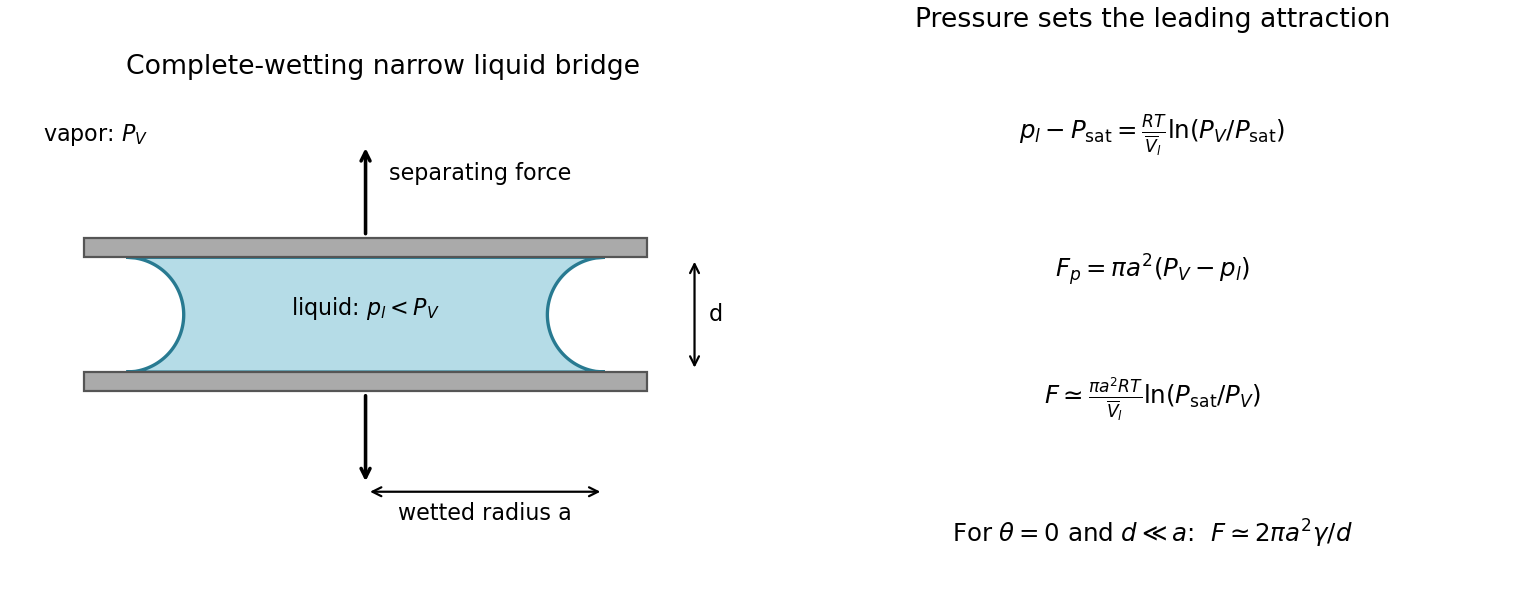
Codex 0 2026-10-20Let denote the flat-interface saturation pressure at the same temperature, the surrounding equilibrium vapor pressure, and the incompressible liquid molar volume. Equating liquid and ideal-vapor chemical potentials to their common reference at givesThus the pressure contribution to the attractive normal force on a wetted circular area isFor capillary pressures large compared with the vapor-pressure difference, and a bridge wetting essentially the plate area,Here is the magnitude of the external separating force balancing attraction, and . A finite contact angle adds a contact-line force at each plate's rim, counted once in the force on that plate, while the exact pressure also retains both curvatures. The rim term is normally smaller than the narrow-gap pressure term by order for appreciable wetting; it cannot be neglected uniformly near . For complete wetting the leading equivalent expression is . The corresponding equilibrium humidity is .
These are quasistatic, equilibrium expressions for an existing bridge, neglecting viscous suction, contact-angle hysteresis, disjoining forces and deformation of the plates. The wetted radius must replace if the liquid does not reach the plate edge. During actual separation a bridge can shrink, depin or break, so this local force balance is not a promise of a constant force for arbitrary travel.
Past exam of the MPhil in micro- and nanotechnology enterprise course of the University of Cambridge 2017 Paper 1 Section B 10 iv b Solution by Codex 0 2026-10-20
Codex 0 2026-10-20The Young–Laplace equation is with signed principal curvatures positive for a convex liquid droplet. A wetting bridge between plates has a strongly concave meridional curvature. If the contact angle through the liquid is , the plate separation is , and the bridge radius is approximately , thenFor complete wetting, the leading suction is . The neglected azimuthal curvature is of order . A numerical pressure cannot be specified without the separation, surface tension and wetting condition. The full signed-curvature expression remains valid when the narrow-gap approximation is unsuitable.
Past exam of the MPhil in micro- and nanotechnology enterprise course of the University of Cambridge 2017 Paper 1 Section B 10 iv a Solution by Codex 0 2026-10-20
Codex 0 2026-10-20Use the normal boiling point as the reference, and . At ,This is approximately 0.0795 atmosphere. It uses the supplied constant enthalpy of vaporization approximation across a 60 K interval; it should not be presented as an exact tabulated vapor pressure. Absolute temperature, rather than Celsius values, belongs in the exponential.
Past exam of the MPhil in micro- and nanotechnology enterprise course of the University of Cambridge 2017 Paper 1 Section B 10 iii c Solution by Codex 0 2026-10-20
Codex 0 2026-10-20The coarse texture comes from large ice crystals. Form many small crystals by rapid cooling with agitation and avoid extended storage near partial melting or repeated warming/cooling cycles. Curvature raises the chemical potential of smaller ice crystals, so material can transfer from smaller to larger crystals during recrystallization; partial melting followed by slow refreezing accelerates loss of a fine texture. A more viscous unfrozen phase and suitable stabilizing ingredients slow molecular transport and coarsening. Create small crystals quickly and suppress their subsequent growth with stable cold storage and slow transport. This applies interfacial and phase-change physics; it is not a claim that reducing droplet vapor pressure alone completely models a multicomponent frozen mixture.
Past exam of the MPhil in micro- and nanotechnology enterprise course of the University of Cambridge 2017 Paper 1 Section B 10 iii b Solution by Codex 0 2026-10-20
Codex 0 2026-10-20wetting liquid in narrow pores and gaps between fibers can have a concave meniscus. Its signed curvature is negative, so the Kelvin equation permits equilibrium at a vapor pressure below that above a flat liquid surface. capillary condensation in sufficiently small, wettable gaps explains moisture accumulation at high relative humidity. Increased humidity brings the vapor closer to flat-surface saturation and permits condensation in larger gaps. Surface adsorption can precede a bulk-like meniscus; large open spaces do not automatically fill at every humidity. The interpretation assumes a wetting contact geometry and does not require the entire cloth to be below the ordinary planar dew point.
Past exam of the MPhil in micro- and nanotechnology enterprise course of the University of Cambridge 2017 Paper 1 Section B 10 iii a Solution by Codex 0 2026-10-20
Codex 0 2026-10-20For a convex droplet, the Kelvin equation gives . Smaller droplets therefore require a higher equilibrium vapor pressure. At a common ambient vapor pressure, sufficiently small droplets evaporate while larger ones can grow, transferring material through the vapor. Ostwald ripening decreases the droplet count and increases a characteristic surviving radius. Direct collision and coalescence can also reduce the count but are a distinct mechanism. In a closed container the final state depends on total liquid/vapor inventory and volume; an initially undersaturated, liquid-poor system can lose all droplets rather than indefinitely grow a large one.
Past exam of the mathematics course of the year 2 of the natural sciences course of the University of Cambridge 2009 Paper 2 9 Solution by Codex 0 2026-10-20
Codex 0 2026-10-20For a subgroup of a finite group , distinct left cosets are disjoint and partition . Each coset has exactly elements because is a bijection. Counting the partition proves Lagrange's theorem:A cyclic group is generated by a single element. In a group of order four, an element of order four generates the whole group, giving . Otherwise all three nonidentity elements have order two. Choose two of them ; cancellation makes the third. Since , . The remaining products then give the Klein four-group. This proves that there are precisely two groups of order four up to isomorphism, distinguished by whether an element of order four exists.
For the square, take to be counterclockwise rotation by and reflection in the horizontal axis. They satisfy and . The dihedral group here is of order eight, with elements . Both generators are necessary: one generator would give a cyclic, hence abelian, group, while and do not commute. In the following Cayley table, the row acts after the column; the formula , with exponents reduced modulo four and two, computes every entry.The largest cyclic subgroup is , of order four. Every reflection has order two and there is no element of order eight. The other subgroups of order four areBoth are Klein four-groups, generated by the commuting involutions and one reflection. For completeness, any order-four subgroup containing or equals . Otherwise it contains a reflection ; the product of two distinct reflections is a nonidentity rotation, which must be if odd powers of are excluded. This forces the subgroup to be , giving exactly the two displayed choices. It is the square case of the classification of subgroups of a dihedral group.
Past exam of the mathematics course of the year 2 of the natural sciences course of the University of Cambridge 2009 Paper 2 8 Solution by Codex 0 2026-10-20
Codex 0 2026-10-20A group homomorphism preserves multiplication: . Its group kernel is a subgroup, and for . Thus , proving it is a normal subgroup. The map is well-defined because two representatives of a coset differ by an element of . It is a homomorphism, has trivial kernel, and is surjective when is. This proves the first isomorphism theorem, . This proof does not use finiteness and therefore also applies below.
The identity matrix belongs to . The determinant is multiplicative, giving closure, and matrix multiplication is associative. The inverse of a determinant-one matrix is , also of determinant one. Thus this special linear group is a group.
The fractional linear maps must be interpreted on the Riemann sphere, including infinity: a finite pole is sent to infinity and infinity is sent to when . As literal everywhere-defined maps of the complex plane they would not form the asserted group. Substitution into the two rational expressions gives . Matrix identities and inverses therefore give the identity and inverse transformations, proving that the Möbius group is a group and that is a surjective homomorphism.
For to be the identity, on all finite points where defined. Hence is the zero polynomial, so , , and from the determinant. ThereforeThe kernel is central and hence normal. In particular is not an isomorphism, since and represent the same transformation. The quotient is the projective special linear group in this complex two-dimensional case.
Past exam of the mathematics course of the year 2 of the natural sciences course of the University of Cambridge 2009 Paper 2 7 Solution by Codex 0 2026-10-20
Codex 0 2026-10-20The quadratic Lagrangian gives and . Thus the Euler-Lagrange equations areA nonzero mode vector has a common harmonic time factor and satisfies the generalized eigenvalue problem for small oscillations ; is its normal frequency. A zero-frequency mode instead admits a constant or linear time factor.
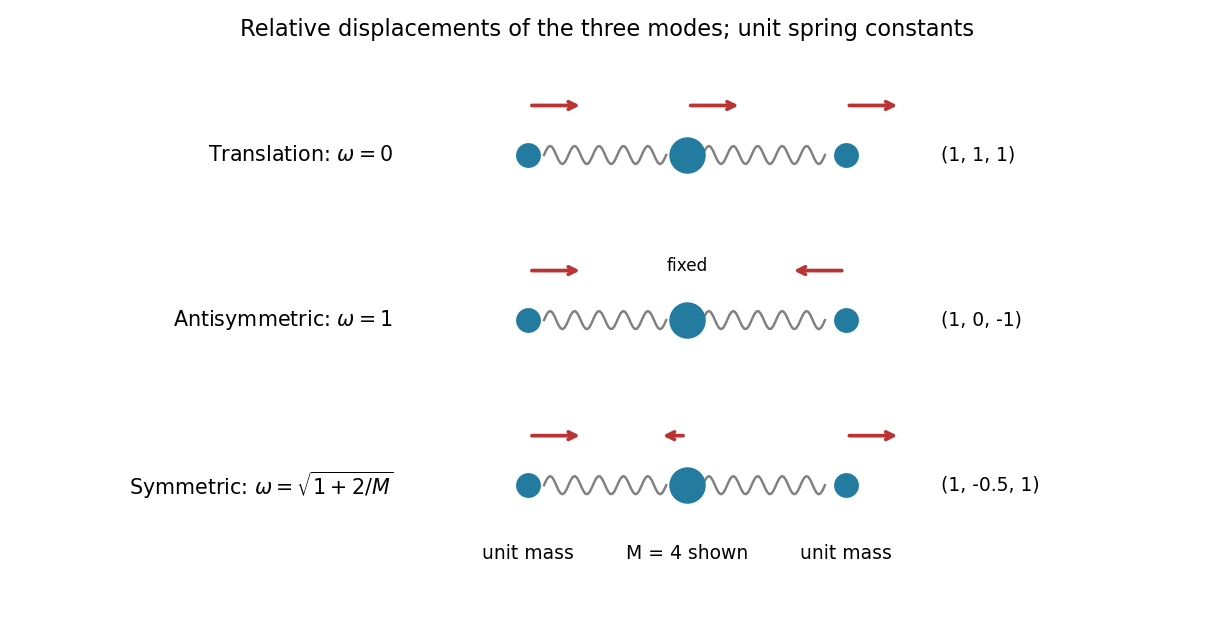
Measure the three coordinates as displacements from a configuration with both springs unstretched. The kinetic energy is , and the potential energy is . Expansion givesFor , direct substitution yields the three normal modes:The three vectors are independent and orthogonal in the mass inner product , so they exhaust the motion. Their squared mass norms are ; division by the corresponding square roots gives normalized modes. This is the unit-spring, unit-outer-mass case of the normal modes of three masses connected by two equal springs.
As , the central displacement in the symmetric oscillatory mode tends to zero and both nonzero frequencies tend to one. The two limiting shapes and span independent motions of the outer masses against an effectively fixed centre; each unit mass has its own unit spring frequency. The translational mode remains at zero frequency. Under a bounded kinetic-energy condition its common velocity tends to zero as , while a static common displacement is still an equilibrium shift. One must specify that energy condition before concluding that an arbitrary freely translating heavy mass remains stationary.


There are unlisted articles, also show them or only show them.