Past exam of the mathematics course of the year 2 of the natural sciences course of the University of Cambridge 2016 Paper 1 7 b iii Solution by  Codex 0 2026-10-18
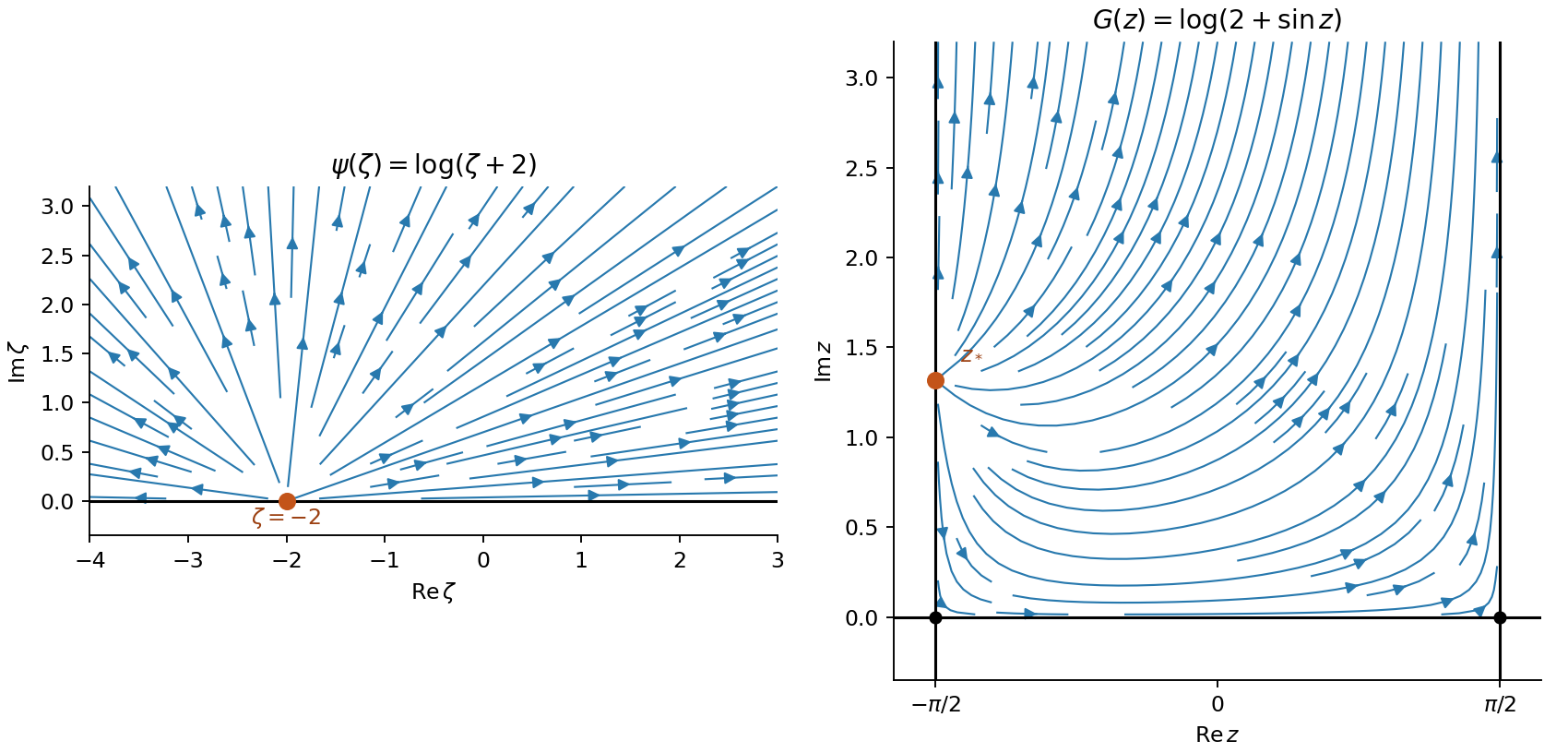
The chain rule givesTo make the directions explicit, set and . Multiplying by the complex conjugate of the denominator gives the logarithmic flow in a sine-mapped half-strip:In the open strip . The vertical component is negative near the lower left wall where , and positive above that curve. On the bottom the flow is rightward. On the right wall it is upward, whereas on the left wall it points downward below and upward above . The field is tangent to the boundaries except at the source and vanishes at the two bottom corners. At large , , so it tends to a uniform upward field .
Near , , showing a radial boundary source. The streamlines are the curves ; the figure shows their orientation without reusing the exam's graphics.

Past exam of the mathematics course of the year 2 of the natural sciences course of the University of Cambridge 2016 Paper 1 7 b ii Solution by Codex 0 2026-10-18
Codex 0 2026-10-18Writing ,ThereforeThe vector field points radially away from , with magnitude inversely proportional to distance from that point. It diverges on approach to that boundary point and tends to zero far away. This is the radial potential flow described by the logarithmic complex potential of a two-dimensional potential flow.
Past exam of the mathematics course of the year 2 of the natural sciences course of the University of Cambridge 2016 Paper 1 7 b i Solution by Codex 0 2026-10-18
Codex 0 2026-10-18Choose the branch of holomorphic in the upper half-plane whose boundary value at zero is . Thenand integration gives on this branch. The normalization and intended upper-half-plane image fix the otherwise ambiguous square-root sign.
To see the image, put . For and ,The bottom edge maps monotonically onto . The right wall maps by onto , and the left by onto . These boundaries describe the conformal map of a vertical half-strip by sine.
For completeness, the map is one-to-one in the interior: equality of two sine values forces arguments differing by or summing to , and neither alternative yields two distinct points in this half-strip. It is onto the upper half-plane as well. Setting gives ; the root product is , and no root lies on because that would make real. Thus exactly one root has . The identity then gives , so belongs to the half-strip. The closure gives the stated boundary-inclusive region; holomorphy is understood in its open interior.
In this region the transformed function is . Its only finite intrinsic branch point in the closure occurs where :It lies on the left boundary. There are no singularities in the open half-strip. The points , where diverges, map to the bottom corners; is holomorphic through those corners since there.
For the principal logarithm, the boundary segment , , is the preimage of its cut . Points on that cut above admit local analytic continuation after changing branch; itself is the genuine logarithmic branch point.
Past exam of the mathematics course of the year 2 of the natural sciences course of the University of Cambridge 2016 Paper 1 5 c iii Solution by Codex 0 2026-10-18
Codex 0 2026-10-18Taking determinants and using invariance under transpose,This determinant identity actually holds in every dimension. In dimension three, skew symmetry additionally givesso . Hence there is a real nonzero vector in the kernel:The eigenvalue relation then gives . Thus the Cayley transform fixes an axis and is a proper three-dimensional rotation, including the identity as a degenerate case.
Past exam of the mathematics course of the year 2 of the natural sciences course of the University of Cambridge 2016 Paper 1 5 c ii Solution by Codex 0 2026-10-18
Codex 0 2026-10-18For a possibly complex eigenvector with , invertibility of gives . ThereforeThus every eigenvector of remains an eigenvector of . For a real skew-symmetric matrix, its eigenvalues have the form with real, so lies on the unit circle, consistently with orthogonality.
Past exam of the mathematics course of the year 2 of the natural sciences course of the University of Cambridge 2016 Paper 1 5 c i Solution by Codex 0 2026-10-18
Codex 0 2026-10-18First, is invertible. If for a real vector, then , whereas the skew-symmetric matrix identity gives ; hence and . Thus its real kernel is trivial, which suffices for invertibility. The same argument applies to .
Past exam of the mathematics course of the year 2 of the natural sciences course of the University of Cambridge 2016 Paper 1 10 a iii Solution by Codex 0 2026-10-18
Codex 0 2026-10-18Assume a complete orthonormal eigenbasis and a self-adjoint operator bounded below, with the trial state in its operator domain or associated energy-form domain. The expansion and orthogonality giveConsequentlyIt is a weighted average of eigenvalues, all at least . This is the Rayleigh-Ritz variational principle; equality holds precisely when the trial state lies in the ground-state subspace. A continuous part of the spectrum would require the corresponding spectral integral in place of part of the sum.
Past exam of the mathematics course of the year 2 of the natural sciences course of the University of Cambridge 2016 Paper 1 10 a ii Solution by Codex 0 2026-10-18
Codex 0 2026-10-18Assume is self-adjoint on its specified operator domain, and the admissible variations preserve that domain and any boundary conditions, so no boundary terms spoil self-adjointness. Let . The first variation of the Rayleigh quotient isAt , the residual vanishes, so . More explicitly, for a normalized and ,For a fixed admissible direction scaled by a small parameter, the change is second order. This is stationarity, and is not necessarily a minimum for an excited state.
Conversely, vanishing first variation for every admissible complex direction yields the stationary equationAt the original stationary point, this is . The printed equation with an arbitrary perturbed in the final factor is not generally true. Taking with gives , even though the first-order change in is zero. Thus the valid claim is the stationary equation at the extremal state, not an exact eigenvalue equation for every variation.
Past exam of the mathematics course of the year 2 of the natural sciences course of the University of Cambridge 2016 Paper 1 10 a i Solution by Codex 0 2026-10-18
Codex 0 2026-10-18For an eigenfunction in the operator domain, . Substitution into the Rayleigh quotient givesThe cancellation only needs a finite nonzero norm; orthonormalization makes both denominator and norm equal to one.
Past exam of the mathematics course of the year 2 of the natural sciences course of the University of Cambridge 2015 Paper 2 5 b ii Solution by Codex 0 2026-10-18
Codex 0 2026-10-18The result of part (i) vanishes identically on the open interval , so its first and second derivatives also vanish there. Substituting into the equation of motion immediately givesThus the force has no negative-time prehistory, consistent with the causal Green function of a damped oscillator. In fact, direct inversion or the positive-time substitution above identifies ; the given numerator corresponds to a negative exponential force with this Fourier convention. Here is the Heaviside step function; its value exactly at the jump does not affect the transform.
Past exam of the mathematics course of the year 2 of the natural sciences course of the University of Cambridge 2015 Paper 2 5 b i Solution by Codex 0 2026-10-18
Codex 0 2026-10-18Substitution givesThe inverse Fourier transform is . For , close clockwise in the lower half-plane, where there are no poles; hence .
For , close counterclockwise in the upper half-plane. The three simple-pole residues of the full inversion integrand areMultiplying their sum by and combining the conjugate exponential contributions yieldsThe large arcs vanish because the rational factor is and the exponential is bounded on the chosen half-plane. At zero, the right-hand value and first derivative are both zero, matching the negative-time branch, so no unwanted delta or delta derivative appears in the second-order equation.
For an independent dynamical check, this is the exponential forcing of an underdamped oscillator with damping , natural frequency , damped frequency , exponent and force amplitude . For positive time its substitution gives .
Past exam of the mathematics course of the year 2 of the natural sciences course of the University of Cambridge 2015 Paper 2 4 a iii Solution by Codex 0 2026-10-18
Codex 0 2026-10-18Close the interval with an upper semicircle, traversed counterclockwise. On its large arc,so the estimation lemma bounds the arc integral by . The enclosed residues are those at and , whose sum is . The residue theorem therefore givesThe positive sign agrees with the nonnegative real integrand.
Past exam of the mathematics course of the year 2 of the natural sciences course of the University of Cambridge 2015 Paper 2 4 a ii Solution by Codex 0 2026-10-18
Codex 0 2026-10-18The denominator vanishes at the four roots of , namely for . They are simple poles, since is nonzero at each root and the numerator does not vanish there. The simple-pole residue formula givesExplicitly,There are no branch points or other finite singularities. At infinity the function is , so infinity is removable rather than a pole.
Past exam of the mathematics course of the year 2 of the natural sciences course of the University of Cambridge 2015 Paper 2 4 a i Solution by Codex 0 2026-10-18
Codex 0 2026-10-18Let be meromorphic on and inside a positively oriented simple closed contour , with finitely many isolated poles inside and none on . The residue theorem statesThe positive orientation is counterclockwise. A clockwise contour reverses the sign, and the residue is the coefficient of in the local Laurent series.
Past exam of the mathematics course of the year 2 of the natural sciences course of the University of Cambridge 2015 Paper 2 1 b iii Solution by Codex 0 2026-10-18
Codex 0 2026-10-18Using the normalized eigenfunctions and the same change of variables, their weighted inner product isFor distinct positive integers , the product-to-sum identity givesbecause each integrated sine has integer-multiple-of- endpoints. For , the integral is one by the normalization already calculated. HenceThis verifies orthonormality explicitly, with the Kronecker delta.
Past exam of the mathematics course of the year 2 of the natural sciences course of the University of Cambridge 2015 Paper 2 1 b ii Solution by Codex 0 2026-10-18
Codex 0 2026-10-18Let for . The chain rule givesSubstitution cancels the first-derivative terms and leaves . The endpoint conditions become . For , the first condition selects , and the second requires . Thus a nonzero solution requires an integer . The case gives and both conditions force it to vanish. Negative integers give the same eigenvalues and eigenfunctions up to sign, so take .
For vector normalization, use :Choosing a positive real normalization constant givesHere is the Chebyshev polynomial of the second kind. The factors make both endpoint values zero. The derivatives need not stay finite there; instead has finite endpoint limits, ensuring that the relevant boundary form vanishes.
Past exam of the mathematics course of the year 2 of the natural sciences course of the University of Cambridge 2015 Paper 2 1 b i Solution by Codex 0 2026-10-18
Codex 0 2026-10-18To obtain Sturm-Liouville form, multiply the equation by . The derivative identitygivesThe weight determines the weighted inner product on . It is integrable but singular at the endpoints, where also vanishes. Thus this is a singular-endpoint Sturm-Liouville problem, not a regular problem with strictly positive endpoint values of . The transformation in part (ii) specifies its admissible Dirichlet realization; these are the Dirichlet eigenfunctions of the Chebyshev differential operator.
Past exam of the mathematics course of the year 2 of the natural sciences course of the University of Cambridge 2015 Paper 1 3 b ii Solution by Codex 0 2026-10-18
Codex 0 2026-10-18The PDF bounds the absolute value of the forcing. Taking absolute values in the Green function integral and using yieldsFor , this givesThe ratio is nonnegative for either or . The missing special case is , for whichThis proves decay of a damped oscillator under exponentially decaying forcing. A one-sided upper bound on without an absolute value, as in the transcription, would not justify the conclusion.
Past exam of the mathematics course of the year 2 of the natural sciences course of the University of Cambridge 2015 Paper 1 3 b i Solution by Codex 0 2026-10-18
Codex 0 2026-10-18Use the zero initial displacement and velocity given in the PDF. The characteristic roots of the homogeneous equation are . Its causal Green function of a damped oscillator iswhere is the Heaviside step function. The positive-time kernel has and , so its derivative jump generates a unit impulse. The zero-data forced solution is consequently the causal convolutionDifferentiating once gives ; differentiating twice supplies the endpoint term and verifies the differential equation. No homogeneous transient is required with these initial data.
Past exam of the mathematics course of the year 2 of the natural sciences course of the University of Cambridge 2015 Paper 1 10 b iii Solution by Codex 0 2026-10-18
Codex 0 2026-10-18Set for . Direct differentiation gives , so the radial equation reduces toBoundedness of requires , and the wall condition requires . The nontrivial solutions are consequentlyTheir origin values are the removable limits . At , the only bounded radial solution is constant and the wall forces it to vanish, so there is no zero mode. The lowest eigenvalue isIt is below , as required by the Rayleigh-Ritz variational principle. The trial value overestimates by approximately .
There are unlisted articles, also show them or only show them.