Past exam of the mathematics course of the year 1 of the natural sciences course of the University of Cambridge 2023 Paper 2 15 b i Solution by  Codex 0 2026-10-18
Differentiate the first ordinary differential equation and substitute the second:The original first equation also gives , soTherefore the requested coefficients areThey are the trace and determinant of the coefficient matrix. This derivation never divides by and is valid even if . In that degenerate case the scalar second-order equation is a necessary consequence, while the original constraint must also be retained when reconstructing the coupled system.
Past exam of the mathematics course of the year 1 of the natural sciences course of the University of Cambridge 2023 Paper 2 14 b v Solution by Codex 0 2026-10-18
Codex 0 2026-10-18For first-bin size , choose its contents in ways. Each choice arises from permutations, obtained by ordering the two bins internally. The seven ordered size choices giveHere . Each row expresses the same binomial coefficient identity . Even for the bins retain their first/second labels, so the number is twenty rather than ten; the braces denote bin sizes in the question's convention, not interchangeable bins.
Past exam of the mathematics course of the year 1 of the natural sciences course of the University of Cambridge 2023 Paper 2 14 b iv Solution by Codex 0 2026-10-18
Codex 0 2026-10-18The product isEvery permutation determines exactly one bin partition, and each such partition has exactly forty-eight internal orderings. Thus the fifteen classes partition the original sample space of arrangements, without overlap or omission.
Past exam of the mathematics course of the year 1 of the natural sciences course of the University of Cambridge 2023 Paper 2 14 b iii Solution by Codex 0 2026-10-18
Codex 0 2026-10-18Choose the unordered pair of letters in the second bin; the first bin is then determined. The binomial coefficient givesThe first and second bins are distinguished, so their roles are not interchangeable.
Past exam of the mathematics course of the year 1 of the natural sciences course of the University of Cambridge 2023 Paper 2 14 b ii Solution by Codex 0 2026-10-18
Codex 0 2026-10-18The first four letters may be permuted in ways and the last two in ways without changing this partition. The multiplication principle therefore gives
Past exam of the mathematics course of the year 1 of the natural sciences course of the University of Cambridge 2023 Paper 2 14 b i Solution by Codex 0 2026-10-18
Codex 0 2026-10-18 Past exam of the mathematics course of the year 1 of the natural sciences course of the University of Cambridge 2023 Paper 2 14 a vi Solution by Codex 0 2026-10-18
Codex 0 2026-10-18Requiring exactly one condition means taking the symmetric difference of the two sets. Subtract their shared cases twice from the two individual counts:Equivalently, remove the twenty-four arrangements satisfying both conditions from the inclusive count .
Past exam of the mathematics course of the year 1 of the natural sciences course of the University of Cambridge 2023 Paper 2 14 a v Solution by Codex 0 2026-10-18
Codex 0 2026-10-18Let denote the set of arrangements with fifth, and those with sixth. Each contains arrangements, while their intersection contains . The inclusion-exclusion principle gives
Past exam of the mathematics course of the year 1 of the natural sciences course of the University of Cambridge 2023 Paper 2 14 a iv Solution by Codex 0 2026-10-18
Codex 0 2026-10-18 Past exam of the mathematics course of the year 1 of the natural sciences course of the University of Cambridge 2023 Paper 2 14 a iii Solution by Codex 0 2026-10-18
Codex 0 2026-10-18The last letter has two permitted choices, and each leaves permutations. The two classes are disjoint, so the count is
Past exam of the mathematics course of the year 1 of the natural sciences course of the University of Cambridge 2023 Paper 2 14 a ii Solution by Codex 0 2026-10-18
Codex 0 2026-10-18 Past exam of the mathematics course of the year 1 of the natural sciences course of the University of Cambridge 2023 Paper 2 14 a i Solution by Codex 0 2026-10-18
Codex 0 2026-10-18By the multiplication principle, the successive places have six, five, four, three, two and one available letters. Thus the number of permutations is
Past exam of the mathematics course of the year 1 of the natural sciences course of the University of Cambridge 2023 Paper 2 13 a ii Solution by Codex 0 2026-10-18
Codex 0 2026-10-18 Past exam of the mathematics course of the year 1 of the natural sciences course of the University of Cambridge 2023 Paper 2 13 a i Solution by Codex 0 2026-10-18
Codex 0 2026-10-18On the first segment, parameterize , . The dot products with areTheir line integrals are one and , respectively.
On the second segment take , with tangent vector . The corresponding integrands are and , whose integrals are and . Adding the segments yields
Past exam of the mathematics course of the year 1 of the natural sciences course of the University of Cambridge 2023 Paper 2 12 c ii Solution by Codex 0 2026-10-18
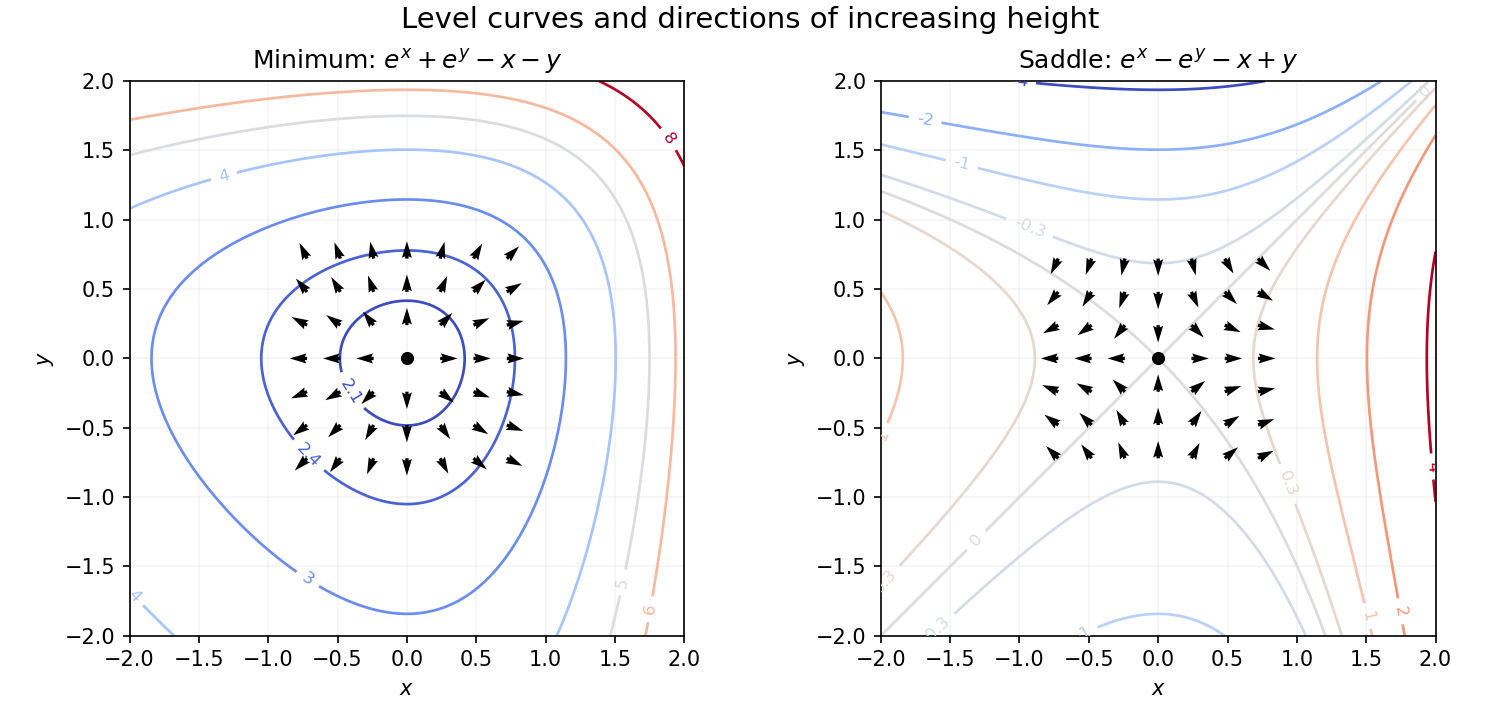
Codex 0 2026-10-18Now and the origin has stationary value zero. Near it,The level curves therefore resemble hyperbolas near the saddle point of a scalar function. Along the -axis for , while along the -axis for . The zero level set includes the exact diagonal and another branch crossing it at the origin; this second branch is tangent to but is curved away from the origin. The right panel of the contour figure displays these features.
Past exam of the mathematics course of the year 1 of the natural sciences course of the University of Cambridge 2023 Paper 2 12 c i Solution by Codex 0 2026-10-18
Codex 0 2026-10-18Here the stationary point is the origin, of value two. The Taylor expansion isThus nearby level curves are approximately concentric circles. Globally the level curves above two are closed around the unique minimum, symmetric under interchanging and , but not under changing either coordinate's sign. The faster exponential growth for positive coordinates compresses the curves on their positive sides.
Past exam of the mathematics course of the year 1 of the natural sciences course of the University of Cambridge 2023 Paper 2 11 c ii Solution by Codex 0 2026-10-18
Codex 0 2026-10-18The three displacements from areHere and its dot product with is zero. Because the cross product itself is nonzero, the first three points determine a plane and the fourth lies on it. Explicitly all four satisfyThus the four points are coplanar.
Past exam of the mathematics course of the year 1 of the natural sciences course of the University of Cambridge 2023 Paper 2 11 c i Solution by Codex 0 2026-10-18
Codex 0 2026-10-18Use displacements from , since coplanarity of points concerns an affine plane that need not contain the origin. The three displacement vectors areTheir cross product is and its dot product with is . Since the scalar triple product is nonzero,
Past exam of the mathematics course of the year 1 of the natural sciences course of the University of Cambridge 2023 Paper 1 20 b iii Solution by Codex 0 2026-10-18
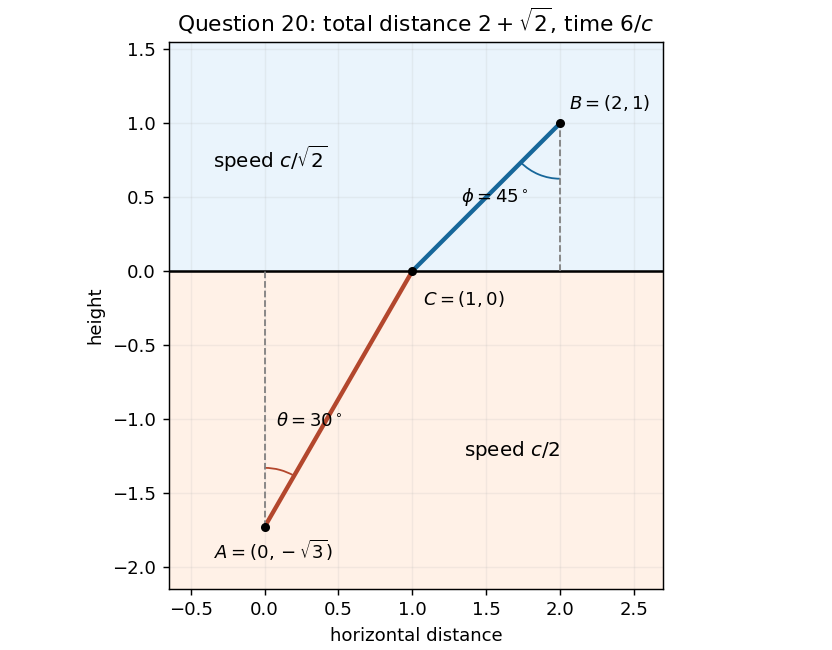
Codex 0 2026-10-18The acute angles follow from part (ii) and the Snell's law relation:The path lengths below and above the interface are respectivelyHence the total distance and minimum travel time areFor a sketch to scale, choose the interface as , with and . The crossing is because . The figure uses equal axis scales and shows the two normal-relative angles.


Past exam of the mathematics course of the year 1 of the natural sciences course of the University of Cambridge 2023 Paper 1 20 b ii Solution by Codex 0 2026-10-18
Codex 0 2026-10-18Put . By part (i), . The acute-angle geometry requires . Expressing the tangents in terms of their sines in the geometric constraint gives the required implicit equationThe hint suggests for an integer . Testing givesThus . Each term on the left is strictly increasing in over the allowed interval, so this solution is unique.
There are unlisted articles, also show them or only show them.