Past exam of the mathematics course of the year 1 of the natural sciences course of the University of Cambridge 2024 Paper 2 16 b i Solution by  Codex 0 2026-10-18
On the face , and the outward unit normal is . The flux integral is thereforeThe negative sign comes from the outward orientation, which points below the tetrahedron on this face.
Past exam of the mathematics course of the year 1 of the natural sciences course of the University of Cambridge 2024 Paper 2 15 a iii Solution by Codex 0 2026-10-18
Codex 0 2026-10-18The characteristic roots areTaking real linear combinations of the two complex exponential solutions yieldsThe coefficient is three here, as confirmed in the PDF; the OCR replaces it by an undefined symbol.
Past exam of the mathematics course of the year 1 of the natural sciences course of the University of Cambridge 2024 Paper 2 15 a ii Solution by Codex 0 2026-10-18
Codex 0 2026-10-18The characteristic equation factors asThe distinct characteristic roots therefore give the general solution
Past exam of the mathematics course of the year 1 of the natural sciences course of the University of Cambridge 2024 Paper 2 15 a i Solution by Codex 0 2026-10-18
Codex 0 2026-10-18The characteristic equation has the repeated polynomial root , because both and occur as independent solutions. Hence its characteristic polynomial isComparing constant terms gives
Past exam of the mathematics course of the year 1 of the natural sciences course of the University of Cambridge 2024 Paper 2 14 b iv Solution by Codex 0 2026-10-18
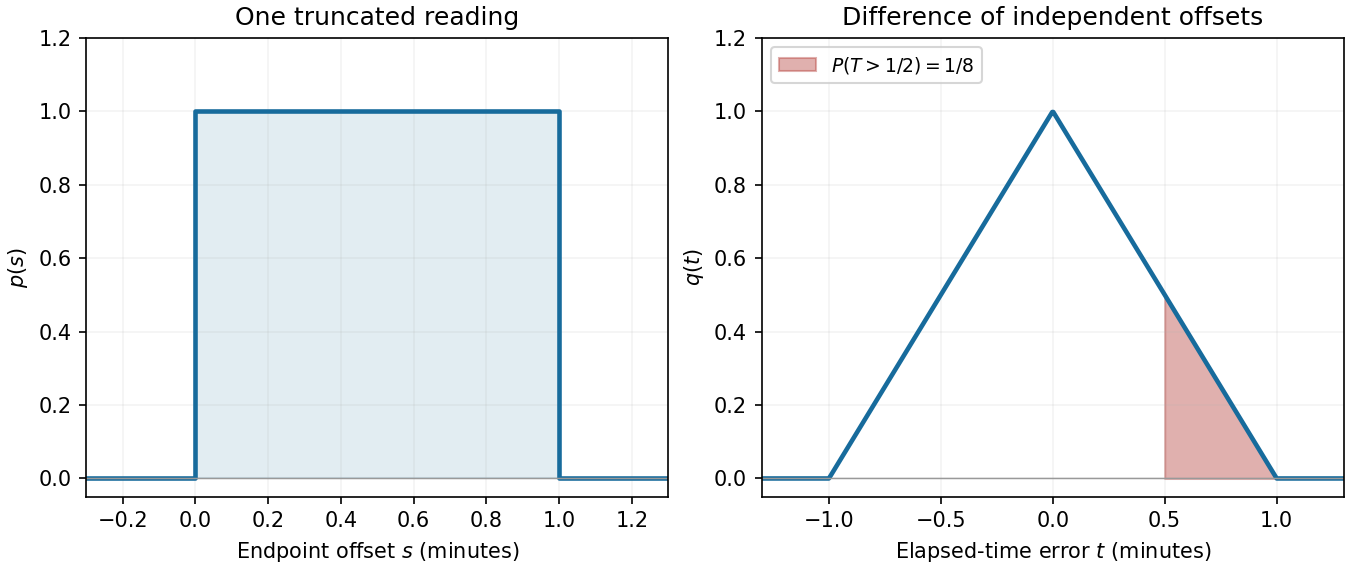
Codex 0 2026-10-18An excess of thirty seconds is in minute units. ThereforeThis is the shaded triangular area under the probability density function.
Past exam of the mathematics course of the year 1 of the natural sciences course of the University of Cambridge 2024 Paper 2 14 b iii Solution by Codex 0 2026-10-18
Codex 0 2026-10-18Since is an even function, is an odd function and its integral over the symmetric interval vanishes. Thus . Its variance isConsequentlyThe standard deviation is approximately minute, or seconds.
Past exam of the mathematics course of the year 1 of the natural sciences course of the University of Cambridge 2024 Paper 2 14 b ii Solution by Codex 0 2026-10-18
Codex 0 2026-10-18The probability density function graph joins to to and is zero elsewhere, as shown in the right panel of the timing figure. Its area isThus the probability distribution is normalized.
Past exam of the mathematics course of the year 1 of the natural sciences course of the University of Cambridge 2024 Paper 2 14 b i Solution by Codex 0 2026-10-18
Codex 0 2026-10-18Let be the finish-time offset from the start of its displayed minute. The elapsed time is , so . To obtain the stated density, use the intended model that and are independent random variables, both with the uniform distribution on .
Their joint probability density function is one on the unit square. Equivalently, the convolution of probability densities givesThe integrand is one exactly where and . The overlap has length for , length for , and zero otherwise. ThereforeThis is a symmetric triangular distribution. The independence and finish-time uniformity are additional modelling assumptions: the two truncated clock readings alone do not imply them. For example, if then the elapsed time is exactly twenty-five minutes and , even though each endpoint offset is individually uniform.
Past exam of the mathematics course of the year 1 of the natural sciences course of the University of Cambridge 2024 Paper 2 14 a iii Solution by Codex 0 2026-10-18
Codex 0 2026-10-18 Past exam of the mathematics course of the year 1 of the natural sciences course of the University of Cambridge 2024 Paper 2 14 a ii Solution by Codex 0 2026-10-18
Codex 0 2026-10-18The graph is a rectangle of height one over , with zero height elsewhere. Its unit area is the required normalization of the probability density function.

Past exam of the mathematics course of the year 1 of the natural sciences course of the University of Cambridge 2024 Paper 2 14 a i Solution by Codex 0 2026-10-18
Codex 0 2026-10-18A displayed minute contains one minute of possible start times, so the specified uniform distribution has probability density functionEndpoint choices for a probability density function do not affect any probabilities.
Past exam of the mathematics course of the year 1 of the natural sciences course of the University of Cambridge 2024 Paper 2 13 b ii Solution by Codex 0 2026-10-18
Codex 0 2026-10-18On the circular arc, and , so the line integral reduces toThis exact differential evaluation applies to the specified arc; for example its parametric equation is , . On the vertical segment , only contributes, giving . The whole path therefore givesTo answer the final conservativeness requirement, compute the curl:It vanishes identically exactly whenOn the simply connected whole space this condition is sufficient for a conservative vector field. Explicitly a vector-field potential isBoth path calculations then give , equal to by the fundamental theorem for line integrals. Equality of just these two path values would only force ; it is the curl calculation that establishes full path independence.
Past exam of the mathematics course of the year 1 of the natural sciences course of the University of Cambridge 2024 Paper 2 13 b i Solution by Codex 0 2026-10-18
Codex 0 2026-10-18 Past exam of the mathematics course of the year 1 of the natural sciences course of the University of Cambridge 2024 Paper 2 11 d iv Solution by Codex 0 2026-10-18
Codex 0 2026-10-18 Past exam of the mathematics course of the year 1 of the natural sciences course of the University of Cambridge 2024 Paper 2 11 d iii Solution by Codex 0 2026-10-18
Codex 0 2026-10-18Decompose into its orthogonal projections parallel and perpendicular to . Since removes the parallel component,The last vector is the displacement to the point of the straight line nearest the origin. HenceThe original PDF has , not the squared magnitude inserted by the OCR.
Past exam of the mathematics course of the year 1 of the natural sciences course of the University of Cambridge 2024 Paper 2 11 d ii Solution by Codex 0 2026-10-18
Codex 0 2026-10-18The unit vector specifies the direction of the straight line. Reversing its sign, together with the sign of , leaves the same straight line.
Past exam of the mathematics course of the year 1 of the natural sciences course of the University of Cambridge 2024 Paper 2 11 d i Solution by Codex 0 2026-10-18
Codex 0 2026-10-18Take the cross product with :Thus one choice isConversely, this cross product equation implies , so is parallel to . It therefore describes precisely the original straight line.
Past exam of the mathematics course of the year 1 of the natural sciences course of the University of Cambridge 2024 Paper 1 20 c iv Solution by Codex 0 2026-10-18
Codex 0 2026-10-18For , interpret the endpoint by a one-sided limit. Part (iii) shows that extends continuously there with value zero, so both nested integrals converge. Let denote the nested expression inside the derivative. The fundamental theorem of calculus, applied twice with moving lower endpoints, givesBy part (iii), , henceA direct check is , so , with the same third derivative.
Past exam of the mathematics course of the year 1 of the natural sciences course of the University of Cambridge 2024 Paper 1 20 c iii Solution by Codex 0 2026-10-18
Codex 0 2026-10-18At , the integrand vanishes for , so andSolving the first-order linear differential equation from part (i) on gives . The initial condition fixes , soEquivalently, the defining exponent is the logarithmic integral representation of the natural logarithm, .
Past exam of the mathematics course of the year 1 of the natural sciences course of the University of Cambridge 2024 Paper 1 20 c ii Solution by Codex 0 2026-10-18
Codex 0 2026-10-18The required range isNear , the ratio tends to , so it causes no convergence problem. Near , one useful identity isFor , this bounds its absolute value by , which is integrable on . It also supplies the domination used in part (i).
For , the integrand is negative and behaves as near zero; its improper integral diverges. For its negative singularity is even stronger, and comparison with that same divergent integral again rules out convergence. Thus the original finite real-valued definition of has precisely the stated domain.
There are unlisted articles, also show them or only show them.