Past exam of the mathematics course of the year 1 of the natural sciences course of the University of Cambridge 2017 Paper 2 16 b ii Solution by  Codex 0 2026-10-18
Differentiate the corresponding components:
Past exam of the mathematics course of the year 1 of the natural sciences course of the University of Cambridge 2017 Paper 2 16 b i Solution by Codex 0 2026-10-18
Codex 0 2026-10-18The PDF diagram specifies the prism asIts triangular horizontal cross-section has area four. Calculate the outward flux on each face using its outward normal vector.
Past exam of the mathematics course of the year 1 of the natural sciences course of the University of Cambridge 2017 Paper 2 16 a ii Solution by Codex 0 2026-10-18
Codex 0 2026-10-18The Cartesian curl isEach component measures circulation in the plane perpendicular to its corresponding coordinate axis.
Past exam of the mathematics course of the year 1 of the natural sciences course of the University of Cambridge 2017 Paper 2 16 a i Solution by Codex 0 2026-10-18
Codex 0 2026-10-18 Past exam of the mathematics course of the year 1 of the natural sciences course of the University of Cambridge 2017 Paper 2 15 a ii Solution by Codex 0 2026-10-18
Codex 0 2026-10-18Use , so . Up to an overall minus sign, the differential form becomesSeeking a monomial integrating factor , equality of mixed derivatives givesThese give , so the integrating factor in the original variables isOne may verify exactness directly without relying on invertibility of the cosine substitution:Thus the implicit first integral isThe equivalence with the differential equation holds directly where . The zero solution is included at . At a zero of , the original graph equation requires for any finite differentiable continuation, so no extra finite graph with nonzero is created by multiplying by the vanishing factor. If one allows vertical parametrized integral curves of the differential form, is also such a curve and is already contained in the level set .
Past exam of the mathematics course of the year 1 of the natural sciences course of the University of Cambridge 2017 Paper 2 15 a i Solution by Codex 0 2026-10-18
Codex 0 2026-10-18Write the differential form as , with the coefficients as printed. A monomial integrating factor can be found from . The exactness condition givesSolving yields . Thus, on ,After multiplication, the differential form isHence the implicit solutions areThe branch was excluded by the integrating factor but satisfies the original equation and must be restored. On any graph branch with , differentiation of the boxed first integral recovers the original differential equation.
Past exam of the mathematics course of the year 1 of the natural sciences course of the University of Cambridge 2017 Paper 2 14 c iii Solution by Codex 0 2026-10-18
Codex 0 2026-10-18Under independence, there are two disjoint ways to score two goals in total. One game can contain both, with probabilityAlternatively, two different games can contain one goal each, with probabilityAdding givesThis also follows from the Sum of independent Poisson random variables: the season total is Poisson with parameter , whose probability at two is .
Past exam of the mathematics course of the year 1 of the natural sciences course of the University of Cambridge 2017 Paper 2 14 c i Solution by Codex 0 2026-10-18
Codex 0 2026-10-18The intended season calculation needs the additional assumption that scores in different games are independent random variables. The printed statement gives their common one-game distribution but does not explicitly state independence; identical marginals alone do not determine season probabilities.
Under independence, each game has probability of at least one goal, soWithout independence this product is not determined by the supplied marginal distribution.
Past exam of the mathematics course of the year 1 of the natural sciences course of the University of Cambridge 2017 Paper 2 14 b iii Solution by Codex 0 2026-10-18
Codex 0 2026-10-18The zero-goal term contributes nothing to the expected value. Shift the summation index in the remaining terms:The exponential series justifies the convergent reindexing. Thus the parameter is the mean goals per game.
Past exam of the mathematics course of the year 1 of the natural sciences course of the University of Cambridge 2017 Paper 2 14 b ii Solution by Codex 0 2026-10-18
Codex 0 2026-10-18For a nonnegative integer , add the probabilities of the disjoint events with goals. The cumulative distribution function is
Past exam of the mathematics course of the year 1 of the natural sciences course of the University of Cambridge 2017 Paper 2 14 b i Solution by Codex 0 2026-10-18
Codex 0 2026-10-18Normalization of the probability mass function requiresThusThe resulting law is the Poisson distribution with parameter .
Past exam of the mathematics course of the year 1 of the natural sciences course of the University of Cambridge 2017 Paper 2 12 b i Solution by Codex 0 2026-10-18
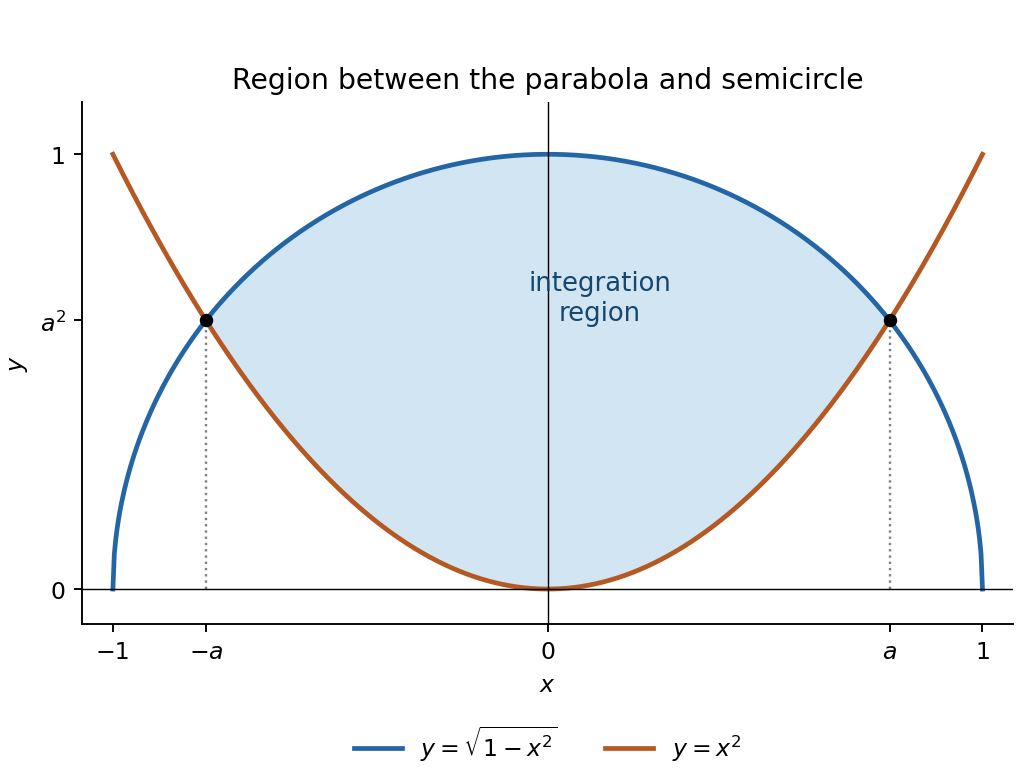
Codex 0 2026-10-18The region lies above the parabola and below the upper semicircle . Their intersections satisfy , hence with . In particular, . The region isIt is symmetric about the axis, with endpoints ; at it extends from to .

Past exam of the mathematics course of the year 1 of the natural sciences course of the University of Cambridge 2017 Paper 2 12 a ii Solution by Codex 0 2026-10-18
Codex 0 2026-10-18Height above the surface is . Integrate the density over all exterior spherical shells:Repeated integration by parts, or the substitution , givesExpand and use these moments to obtain the mass of an exponential spherical atmosphere:For , the leading term is surface area times column mass ; the other terms retain the finite-curvature corrections.
Past exam of the mathematics course of the year 1 of the natural sciences course of the University of Cambridge 2017 Paper 2 12 a i Solution by Codex 0 2026-10-18
Codex 0 2026-10-18In spherical coordinates, is the polar angle from the positive axis and the azimuthal angle. The Jacobian determinant of the coordinate transformation gives the volume element
Past exam of the mathematics course of the year 1 of the natural sciences course of the University of Cambridge 2017 Paper 1 19 d ii Solution by Codex 0 2026-10-18
Codex 0 2026-10-18The function is likewise positive and decreasing on , with . NowThe integral test for convergence shows that converges. This comparison integral determines convergence, not the numerical value of the series itself.
Past exam of the mathematics course of the year 1 of the natural sciences course of the University of Cambridge 2017 Paper 1 19 d i Solution by Codex 0 2026-10-18
Codex 0 2026-10-18The function is positive and decreasing for , since . The integral test for convergence therefore applies. Its comparison improper integral isConsequently diverges.
Past exam of the mathematics course of the year 1 of the natural sciences course of the University of Cambridge 2017 Paper 1 17 a ii Solution by Codex 0 2026-10-18
Codex 0 2026-10-18Separate one factor of the hyperbolic sine and use the hyperbolic Pythagorean identity . With and , integration by substitution givesFor real , the hyperbolic cosine never vanishes. Differentiating the result gives , checking the sign of the reciprocal term.
Past exam of the mathematics course of the year 1 of the natural sciences course of the University of Cambridge 2017 Paper 1 17 a i Solution by Codex 0 2026-10-18
Codex 0 2026-10-18Use integration by substitution with , so . For , also , andThe domain condition explains why no absolute value is needed around the inner logarithm.
There are unlisted articles, also show them or only show them.