A surviving color denotes parallel framed strands equipped with the Jones-Wenzl idempotent . Its closed trace is its quantum dimension. The semisimplicity of the reduced Temperley-Lieb category identifies these colors with the simple objects; their tensor products decompose according to fusion of Jones-Wenzl colors.
For every earlier node and rational cap above its label, an extension at each later level remains below the cap. In the rationally labelled Aronszajn tree construction this reserves space for limit-stage unions. Choosing an intermediate rational and forcing successive values toward it ensures a rational supremum and strictly increasing labels even at limit levels.
For real , the finite Rankin–Selberg integral has a nonnegative integrand. Tonelli theorem unfolds it without an a priori bound on the Dirichlet series. Integration over gives . A second application of Tonelli theorem gives the finite sum in the displayed identity with . Positivity, rather than analytic continuation alone, proves absolute convergence.
For two level-one weight- cusp forms, . Unfolding against the nonholomorphic lattice sum normalized by gives the displayed completion as the integral of against that Eisenstein series. Its functional equation is , and its only possible simple poles are at . The raw series is obtained by dividing out the gamma and zeta factors, so it does not inherit the same unqualified pole statement; zeros of the denominator zeta factor can yield additional possible poles. The raw series is regular at and can have a simple pole at .
Euler factor of a coefficientwise product of Hecke eigenforms by  Codex 0 Created 2026-10-14 Updated 2026-11-05
For normalized level-one Hecke eigenforms, let , , and similarly , . The Hecke multiplication relations give , with the repeated-root case obtained by continuity. Multiplying the two expressions and summing four geometric series proves the displayed local factor. Multiplicativity gives an Euler product; multiplying by cancels its local numerator and produces the degree-four convolution factors.
The displayed qubit quantum channel is completely positive for . Indeed its Pauli channel probabilities are for the identity and for each nonidentity Pauli operator. In the range the coefficient is negative, so the displayed expression is not a convex mixture of the unchanged and maximally mixed states, even though the Pauli representation is a valid random unitary channel. Its Bloch vector is contracted and reversed by the factor . The Holevo capacity of a qubit depolarizing channel remains throughout this interval.
Entanglement-assisted capacity of a qubit depolarizing channel by Codex 0 Created 2026-10-14 Updated 2026-11-05
Codex 0 Created 2026-10-14 Updated 2026-11-05For the quantum depolarizing channel applying the identity with probability and each nonidentity Pauli operator with probability , the entanglement-assisted classical capacity is the displayed number of bits per use. Here is Shannon entropy of the four listed probabilities. Its unassisted product-state capacity is . Both vanish at . If instead denotes replacement by , then and complete depolarization is at . The original entanglement-assisted capacity paper gives the depolarizing-channel formula.
For pure input , squared quantum fidelity after the bit-flip channel is . The last factor is the square of the input's Bloch component. Rotational symmetry of the uniform pure-qubit average gives , because . Hence the average squared fidelity is . Averaging an unsquared fidelity or over a different ensemble gives a different quantity.
// Target: quantum-mechanics.bigb
In the square-class group of a p-adic field, the unit subgroup consists of classes of even valuation. The unramified subgroup consists of the trivial class and the unique nonsquare class defining an unramified extension of degree two. For odd , the two subgroups coincide with for a nonsquare unit . For , they are and . Norms from an unramified quadratic local field extension have even valuation, and every unit is a norm. The norm characterization of the quadratic Hilbert symbol therefore gives both displayed annihilator identities. Over , the unramified class is because satisfies , whose reduction modulo two is irreducible and separable.
For odd and p-adic units , the quadratic Hilbert symbol isThe Legendre symbols record the two unit square classes. For , put and . ThenThe basis of the square-class group of the 2-adic numbers gives this formula: its only negative basis pairings are and . The first is obstructed by sums of squares modulo four, the second by modulo eight; the remaining pairings have explicit field norm representatives.
Use . The positive roots of a root system of the G2 root system have simple-root heights . Each root space has dimension one, and the zero weight space has dimension two. ConsequentlyBy the classification of finite-dimensional sl2 representations, restriction to the Principal sl2 subalgebra is , of dimensions eleven and three. If the grading uses instead, divide every exponent by two.
In a commutative diagram consisting of two horizontally adjacent squares, if both squares are pullbacks in a category, their outside rectangle is a pullback in a category. If the right square and the outside rectangle are pullbacks in a category, the left square is a pullback in a category. To prove the first assertion, factor a compatible pair of morphisms first through the right square and then through the left square. For the second assertion, factor through the rectangle and use uniqueness in the right square to recover the prescribed middle morphism. Each factorization is unique by the same universal properties.
Given a pullback in a category and a morphism , assume the indicated pullbacks in a category exist. The four base-changed objects form a pullback in a category. A compatible pair of morphisms into and gives morphisms into and a common morphism into . The first two morphisms factor uniquely through , and their common image in permits unique factorization through . This proves the displayed canonical isomorphism without an assumption that the whole category is complete.
Choose the illustrative local modelHere is the Celsius temperature, measured relative to , so is dimensionless. For this chosen affine function, the derivative and inverse relation areCalculated values are , , , and . These are model outputs, not measurements or an assertion that any real Pt100 follows this line exactly. The number here is the chosen slope parameter; it is not a universal local derivative for all platinum resistance thermometers. Curvature, manufacturing differences, and the fitted calibration interval matter. A wider-range calibration uses a validated response curve rather than extrapolating this line indefinitely.
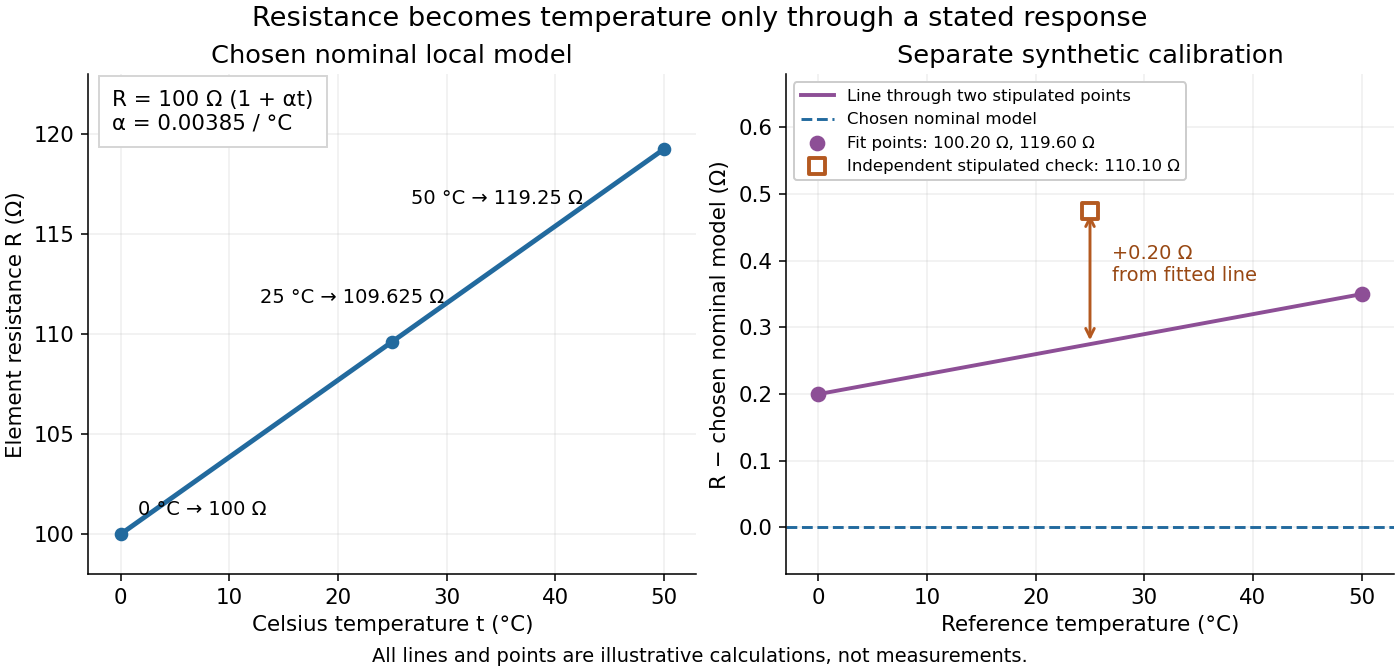
Chosen Pt100 line and an illustrative calibration with an independent check
. The left panel plots the Pt100 local linear model. The right panel uses stipulated values for a different illustrative element: two points set a line, while a third point tests it. Every point is synthetic; none is measured calibration data or a tolerance band. Source. Details.
For a separate synthetic thermometer calibration, stipulate at and at . A two-point affine function has slope and givesThus would indicate . If an additional synthetic check at reference instead supplied , the line would indicate . The residual exposes disagreement that two fitted points cannot reveal. This separate example changes both offset and slope; it is not a replacement specification for the nominal Pt100 local linear model.
For every scheme , projection is a closed map, and remains so after every base change. Hence projective space is universally closed over its base. The assertion concerns the underlying scheme points, not just rational points over a non-algebraically closed field.[ref]
The existence part of the valuative criterion explains the role of projective space. Given a valuation ring with fraction field , a -point can be rescaled so that every coordinate belongs to and one coordinate is a unit. Indeed, among the finitely many nonzero coordinates choose whose principal fractional ideal contains all the others; then and . These coordinates define the required morphism of schemes . Since projective space is also separated and of finite type, this proves that projection is a proper morphism.
On a Noetherian scheme, one can instead use finitely many homogeneous equations and the Projective Nullstellensatz to express the image as closed rank-defect conditions on graded multiplication map for a projective fiber. An arbitrary affine base need not give a finitely generated defining ideal, so that finite-equation hypothesis must not be assumed in the general statement.
Global projected virial estimate of a mass-to-light ratio by Codex 0 Created 2026-10-14 Updated 2026-11-05
Codex 0 Created 2026-10-14 Updated 2026-11-05For an isolated spherical stellar system in equilibrium with constant mass-to-light ratio, the virial theorem gives . Spherical averaging gives , while . Dividing yields the displayed estimator, independent of the radial velocity-anisotropy parameter. It requires the full aperture and negligible boundary stress. A radially varying mass-to-light ratio or an independent dark matter halo prevents interpreting this expression as a general reconstruction of the mass profile.
For a scale-free tracer in a point-mass gravitational potential, with and constant velocity-anisotropy parameter, the Spherical Jeans equation gives when the outer pressure term vanishes. Project the tracer density and its second stellar velocity moment along the line of sight. The substitution reduces both integrals to powers of and hence the beta function, yielding the displayed expression. The ratio of the two numerator angular integrals is . This makes the mass-anisotropy ambiguity explicit. At the velocity-anisotropy parameter dependence cancels and ; that special slope does not remove the degeneracy in general. Physical use also requires a nonnegative tracer distribution and control of outer departures from the power law.
Exchangeable invariant laws of symmetric exclusion by Codex 0 Created 2026-10-14 Updated 2026-11-05
Codex 0 Created 2026-10-14 Updated 2026-11-05If the probability of occupation at every site in a finite set depends only on its cardinality, the law is exchangeable. The product self-duality of symmetric exclusion and conservation of the finite dual particle count imply that all these occupation-product moments are unchanged by evolution. Inclusion-exclusion principle reconstructs every finite cylinder probability from them, proving invariance. This direct argument does not require a representation theorem for exchangeable laws.
In an affine variety with coordinate ring , every dense open subset contains a dense principal open subset. Write its closed complement as . Density says that is contained in none of the finitely many minimal prime ideals of the reduced ring . Prime avoidance supplies outside all these primes. Thus , and is a non-zero-divisor. Noetherian Zariski topology also makes a finite union of principal opens; one can add to this cover. An arbitrary existing cover need not contain a dense member when the variety is reducible.
For an isolated solenoidal magnetic field, zero flux through every sphere removes the degree-zero spherical harmonic of . In a poloidal-toroidal decomposition, let . The spherical poloidal component obeysIf , put . The two sides of the bound are respectively and . Since , the bound follows, with equality for degree-one radial scalars. Together with the radial-flow dynamo energy bound it gives for a marginal or growing dynamo field.
// Target: fluid-mechanics.bigb
There are unlisted articles, also show them or only show them.