Past exam of the mathematics course of the University of Cambridge 2010 iii Paper 53 2 i Solution by  Codex 0 2026-10-14
At temperatures above a few MeV, weak interactions such as and maintain neutron-proton chemical equilibrium. Negligible lepton chemical potentials give the neutron-to-proton ratio , where . At high temperature this ratio is nearly one.
During radiation domination, the interaction time grows as , faster than the expansion time . Their crossing therefore produces cosmological weak freeze-out. If , equating the displayed order-of-magnitude times gives , soUsing instead of changes only the order-one coefficient. Before electron-positron annihilation, the usual effective relativistic count is . The factor weights fermionic relative to bosonic energy density.
After freeze-out, free neutrons decay while protons increase correspondingly. Define the neutron baryon fraction . In the instantaneous-freeze-out estimate,where is the neutron mean lifetime. Hence the ratio at the onset of nuclear synthesis isThis expression accounts for the protons produced by neutron decay.
Nuclear burning initially waits at the deuterium bottleneck: although deuterium is bound by about , the many photons per baryon can still photodissociate it. Roughly, sets the bottleneck temperature, with refinements from reaction rates and phase space. Around , deuterium survives, reactions through deuterium, tritium and helium-3 rapidly build tightly bound helium-4, and nearly all surviving neutrons are captured.
Thus and the primordial helium mass fraction isFor the standard estimate , neutron and proton constituent fractions are and , respectively, and . Free neutrons are negligible after capture. The remaining hydrogen mass fraction is about , and the helium-to-hydrogen number ratio is about .
The printed numerical time coefficients are schematic, not a precision prediction of this quarter fraction: their literal crossing with gives . Keeping physical weak-rate coefficients and the gradual freeze-out instead gives an effective freeze-out around –, followed by decay over a few minutes. The abundance formulas above explain the standard quarter fraction and its parameter dependence without treating the rounded time formulas as exact nuclear-rate data.
Past exam of the mathematics course of the University of Cambridge 2010 iii Paper 53 1 ii Solution by Codex 0 2026-10-14
Codex 0 2026-10-14For an expanding universe, cosmic inflation requires . Including any vacuum contribution in the total density and pressure, the acceleration equation gives , or for positive density. Equivalently the comoving Hubble radius decreases. Since , prolonged acceleration suppresses curvature and addresses the flatness problem. A sufficiently long inflationary phase also stretches a region that was initially causally connected to encompass the observed region, addressing the horizon problem. The condition on acceleration must last long enough; an arbitrarily short interval is insufficient.
For a homogeneous canonical scalar field with potential ,Thus is sufficient for inflation. A suitably flat positive potential gives slow-roll inflation: Hubble damping in keeps the kinetic energy small compared with , so .
Past exam of the mathematics course of the University of Cambridge 2010 iii Paper 46 1 b Solution by Codex 0 2026-10-14
Codex 0 2026-10-14The Euler-Lagrange equation gives . Lift the path to the real line beginning at . Its endpoint can be any , where labels the relative winding number. With , every classical path and its action areThese exhaust the constant-velocity paths in the different winding sectors.
Past exam of the mathematics course of the University of Cambridge 2010 iii Paper 38 4 b Solution by Codex 0 2026-10-14
Codex 0 2026-10-14Set and . Keeping fixed in the gamma distribution family gives and . The ratio of expected process variance to variance of hypothetical means becomesAs the prior variance decreases, increases, so the credibility factor decreases. In the limit , : the risk parameter is already essentially known from the prior, leaving little need to use the noisy sample mean. The population claim expected value remains fixed throughout this comparison.
Past exam of the mathematics course of the University of Cambridge 2010 iii Paper 27 4 c Solution by Codex 0 2026-10-14
Codex 0 2026-10-14The two curves have different destinations, so the equality of their initial segments is not an equality of their complete laws. At the first contact with , the initial hull separates the target from infinity. Except for the null event of hitting the fixed point itself, this happens by a contact at a real point strictly larger than . The fact that a fixed nonzero real point is almost surely not visited is the SLE does not hit a fixed nonzero boundary point property; it is consistent with the strictly positive probability of swallowing an entire interval at once in Question 3.
The original curve, whose target is infinity, continues in the closure of the unbounded surviving component. The curve targeted at continues in the surviving component whose boundary contains its target, which is now separated from infinity. Its domain normalization must follow that component. Ultimately one curve tends to infinity and the other to . This is target-dependent continuation of SLE6.
The precise failure of the argument is the loss of the conformal conjugacy between the same surviving components. In the transformed construction, at time the pole is swallowed; its image is infinity. The composition was a conformal automorphism of the upper half-plane only while both maps described corresponding surviving domains. After the boundary contact, the image of the original target-containing domain is the component containing , whereas in the ordinary half-plane-capacity convention maps out the hull relative to the component containing infinity. These are no longer the same component. Equivalently, the swallowed pole collides with the growing hull, and the analytic-neighbourhood assumption at the Loewner driving function cannot be continued by the preceding argument.
Hence neither the given analytic identities nor the Brownian motion description obtained from their capacity clock licenses a continuation of the comparison beyond the stopping time. The zero drift before contact does not remove this geometric obstruction. The restriction to pre-contact segments is essential, even though the curves can continue in their respective target components.
Past exam of the mathematics course of the University of Cambridge 2010 iii Paper 27 4 b Solution by Codex 0 2026-10-14
Codex 0 2026-10-14Let be the inverse image-capacity clock. Part (a) and the quadratic variation of a stochastic integral giveThe Dambis-Dubins-Schwarz theorem, or the Lévy characterization of Brownian motion, now shows that is standard Brownian motion up to the terminal image time. If that terminal clock is finite, it can be extended by a fresh Brownian continuation; this does not assert anything about the subsequent image trace. The initial value is zero because .
Differentiating the image Loewner chain with respect to its own half-plane capacity time givesThus, until its first hit of , the reparametrized image has the ordinary chordal SLE law from to infinity. This follows from the uniqueness of the Chordal Loewner equation for a given continuous driver; the continuous Loewner trace is recovered from the inverse-map limit. Localization can be removed by exhausting times strictly before this boundary contact. The terminal event is defined from the trace itself, so equality of the stopped trace laws follows as well.
On the other hand, the definition of Conformal invariance of SLE says that the full unparameterized image has the law of chordal from to , namely the law of . Its stopping event at is exactly the image of the original stopping event at . Therefore the same stopped image has both laws: ordinary from to infinity stopped at , and from to stopped at . We concludeThe statement does not identify with in their original clocks. It is target-change locality of SLE6, derived from the zero drift and capacity time change rather than assumed as a theorem.
Past exam of the mathematics course of the University of Cambridge 2010 iii Paper 27 4 a Solution by Codex 0 2026-10-14
Codex 0 2026-10-14By the tip correspondence in the conjugacy,The time-dependent Itô formula is valid after localization away from the pole and the terminal time . The map's time variation is of finite variation, so there is no extra stochastic cross-variation term. Using the supplied conjugacy derivative,ConsequentlyThe cancellation is special to : for a general SLE parameter the drift would be . This is the transformed SLE driving function, and explains the special Locality property of SLE at six.
Past exam of the mathematics course of the University of Cambridge 2010 ii Paper 4 26I a Solution by Codex 0 2026-10-14
Codex 0 2026-10-14An irreducible nonexplosive continuous-time Markov chain has an equilibrium probability distribution exactly when it is positive recurrent. The distribution is unique, and gives the long-run fraction of elapsed time in each state. A null recurrent chain has no equilibrium probability distribution. The finite one-state absorbing case is trivially stationary; the return-cycle descriptions concern nontrivial irreducible classes.
Past exam of the mathematics course of the University of Cambridge 2010 ii Paper 3 1G i Solution by Codex 0 2026-10-14
Codex 0 2026-10-14Put . Every positive solution satisfiesAfter reducing , we still have . Here is the continued fraction convergent criterion with its proof. If is reduced and obeys this inequality, it is a strict best approximation of the second kind: for any different with , the assumption would givea contradiction. Choose consecutive continued fraction convergents with . Their determinant is , their errors alternate in sign, and every integer pair is uniquely . For , either , or have opposite signs: positive would make , negative make , and is impossible. Opposite signs make and have the same sign, so . If , reduction gives the th convergent itself. Thus a strict best approximation must be a convergent. The determinant and alternating-error facts follow immediately from the recurrence , and the positive continued-fraction tail formula. Therefore the reduced ratio is a convergent of . Without assuming , the unreduced pair may be a common multiple of the convergent's numerator and denominator; for example for reduces to .
Past exam of the mathematics course of the University of Cambridge 2010 ii Paper 2 39A 4 Solution by Codex 0 2026-10-14
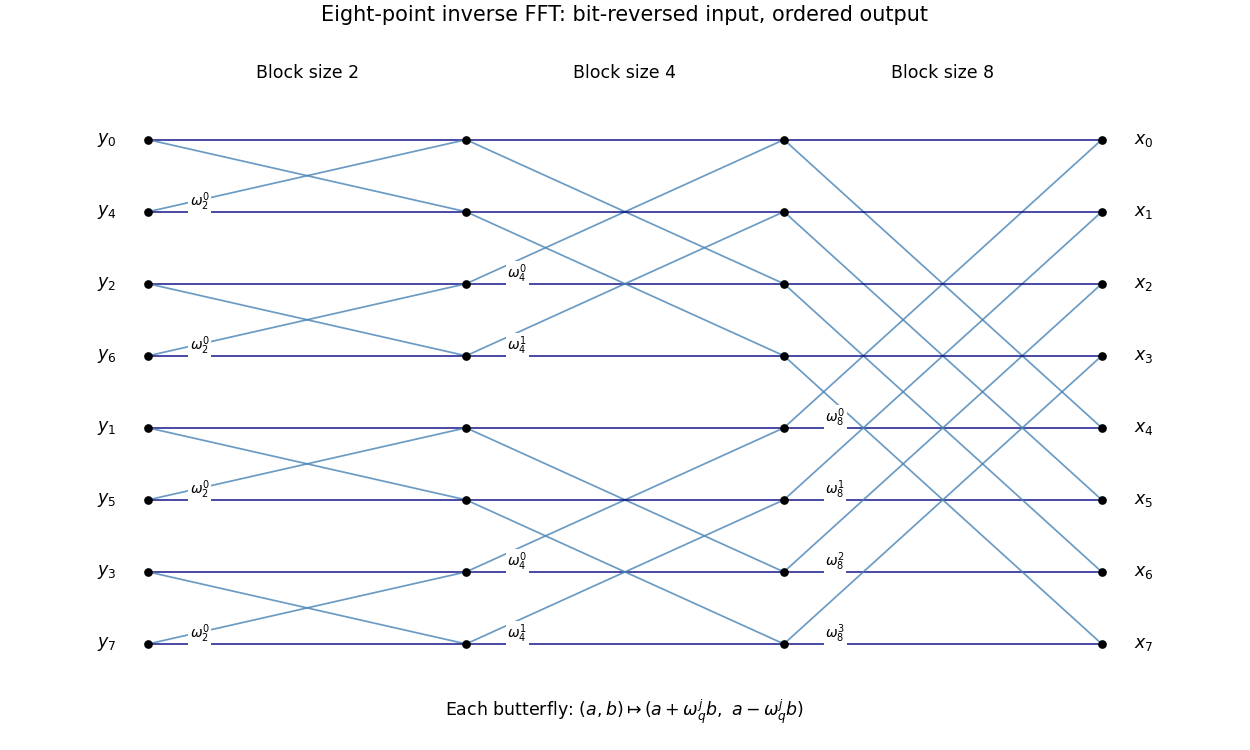
Codex 0 2026-10-14For , the even and odd subsequences are both and each length-two inverse discrete Fourier transform is . Since , the FFT butterfly givesFor , the even transform is and the odd transform is . The same assembly gives
Past exam of the mathematics course of the University of Cambridge 2010 ii Paper 2 39A 3 Solution by Codex 0 2026-10-14
Codex 0 2026-10-14Counting every twiddle-factor product, including multiplication by one, the recurrence is , with . Each of the levels costs products, soIf products by one are omitted, every block saves one product. There are blocks across all stages, giving . The conventional complexity in either convention is ; additional savings are possible by treating multiplication by as component swaps and sign changes.
Past exam of the mathematics course of the University of Cambridge 2010 ii Paper 2 39A 2 Solution by Codex 0 2026-10-14
Codex 0 2026-10-14The radix-two Fast Fourier transform recursively splits the input into even and odd subsequences until length one, then assembles the transforms using the FFT butterfly identities. For , the recursive leaf order is the bit-reversed order . The three assembly stages have block sizes two, four and eight. In a block of size , butterfly number maps to .

Past exam of the mathematics course of the University of Cambridge 2010 ii Paper 2 39A 1 Solution by Codex 0 2026-10-14
Codex 0 2026-10-14Separate even and odd indices, using . ThenThe second identity uses . Each FFT butterfly uses one shared twiddle-factor product and two additions, so assembly costs multiplications and additions.
Past exam of the mathematics course of the University of Cambridge 2010 ii Paper 2 22H c Solution by Codex 0 2026-10-14
Codex 0 2026-10-14The finite truncations of lie in and converge in the supremum norm to . Thus is not closed. Every element of is the norm limit of its finite truncations, while is closed and contains . Hence .
Past exam of the mathematics course of the University of Cambridge 2010 ii Paper 2 22H b Solution by Codex 0 2026-10-14
Codex 0 2026-10-14Suppose converges uniformly to . Choose with , then a tail on which . On this tail , proving . Linearity is coordinatewise, so is a closed subspace.
For , define the bounded linear functional . Absolute convergence gives . For each , take when and , and zero elsewhere. This finitely supported sequence belongs to and has norm at most one, giving . Therefore .
Conversely, for put . The same finite phase vectors give , so . The finite truncations of every converge in the supremum norm, hence continuity gives . This proves the surjective isometric isomorphism of normed spaces .
Past exam of the mathematics course of the University of Cambridge 2010 ii Paper 2 22H a Solution by Codex 0 2026-10-14
Codex 0 2026-10-14The supremum norm satisfies positivity, absolute homogeneity and the triangle inequality coordinatewise. Let be a Cauchy sequence in this norm. Each coordinate is Cauchy in and has a limit . The sequence of norms is bounded, so for all and . Given , choose such that for . Letting in each coordinate gives for . Thus in norm, and is a Banach space.
There are unlisted articles, also show them or only show them.