
When an experiment's configuration is observed, inference conditions on the experiment actually performed rather than averaging over its possible configurations. Conditioning on an ancillary statistic is a central application; freedom from a nuisance parameter must still be checked in the resulting conditional distribution.
For first-order logic, every sentence true in every model of a theory is derivable from that theory. Equivalently, every consistent theory has a model.
The fragment permits at most distinct variable names, but allows bound names to be reused. It can contain formulas of arbitrarily large quantifier depth. On a linear order, alternating two variable names can express an increasing chain of any prescribed finite length.
Let be a commutative algebra over a field , with a homomorphism restricting to the identity on , and let be its kernel. If is generated by finitely many elements, subtracting their images in gives finitely many generators in . Every polynomial in those generators, modulo , is a linear combination of their classes. Thus , the algebraic cotangent space at this point, is finite-dimensional. For and , the classes , , form an infinite basis modulo . This is a subalgebra of a polynomial ring which is not a finitely generated algebra.
Consider the advection equation with constant speed , no sources, and periodic boundary conditions on . Use equal cells of width , time step , and indices modulo . The exact solution is the periodic translation . At a face, the Riemann problem transports the left state to the right, so the two-state upwind numerical flux is , with .[ref]
Riemann Problems and Jupyter Solutions by David I. Ketcheson, Randall J. LeVeque, and Mauricio J. del Razo. Advection, equations adv:advection and adv:solution, §The Riemann problem; Approximate solvers, §High-resolution methods: reduction to upwind advection
The finite volume method with this numerical flux and an explicit Euler method step givesHere represents a cell average; the recurrence also occurs in the upwind finite difference scheme. Impose the specific CFL condition . Each updated cell average is then a convex combination of two old ones. This proves preservation of their initial minimum and maximum, including nonnegativity for nonnegative data, and contraction of the maximum norm of the difference of two solutions on this periodic grid. These statements concern this constant-speed scalar update with this time step.
For an original synthetic example, take , , , , hence Courant number . Choose a function constant on each successive cell, with the following values, so these are exact initial cell averages. One step givesFor example, cell zero receives from cell seven across the periodic face: . All eight face transfers cancel in the total by shared face flux cancellation. More generally this periodic recurrence conserves the total algebraically for any , even though the CFL condition is needed for the convex combination argument. With the same initial data and , one step gives and , despite preserving the total.
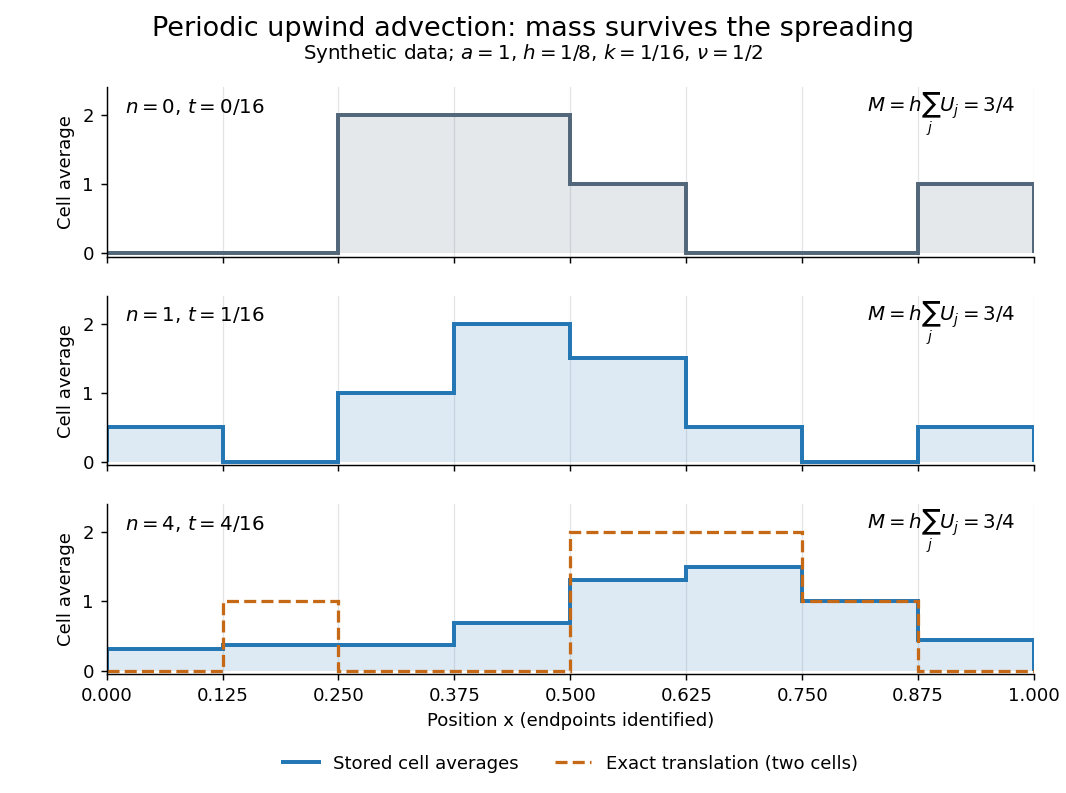
Original periodic upwind profile at zero, one and four steps: the integral remains three quarters while jumps spread
. Details. After four steps, , the exact translated profile has moved two cells to the right. Repeated averaging instead gives the explicit binomial coefficient formulawith all indices modulo eight. The diagram compares these computed cell averages with the exact translated cell averages. Their integrals agree, but the numerical jumps spread across cells. The finite volume method is useful for jump discontinuities because it retains the integral balance even at a jump; conservation alone does not guarantee a sharp profile. At this particular update is an exact one-cell shift, whereas for it mixes neighboring states. No accuracy conclusion at a jump follows just from the conserved total.


The Jacobian matrix of a deformation map carries an infinitesimal reference line element to its current image. Its determinant is the local volume ratio. An orientation-preserving deformation has , and incompressibility imposes .
A stretch tensor isolates local changes of material length from the rotation contained in a deformation gradient. For an invertible orientation-preserving , the polar decomposition in continuum mechanics iswhere is a rotation matrix and are positive-definite symmetric matrices. The right stretch tensor acts on directions in the reference configuration; the left stretch tensor acts on directions in the current configuration.
The eigenvalues of either stretch tensor are the principal stretches. A value two means a material line in the corresponding principal direction doubles its length, while a value one means unchanged length. For a pure rotation, both stretch tensors are , even though need not equal . This makes them useful when an experiment includes substantial specimen rotation that should not be mistaken for strain.
Simple shear displaces one coordinate direction in proportion to a transverse coordinate while preserving volume. Its deformation gradient has a single off-diagonal component . Simple shear flow describes the corresponding velocity field rather than the finite deformation.
In plane strain, the deformation map has , and . The out-of-plane stretch is one and out-of-plane shear vanishes. This kinematic condition need not make the out-of-plane stress vanish.
With the right Cauchy-Green deformation tensor , the Green-Lagrange strain tensor measures the change in the material metric. Since , its work-conjugate stress and strain partner is the second Piola-Kirchhoff stress tensor . The formula follows by cycling factors in , not by identifying nominal and symmetric material stress.
For , differentiation of gives . Its reference-power conjugate is . In a convected coordinate basis , these are the covariant components of the Kirchhoff stress tensor. The second Piola-Kirchhoff stress tensor instead gives its contravariant components, since .
For a right stretch tensor , define . A standard normalized choice has , , and strictly increasing; requiring gives a nonsingular stretch-to-strain parameterization. This strain vanishes exactly for a rigid rotation, is independent of superposed spatial rotations, and agrees to first order with the infinitesimal symmetric displacement gradient. Indeed gives , and Taylor expansion of proves the last statement.
An automaton transition changes an automaton state on reading a symbol. A DFA specifies one destination; an NFA may specify several or none.
An automaton state is one possible memory configuration of a finite-state machine. The initial automaton state is the starting configuration; accepting automaton states indicate successful recognition when the whole word has been read.
For a relational structure, the Gaifman graph has the same universe. Two distinct elements are adjacent if they occur together in some tuple of some interpreted relation. A tuple's radius- neighbourhood is the induced structure on the union of its radius- graph balls, with the tuple marked by constants.
Extend first-order logic by iterating definable relation operators from the empty relation. If iteration reaches a fixed point, use that relation; if it enters a nontrivial cycle, the partial fixed point is the empty relation. For a fixed arity on a finite universe, a relation requires polynomially many bits and there are exponentially many states, so iteration is evaluable in PSPACE. On finite ordered structures this logic captures PSPACE.
Two formulas with the same free variables are asymptotically equivalent when the probability of their universal equivalence tends to one over the chosen finite-structure distribution. If a quantifier-eliminating extension theory has all its axioms of asymptotic probability one, compactness makes every formula asymptotically equivalent to a quantifier-free one: each particular equivalence follows from finitely many axioms, whose conjunction still has limiting probability one.
A group between a nonabelian simple group and its automorphism group. Finite two-transitive groups are either of this type or affine two-transitive groups, a structural theorem rather than an order-divisibility test.
A group of order ten is either a cyclic group or the dihedral group of the pentagon. Lagrange's theorem and the fact that a group of exponent two has power-of-two order force an element of order five or ten. In the latter case the group is cyclic. In the former case its order-five cyclic subgroup is normal by index two; an outside involution acts on it either trivially or by inversion. The trivial action gives , and inversion gives .
There are unlisted articles, also show them or only show them.