
For a complex CM torus and an idele of its CM field, the automorphism corresponding to by Artin reciprocity takes its lattice to and acts on torsion through the adelic scalar . When the curve is defined over a larger field, use the idelic norm to the CM field. Comparison with the original curve gives a scalar in the CM field, producing the Hecke character of a CM elliptic curve.
A complex CM period compares an algebraic invariant differential on a CM elliptic curve with its analytic lattice coordinate. At an ordinary prime, a -adic CM period compares the same differential with the invariant differential of the multiplicative formal group: an isomorphism is normalized by . Matched periods make normalized critical Hecke L-function values algebraic and give precise p-adic L-function interpolation.
The Milnor-Novikov coefficient theorem identifies the coefficient ring of complex cobordism as the displayed graded polynomial ring. In cohomological grading it has no positive-degree or odd-degree coefficients. Homological grading reverses the signs: has polynomial generators in degrees .
Represent a map by a smooth map, embed its graph into , and specify a stable complex structure on the normal bundle of that embedding, with the standard framing on the auxiliary real coordinates. Stabilization and homotopy identify equivalent choices. The auxiliary dimension is chosen to make the normal rank even; odd relative dimensions use an extra real suspension coordinate. The resulting oriented stable normal data defines the Gysin map in complex cobordism.
For a rank- real bundle with chosen stable complex normal orientation, the complex-cobordism Thom class gives the displayed isomorphism by . Stabilizing by a trivial complex bundle suspends the Thom space and its class compatibly. The class of an actual complex rank- bundle has degree .
Pulling the external product of two normally complex submanifolds back along the diagonal gives their transverse intersection. Its normal complex structure is the direct sum of the restricted normal complex structures. Multiplication of Thom classes for a direct sum identifies this geometric representative with the cup product in complex cobordism. Empty intersection represents zero.
// Target: geometry-and-topology.bigb
The displayed product applies when . Move one projective subspace by a unitary isotopy into transverse position. The intersection is a linear projective subspace of dimension , with normal complex bundle the sum of the restricted input normal bundles. If , representatives can be made disjoint and the product is zero.
A complete sufficient statistic is independent of every ancillary statistic. To prove this, let be complete and sufficient, let be ancillary, and take any bounded measurable function . By sufficiency, has a parameter-independent version; by ancillarity, is independent of . Thus for every . Completeness gives almost surely. Choosing to be the indicator of each measurable event in the ancillary space proves independence. Completeness is essential: a sufficient statistic may itself contain a nonconstant ancillary, as in the minimum and maximum of a uniform location sample.
The octahedral graph is the graph obtained from by removing a perfect matching; equivalently it is . Its chromatic number is three, and it contains two vertex-disjoint triangles in a graph. A complete bipartite graph with a single additional internal edge cannot contain it: every triangle in that host uses the additional edge.
The open subsets of a topological space form a frame. Arbitrary joins are unions, finite meets are intersections, and an arbitrary meet is the interior of an intersection. A continuous map induces a frame homomorphism in the opposite direction by inverse image.
There is a natural bijection between continuous maps and frame homomorphisms . It sends to ; the inverse sends to the point . Its adjunction unit sends a point of to its open-neighbourhood membership map. The counit is represented by . Every open of is such a , and every point of a frame is uniquely evaluation at a point of . Consequently is a homeomorphism, and this is an idempotent adjunction.
A nucleus is an inflationary, idempotent, finite-meet-preserving map on a frame. Its fixed elements form a frame, whose joins are obtained by applying to ambient joins. The induced locale is a sublocale. The nuclei on a frame themselves form a frame in pointwise order; their meets are pointwise, but their joins usually are not.
A preframe is a partially ordered set with finite meets and nonempty directed joins, with finite meets distributing over directed joins. Its homomorphisms preserve these operations. Forgetting the arbitrary joins of a frame leaves a preframe.
An upward-closed subset of a frame containing , excluding and closed under finite meets is completely prime if membership of an arbitrary join implies membership of some summand. Its characteristic map is a point of a frame. Constructively the map takes values in the frame of truth values.
A subframe is a subset of a frame closed under arbitrary ambient joins and finite ambient meets, including and . The inclusion is a frame homomorphism. In contrast, the fixed elements of a nucleus on a frame usually need their own regularized joins and are not a subframe.
A clique in a simple graph is a set of vertices such that every pair of distinct members is adjacent. Equivalently, its induced subgraph is a complete graph. The surrounding graph need not itself be complete: a clique describes complete pairwise connectivity within a selected group.
Consider the original graph withThe set is a clique because all three pairs are edges. The set is not a clique: the edge is missing. A path in a graph connecting all selected vertices is therefore insufficient; every pair must have a direct edge.
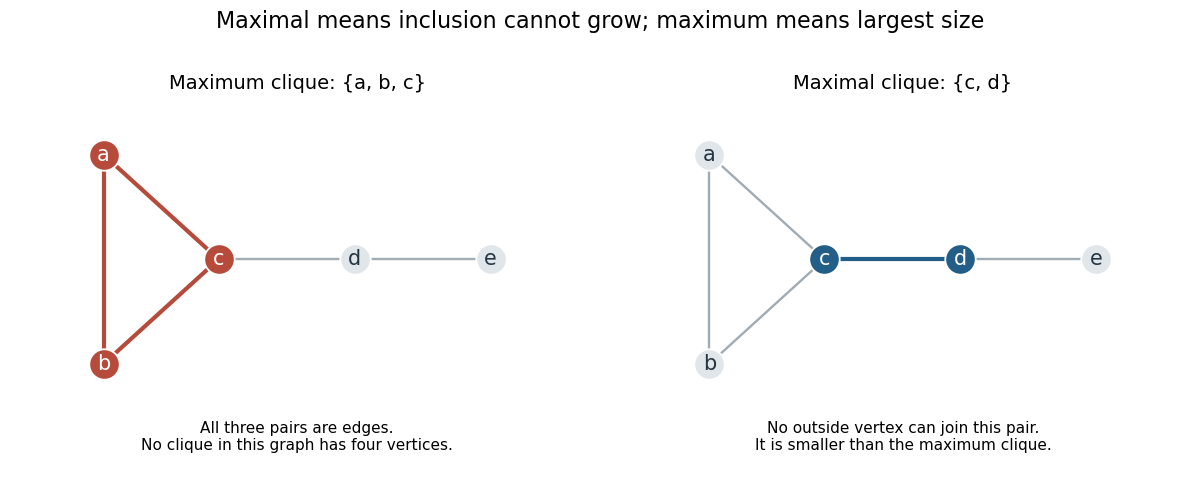

Here the clique number is . The maximum clique is , but and are also maximal cliques. This distinction is useful when an algorithm stops as soon as its current clique cannot be enlarged: that stopping condition establishes maximality, while finding the largest possible clique is a separate requirement.
A topological space is compact when every cover by members of a fixed subbase has a finite subcover. Equivalently, every family of complements of subbasic opens with the finite-intersection property has nonempty intersection.
There are unlisted articles, also show them or only show them.