
Every allocation in the convex feasible region for a resource budget is a convex combination of its three extreme points:The condition is exactly ; nonnegative give the other two nonnegative coefficients. Thus the half-space description and the convex hull description encode the same triangle. At all three coefficients are , and at they are , , . The green and orange points in the budget diagram therefore have two complementary interpretations: direct resource constraints and mixtures of extreme choices.
The three extreme points alone are not a convex set, because their midpoints are absent. Their convex hull fills the whole triangle. More generally, Caratheodory theorem bounds how many generating points are needed for one convex combination in a finite-dimensional real vector space; its geometric content is that a complicated collection can describe each attainable average with a short representation.
Two convex bodies are homothetic convex bodies if one is a translation of a positive uniform dilation of the other. Their lengths scale by and their volumes by . Closed disks of positive radii are homothetic convex bodies; axis-aligned positive-sided rectangles are homothetic convex bodies exactly when their aspect ratios agree. The Brunn-Minkowski theorem characterizes this relation by equality of root-volumes in Minkowski addition.
Laws of large numbers give conditions under which sample means approach a deterministic expected value. For independent and identically distributed random variables with , the strong law of large numbers gives almost sure convergence, while the weak law of large numbers gives convergence in probability. These conclusions specify different modes of convergence of random variables, rather than a universal numerical accuracy guarantee. The central limit theorem is a separate result about the remaining fluctuations after rescaling.
An iteration converges at least quadratically to a limit if its errors eventually satisfy the displayed bound with a fixed finite . If , induction gives . Exact asymptotic quadratic convergence has . Newton root-finding iteration at a simple scalar root has this order when the second derivative at the root is nonzero; if that derivative vanishes, convergence can be faster.
Let and give each factor of the usual topology of the real line. The familiar standard basis vectors extend to unit sequences with when and zero otherwise. Their finite linear combinations are exactly the finitely supported sequences, rather than all of .
For every fixed coordinate , for all . Therefore in the product topology. More directly, any basic cylinder set containing zero contains every with : all of its tested coordinates are then zero. The moving unit entry escapes every fixed finite collection of observations.
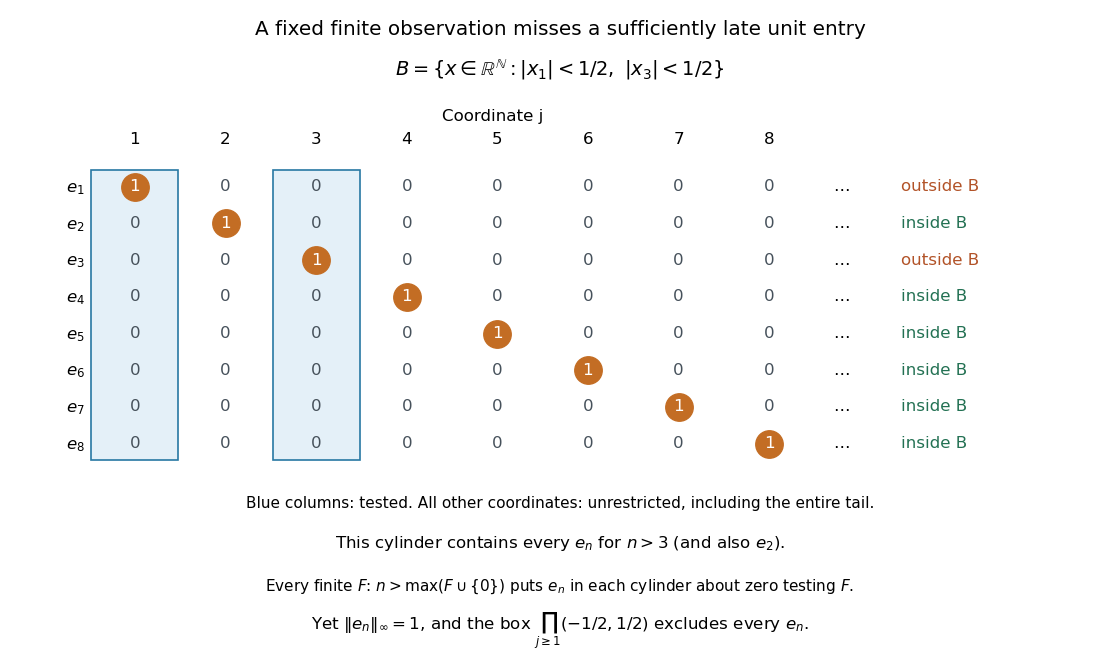

In the l-infinity sequence space of bounded real sequences, however,Thus the same sequence does not converge to zero in the supremum norm. Here the comparison is between the subspace topology inherited from the product topology and the norm topology on . The supremum norm is not a finite-valued norm on all of , which also contains unbounded sequences. In the box topology on , the neighborhood of zero excludes every , so is not a convergent sequence with limit zero there either.
A GHZ state is a multipartite entangled state with coherent amplitudes linking the alternatives in which all qubits are and all are .
Computational-basis measurements give only and , each with probability one half. A classical mixture of those strings gives the same probabilities, but lacks the off-diagonal quantum coherence. For the displayed state, , whereas it is zero for the mixture. Tracing out one qubit leaves a classically correlated mixture of and . [ref]
Observation of Three-Photon Greenberger-Horne-Zeilinger Entanglement by Dik Bouwmeester and others. 1999, three-photon entanglement; the state/mixture calculations here are direct algebra
A Markov policy uses only the current state and, in the nonstationary case, the current time. A stationary Markov policy has the form for one measurable selector . It is a restricted class of control policies, whose sufficiency for an optimization problem requires the appropriate dynamic-programming hypotheses.
For two contraction mappings of a nonempty complete metric space, their fixed points obey . Rearranging proves the displayed bound whenever the uniform metric is finite. It establishes continuity of the fixed-point map at each without assuming a contraction constant shared by all maps near .
Let be differentiable on a neighbourhood of a closed radius- ball in a Banach space, with on that ball. If , the mean-value estimate gives and . The contraction mapping theorem supplies exactly one fixed point in , and its distance from is at most .
// Target: dynamical-systems.bigb
Use radians and take on the closed interval . This is a complete metric space with distance , and . The mean value theorem and give a contraction mapping with . Both the interval and its preservation matter; a small derivative by itself would not ensure that all subsequent approximations stay in the chosen space.
Starting at gives , , , and . The cosine is decreasing here, so successive iterates alternate around the unique fixed point . The contraction iteration error bound needs no prior knowledge of this numerical value. At step 40, and the latest-step bound is below , certifying error below one millionth for exact iteration. The initial-step bound requires 91 iterations for the same tolerance. The observed step-40 error is only about ; the guarantees allow less favorable behavior than this example actually exhibits.
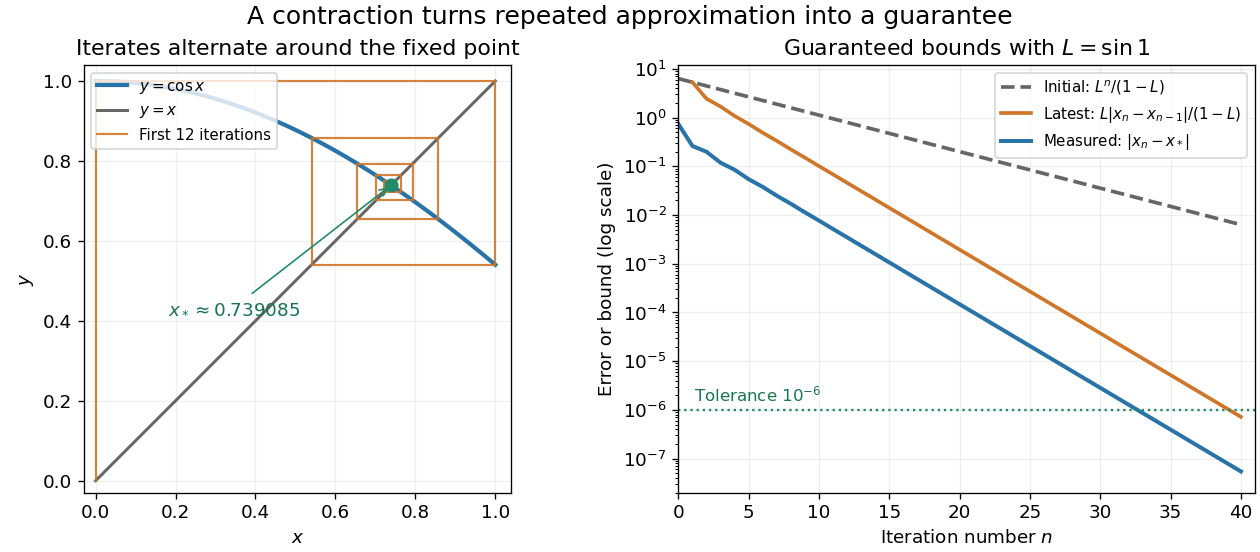

This is the beauty of the contraction mapping theorem: a uniform local improvement controls the entire infinite process. Completeness is essential. On the incomplete interval , the contraction mapping keeps every iterate inside but has no fixed point there; its missing limit is zero. Banach's 1922 paper developed abstract methods for different spaces of functions with applications to integral equations, a motivation still visible whenever repeated approximation is used to construct a function.[ref]
https://www.impan.pl/en/publishing-house/journals-and-series/fundamenta-mathematicae/all/3/0/92453/sur-les-operations-dans-les-ensembles-abstraits-et-leur-application-aux-equations-integrales. Stefan Banach, Sur les opérations dans les ensembles abstraits et leur application aux équations intégrales, Fundamenta Mathematicae 3 (1922), 133–181
Successive steps satisfy . Summing the remaining steps with the triangle inequality gives a bound available before the iteration starts:After computing a new step, the contraction mapping gives the often sharper boundEquivalently, the residual at any satisfies . These estimates convert visible step sizes into guaranteed distances to an unknown fixed point. When is close to one, the factor can be large: a small step alone needs interpretation through the contraction constant.
Let and let be continuous on the upper semicircle , . If , thenIndeed, . Symmetry and on bound the arc integral by .
A rational factor behaving like therefore suffices, even though the crude length-times-supremum bound would only be of constant order. For , use a lower semicircle instead. At , the conclusion can fail: the integral of over the upper semicircle is for every radius. The exponential's sign and the decay assumption are both part of the lemma.
For a simple closed curve in the standard oriented complex plane, positive orientation keeps the bounded interior on the left while traversing the curve. A circle is therefore traversed counterclockwise; reversing direction changes the sign of its contour integral.
A complex integration contour is an oriented piecewise continuously differentiable curve in the complex plane. For a parametrization , its contour integral is . Reversing orientation changes the sign. Unbounded contours require a convergent improper or explicitly regularized limit.
A commutator contour around two branch points cancels the total monodromy of its integrand. For the contour circling clockwise and then anticlockwise, with initial positive-real branches, the Beta function obeysThe contour integral is entire in , giving a meromorphic continuation of the Beta function.
This contour integral defines an analytic function away from the oriented integration curve, under the relevant integrability assumptions. Its limiting values across the curve are related by the Sokhotski–Plemelj theorem. On an oriented real axis, with , the signed Cauchy boundary operators are .
A Bode plot displays the gain and oscillation phase of a frequency response against a logarithmic frequency axis. Gain is often shown as in decibels; phase can use degrees or radians. The first-order low-pass filter loses approximately decibels per factor of ten in angular frequency well above its corner. [ref]
https://www.ocw.mit.edu/courses/2-004-dynamics-and-control-ii-spring-2008/2a0a97261561177bf1a91b07202bb09a_lecture_32.pdf. Rowell, lecture 32, section 2: logarithmic plots
Every function in continuous functions on the p-adic integers has a unique uniformly convergent expansion in the binomial polynomials, with and . Conversely, any coefficient sequence tending to zero defines such a continuous function. To prove the expansion once is known, use for uniform convergence. Finite binomial inversion gives agreement with at each nonnegative integer, and density gives agreement everywhere. The coefficients recover successively from these integer values, proving uniqueness. Moreover , because finite differences bound each coefficient by the norm and the expansion gives the reverse inequality.
For a nonzero vector in a real or complex normed vector space, a norming functional is a continuous linear functional satisfying the displayed conditions. The Hahn-Banach theorem extends the functional sending to on its one-dimensional span. Consequently , with equality at , giving a supporting linear lower bound for the norm. At zero the zero functional can be used as a supporting functional.
The finite negative continued fraction isFor , it describes a negative-framed chain of unknots: the diagonal framings are and adjacent linking numbers are one. Repeated slam-dunk moves give rational surgery coefficient . The corresponding chain matrix is negative definite. To check this, the successive determinants of its negative have recurrence , starting with , ; they are positive and increasing, so Sylvester's criterion applies.
There are unlisted articles, also show them or only show them.