A topological space is compact if and only if every ultrafilter on it converges to at least one point, assuming the ultrafilter lemma. No Hausdorff assumption is needed. In a compact space, the closures of the filter members have the finite intersection property, so choose a point in their intersection. Every open neighbourhood of that point belongs to the ultrafilter, since otherwise its closed complement would be a filter member. Conversely, extend the complements of a cover with no finite subcover to an ultrafilter; a limit point lies in a covering open set, contradicting the simultaneous membership of that set and its complement.
If is compact and , then is injective exactly when it is surjective. Equivalently, every nonzero point of the spectrum of is an eigenvalue. Compactness turns an approximate eigenvector sequence into a convergent eigenvector sequence.
A nondegenerate star-algebra of compact operators decomposes its Hilbert space into irreducible closed reducing subspaces, each equivalence class occurring finitely many times. Pass to its norm closure. A nonzero compact positive element supplies a finite-rank spectral projection; a minimal projection in its finite-dimensional corner has scalar corner algebra. A cyclic vector in its range generates an irreducible reducing subspace. A maximal orthogonal family exhausts the space by nondegeneracy. Infinitely many equivalent copies would give orthogonal unit vectors whose images under some compact algebra element have equal nonzero norms, contradicting compactness.
Compact L2 potential perturbation of the Dirichlet Laplacian by  Codex 0 Created 2026-10-14 Updated 2026-10-25
On a bounded open set, let be the weak solution of . The energy estimate bounds . For , put . The zero-boundary Rellich-Kondrachov compactness theorem gives compact embedding into , and Hölder's inequality gives . Hence is compact on , without a regularity assumption on the boundary. Writing makes equivalent to . The Fredholm alternative for a compact operator then identifies unique solvability with triviality of the homogeneous kernel.
Particle horizon through radiation-matter equality by Codex 0 Created 2026-10-14 Updated 2026-11-05
Codex 0 Created 2026-10-14 Updated 2026-11-05Neglecting curvature and dark energy, integration of the Friedmann equation for radiation in cosmology and pressureless matter gives the displayed comoving particle horizon. At matter-radiation equality, , this is times the radiation-only extrapolation . Its associated inverse length differs by an order-one factor from the matter-radiation equality scale .
Photon arrival from an Einstein-de Sitter particle horizon by Codex 0 Created 2026-10-14 Updated 2026-11-05
Codex 0 Created 2026-10-14 Updated 2026-11-05For an Einstein-de Sitter universe normalized by , . Its current comoving particle horizon is . A photon emitted inward at that location at covers in comoving distance by time . Equating these distances gives arrival at , a travel time of .
A comoving observer has constant comoving coordinates in a homogeneous expanding universe. Its physical separation from another comoving observer grows in proportion to the scale factor, giving relative recession governed by the Hubble parameter. Light exchanged between these observers undergoes cosmological redshift.
For the symmetric group , take the transpositions and . Products of permutations apply the rightmost factor first. ThenThe last permutation sends , , and : two swaps fail to commute by an entire three-cycle.
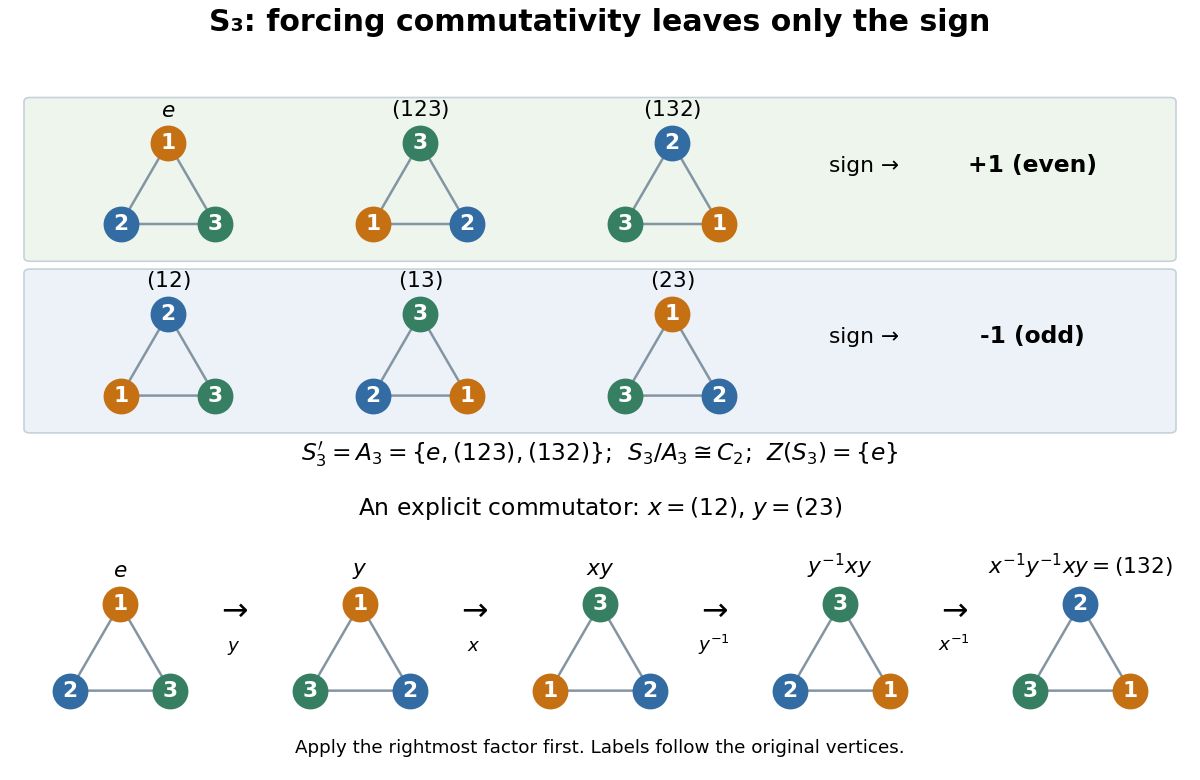

Every group commutator has sign of a permutation , so , the alternating group of even permutations. Conversely, the displayed group commutator generates . Therefore . The two cosets are the even permutations and the odd permutations, and their multiplication is just multiplication of signs:This is the first isomorphism theorem applied to the sign of a permutation. Once commutativity is forced, all three transpositions become indistinguishable, and both three-cycles become the identity element. The surviving information is exactly whether the permutation is even or odd. Compare the very different center of a group .
A comet tail is an extended structure formed from material released by a comet. Its dust tail is shaped largely by radiation pressure, while an ion tail is shaped by the solar wind and magnetic field. The cometary dust tail is the solid-grain component.
Two paths satisfy the synchronous fellow-traveller property with constant if for all equal times, with completed paths held at their endpoints. Checking integer times suffices up to increasing by at most two for unit-speed edge paths. A synchronous combing of a group requires a uniform constant for all adjacent endpoints.
A finitely generated group is synchronously combable if it admits a combing of a group with the synchronous fellow-traveller property. Without a regular-language assumption, this is more general than an automatic group. A bounded-rung strip argument gives a finite group presentation, and finite-state row shortening gives a recursive exponential filling bound and a soluble word problem for a group.
The Kirby color is the weighted sum of annular closures of the surviving Jones-Wenzl idempotents at a root of unity. Its weights are their closed bracket traces. The fusion of Jones-Wenzl colors gives in the annular fusion ring. Inserting the corresponding fusion resolutions along a band gives the Kirby color handle-slide identity, the central ingredient of surgery invariance.
The coronal approximation treats an optically thin, low-density plasma with electron-impact ionization balanced by radiative and dielectronic recombination. Excited-level populations are determined mainly by collisional excitation and radiative decay, not by a Boltzmann distribution over levels. Ion fractions can depend primarily on electron temperature while metastable populations retain density dependence; this distinction enables density diagnostics.
The coefficient of restitution compares normal separation and approach speeds at the actual contact points of a collision. Choose a unit normal vector from the first body toward the second, and let and be the second contact point's velocity relative to the first before and after impact. For approach ,For a rigid body, the contact velocity includes the rotational contribution about its centre of mass. Substituting only centre velocities can therefore give the wrong coefficient.
For two smooth point masses with unchanged tangential relative motion, the loss of kinetic energy is , where is the reduced mass. In that model gives an elastic collision. The value only removes immediate normal separation; a tangential relative velocity can remain, so it does not imply a perfectly inelastic collision with complete sticking. A vertical bounce on a fixed plate gives the measurable relation when constant gravity and negligible air resistance connect each height to its impact speed.
An experiment by S. F. Foerster, M. Y. Louge, H. Chang (collision mechanics) and K. Allia released small spheres without initial rotation and inferred incoming and outgoing velocities from photographs made with timed flashes. They measured normal restitution together with friction and tangential rebound properties, illustrating why one normal coefficient cannot describe all contact dynamics.[ref]
Measurements of the collision properties of small spheres by S. F. Foerster and others. Abstract and Table 1 in the author-hosted excerpt, apparatus and independent normal/tangential impact properties
// Target: classical-mechanics.bigb
The pressure-area law of a collapsible tube specifies transverse mechanical equilibrium of a deformable tube wall. With physical internal and external pressures and cross-sectional area , write . For constant fluid mass density ,is the squared tube wave speed about an undisturbed area .
The kinematic pressure convention used in the parent model instead writes , and . It gives the equivalent expression , whether denotes area or area divided by a fixed reference area. Linearized area and momentum conservation yield this coefficient of the resulting wave equation. A stable local wall branch has positive derivative; prescribed external pressure is held fixed when taking it. This distinguishes a wall stiffness from a change in applied external loading.
Friction-induced instability of a collapsible-tube flow by Codex 0 Created 2026-10-14 Updated 2026-11-05
Codex 0 Created 2026-10-14 Updated 2026-11-05Let , with , and use disturbances about uniform velocity . The intrinsic frequency is . Linearized mass conservation and the decrease in friction as area grows give the displayed dispersion relation. For nonzero and positive flow, one branch grows exactly when . At , one branch is neutral, , while the other remains damped, . The maintained external-pressure gradient supplies the energy; positive friction alone does not imply linear stability of a driven flow.
Spatial attraction of a uniform downhill tube flow by Codex 0 Created 2026-10-14 Updated 2026-11-05
Codex 0 Created 2026-10-14 Updated 2026-11-05For and constant flux , a downhill collapsible tube flow obeys the displayed steady equation. Uniform area satisfies . Since , linearizing about this root gives downstream exponential decay precisely when . This is spatial stability of a steady inlet-value problem, not a guarantee of temporal stability of the driven flow. The wave speed is , so the stable spatial branch is supercritical.
An elastic jump is a short transition from a fast, narrow supercritical collapsible tube flow to a slower, wider subcritical flow. Neglecting body force and distributed friction across the jump conserves flux and the momentum flux shown above. Distinct upstream and downstream areas therefore obey . The flux function has its unique minimum at , so an upstream state below this value has one conjugate state above it. The jump dissipates mechanical energy; it does not conserve a Bernoulli constant.
A positive collapsible tube flow is supercritical when both characteristic speeds are positive relative to the wall. Information then propagates downstream on both branches. For a quadratic pressure-area law and fixed dimensionless flux , the condition is .
A positive collapsible tube flow is subcritical when its characteristic speeds and have opposite signs. A downstream boundary can then send information upstream. For a quadratic pressure-area law and fixed dimensionless flux , this corresponds to .
There are unlisted articles, also show them or only show them.