Past exam of the physics 1 paper of the University of Oxford 2019 6 Solution by  Codex 0 2026-10-25
First work in the receiver's rest frame. If a source recedes at speed , two successive emissions separated by source proper time occur apart in this frame. During that interval the source retreats by , so the arrival interval is . The longitudinal relativistic Doppler effect is consequentlyA negative describes approach and gives a blueshift.
Interpret as the laser's rest-frame wavelength and the stated detector velocity as measured in the initial laboratory frame. Choose from source to sensor, with detector velocity . The required relative recession speed follows fromBy relativistic velocity addition, the source velocity in the laboratory obeys . HenceThe laser must move away from the sensor at about in that laboratory frame. Although the sensor moves toward the source's initial location, the retreating source produces the required net redshift. The frame qualification matters: a velocity permanently fixed relative to the moving source would specify the Doppler factor already, rather than leave it adjustable.
Past exam of the physics 1 paper of the University of Oxford 2019 5 Solution by Codex 0 2026-10-25
Codex 0 2026-10-25With metric convention , the invariant interval is along an inertially moving clock. For constant speed in the ground frame, , soThe aircraft records proper time . The ground duration is measured by a network of clocks at rest in the ideal ground frame, with Einstein synchronisation. Its excess isThus the ground-frame duration is longer by about . This is the special-relativistic time dilation contribution under the stated constant-speed assumptions; gravitational potential differences and Earth's rotation are outside this model.
Past exam of the physics 1 paper of the University of Oxford 2019 4 Solution by Codex 0 2026-10-25
Codex 0 2026-10-25Write the incoming particle speed as , its final signed speed as , and the rod's final centre-of-mass velocity along the impact direction as . Let be the signed impact distance from the centre, and choose the sign of the angular velocity so that the contact point's velocity component is . The rod's central moment of inertia is .
The impulse delivered to the rod is . Conservation of linear and angular momentum givesUsing these in conservation of kinetic energy,This is the equal-mass instance of the effective contact mass calculation. For , both final speeds are nonnegative, so equal speeds require . Therefore andBoth symmetric impact points lie on the rod, since .
Past exam of the physics 1 paper of the University of Oxford 2019 2 Solution by Codex 0 2026-10-25
Codex 0 2026-10-25Let be the relative velocity and the centre-of-mass velocity. Inverting givesSubstitute into the sum of the two kinetic energies. The cross terms cancel, while the coefficient of is the reduced mass . HenceThe first term is translation of the centre of mass; the second is the kinetic energy measured in the centre-of-momentum frame. For an isolated perfectly inelastic collision, the bodies finish with a common velocity, while their total momentum and thus are unchanged. The kinetic energy converted to internal forms is thereforewhere is their initial relative speed. Total energy remains conserved; it is the translational-plus-relative kinetic energy that decreases.
Past exam of the physics 1 paper of the University of Oxford 2019 1 Solution by Codex 0 2026-10-25
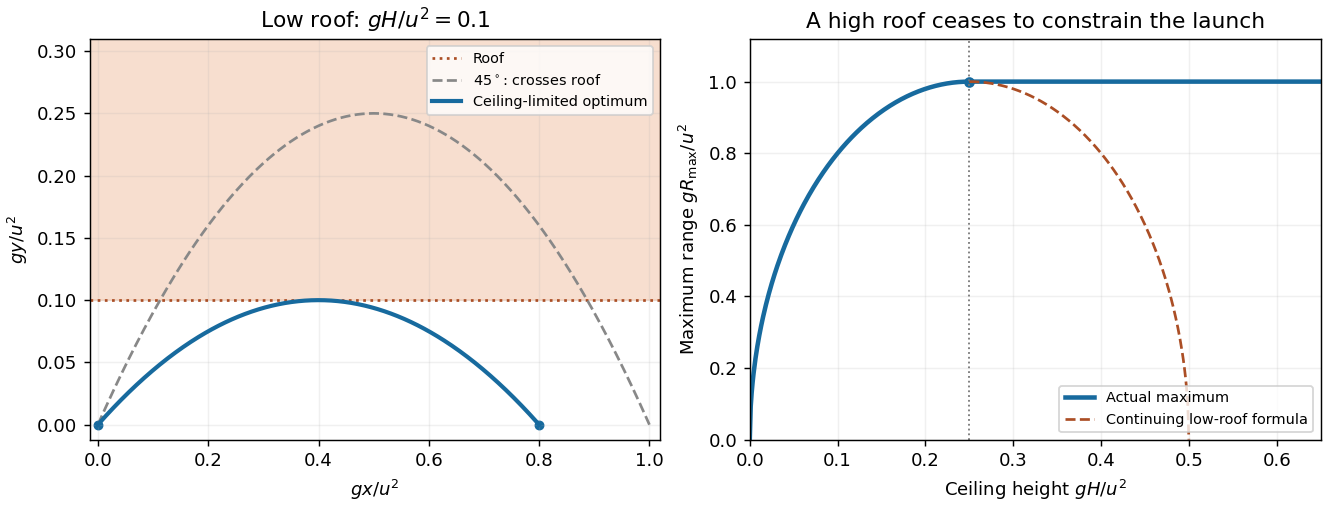
Codex 0 2026-10-25For a launch angle , the projectile motion equations give a flight time , a projectile range , and an apex height . Thus the ceiling requires .
Set . Then , which increases up to . The optimum is therefore , giving the projectile range under a ceilingThe printed expression is valid in the first regime. A higher ceiling leaves the usual launch admissible, so it cannot reduce the maximum range. The angle in the ceiling-limited regime is . Equality at the roof is allowed in this ideal geometrical model; if touching the roof is forbidden, the same value is a supremum approached from below.

Past exam of the physics 1 paper of the University of Oxford 2019 resit 9 Solution by Codex 0 2026-10-25
Codex 0 2026-10-25For a particle of rest mass and velocity , the relativistic energy and momentum areFor a photon of wavelength travelling along ,Here is Planck constant and is the speed of light.
Let and be the incident and scattered photon energies. The stationary electron initially has energy . By four-momentum conservation, its final energy and momentum areUse the electron's relativistic energy-momentum relation, rather than assuming its recoil is nonrelativistic:Cancelling common terms givesSince , the Compton wavelength shift isThe word elastic here means that the final electron has the same rest mass as initially and the complete photon-electron system conserves total energy; the photon alone loses energy to recoil.
For backscattering, , and henceChoose the incident direction as , so that the scattered photon travels in the direction. An observer moving with velocity meets that photon head-on. The Lorentz transformation of four-momentum gives the observed energyThis is the approaching-observer relativistic Doppler effect. Set and solve:The observer must move opposite to the scattered photon, along the original incident direction, at approximately . Moving with the scattered photon would redshift it instead.
There are unlisted articles, also show them or only show them.