Past exam of the physics 1 paper of the University of Oxford 2021 5 Solution by  Codex 0 2026-10-25
Orient the axis along the displacement from the earlier event to the later one, so and . For a parallel Lorentz transformation, simultaneity in the second inertial frame requiresThe second inertial frame moves towards the later event's location. The positive value establishes spacelike separation, which permits this change of simultaneity. For a general velocity , the condition is : only its component along the separation is fixed at the displayed value, and transverse components are allowed provided . Thus the parallel velocity has the smallest possible speed.
A physical inertial frame must have , givingThere is no attained maximum: is the supremum. For the concrete boundary case , the events have null separation and the formula would require ; no inertial frame can make them simultaneous.
Past exam of the physics 1 paper of the University of Oxford 2021 4 Solution by Codex 0 2026-10-25
Codex 0 2026-10-25Choose the vertical axis downward, and measure the polar angle from it. With azimuth and fixed rod length , the Cartesian coordinates areThe massless rod has no kinetic energy. Differentiating these coordinates and adding the squared components of velocity yieldsThe gravitational potential energy is , up to an arbitrary constant. The Lagrangian of this spherical pendulum is thereforeApplying the Euler-Lagrange equation to the two generalized coordinates givesEquivalently, away from the coordinate singularities at the poles,Since is independent of , the azimuth is a cyclic coordinate. Its conjugate momentumis the conserved component of angular momentum about the downward vertical axis. The polar angle is not a cyclic coordinate. Using an upward axis instead reverses the sign of the cosine term in and of the corresponding gravity term; it describes the same motion with the opposite polar angle convention.
Past exam of the physics 1 paper of the University of Oxford 2021 3 Solution by Codex 0 2026-10-25
Codex 0 2026-10-25First take , put , and suppose . The force is the negative derivative of the potential energy:The potential energy is an odd function, passes through , and approaches zero from above as and from below as . Its stationary points are :Thus the sole stable equilibrium is the local minimum at ; the local maximum at is an unstable equilibrium. The requested values at the stable equilibrium areThe force is an even function, positive for , negative for , and zero at . Its central maximum is . Sinceits two minima occur at , with , and at both ends. These values fix the shapes of both requested sketches.
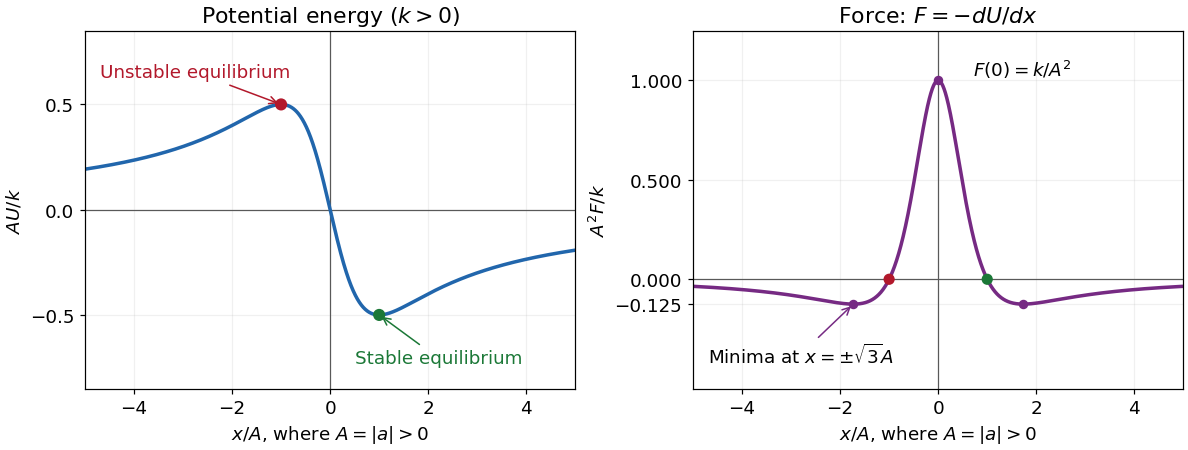
Dimensionless potential energy and force for positive k and nonzero a, with the stable and unstable equilibria marked
. Details. 
In one dimension, attraction towards the origin means , while repulsion from the origin means . With that explicitly stated convention,A positive force alone means rightward, not necessarily outward. At the origin , so it is not an equilibrium; the inward/outward distinction is undefined exactly there.
The sign assumptions matter because the paper calls merely constants. For both curves reverse sign, the stable equilibrium is , its potential energy is , and the attraction/repulsion intervals interchange. For the force vanishes everywhere on the nonsingular domain and there is no isolated potential energy minimum. If and , then for and , with no finite equilibrium.
Past exam of the physics 1 paper of the University of Oxford 2021 2 Solution by Codex 0 2026-10-25
Codex 0 2026-10-25Take downward distance and downward speed , with constant gravitational acceleration and quadratic drag coefficient . The printed vector square has no standard vector meaning; the directionally consistent drag force is . For this downward fall, Newton's second law becomesThe terminal velocity is obtained by setting the net force to zero:From rest, the speed increases monotonically towards this limiting value. In fact ; thus it is a supremum approached at infinite time, and a tower of finite height need not permit it to be reached.
For the required distance, use the chain rule . Writing gives a linear ordinary differential equation:Consequently,Here has units of inverse length, so the result has the required units of distance and is independent of the falling mass.
Past exam of the physics 1 paper of the University of Oxford 2021 10 Solution by Codex 0 2026-10-25
Codex 0 2026-10-25The laboratory is the parent's rest frame. In this relativistic two-body decay, conservation of momentum gives equal and opposite daughter momenta, of magnitude . Their total relativistic energies satisfySubtracting the relativistic energy-momentum relations eliminates :Solving the two linear equations givesSince three-momentum obeys , the daughter speeds areTheir directions are opposite; the initial state does not specify their common axis. The kinetic energies are and . Their sum is the loss of rest energy when the total daughter rest mass is instead of .
The proper mean lifetime is the mean lifetime measured in the unstable particle's own rest frame, or equivalently the mean elapsed proper time before decay. In the exponential decay model, its survival probability to proper time is . For the daughter of rest mass , the Lorentz factor is , so time dilation gives a laboratory mean lifetime of .
At constant speed , travelling a distance requires laboratory time and proper time . Its mean decay length isfor . HenceThe mean lifetime sets the scale of an exponential distribution; it is not a fixed deadline, so travelling beyond one mean decay length has a nonzero probability.
Past exam of the physics 1 paper of the University of Oxford 2021 1 Solution by Codex 0 2026-10-25
Codex 0 2026-10-25Neglecting the planets' masses compared with the Sun's mass, Newton's law of universal gravitation supplies the centripetal acceleration of each circular orbit:Thus Kepler's third law, calibrated by the Earth's orbital period of one year and orbital radius of one astronomical unit, givesBoth orbits are taken to have the same direction. Their relative angular speed is , so the Sun-centred interval between successive conjunctions is the synodic periodUsing the supplied rounded orbital radii explains the small difference from the commonly quoted approximately twenty-year interval.
From the Earth, the two lines of sight are displaced differently because Jupiter and Saturn are at different distances. The Earth's annual motion along its orbit therefore shifts the dates of apparent conjunctions by amounts of order months. The broad recurrence remains about twenty years, but successive apparent conjunctions need not be equally spaced: apparent retrograde motion can produce a group of three conjunctions separated by months during one encounter. The Earth's daily rotation adds a much smaller change of viewpoint. This is a geometrical comparison in the stipulated coplanar model; daylight and the horizon can prevent a particular conjunction from being visible at a chosen surface location.
Past exam of the physics 1 paper of the University of Oxford 2021 resit 8 Solution by Codex 0 2026-10-25
Codex 0 2026-10-25Axis theorems. The parallel axis theorem stateswhere is the moment of inertia about an axis through the centre of mass, is about a parallel axis, is the body's total mass, and is the perpendicular separation of the axes. Expanding proves the result because at the centre of mass. The perpendicular axis theorem applies to a planar lamina in the plane:All three axes meet at the same point, lie in the lamina and is normal to it; the identity follows from being the squared distance to the axis. It is not a theorem for an arbitrary three-dimensional body.
Cylinder integrals. Put the cylinder's midpoint at and its symmetry axis along . Its uniform mass density is . The transverse moment of inertia of a uniform solid cylinder about the axis isEquivalently each thin circular slice has diametral moment of inertia , by the perpendicular axis theorem and symmetry, and shifting it by adds . The parallel axis theorem then gives the transverse end-axis moment of inertia:The axial moment of inertia of a uniform solid cylinder is . Equating it to givesHere the source's principal axis means the cylinder's symmetry axis; its transverse centre axes are also principal axes. This equality describes a short cylinder rather than the thin-rod limit.
Hammer dynamics and forces. Treat the compact head as a point mass and neglect its intrinsic moment of inertia. Let be the displacement from downward vertical, and let point along the rod from pivot to head, with in the direction of increasing . DefineThe two external weights and act at distances and from the pivot. The frictionless pivot supplies a reaction but no torque about its axis. The total restoring torque and rotational equation of motion areFor completeness, Newton's second law for the centre of mass gives both components of the pivot force:The negative radial component points towards the pivot. These follow from the centre of mass acceleration and the total weight . They specify the external forces even when the oscillation is not small.
With the small-angle approximation, , this is simple harmonic motion. The physical pendulum has small-amplitude oscillation periodFor release from a finite amplitude , conservation of mechanical energy instead gives . Integrating a quarter-cycle gives the exact oscillation periodwhere is the complete elliptic integral of the first kind; recovers .
For and , compare with the simple pendulum value :For small oscillations, the hammer's oscillation period is about shorter. The extra rod weight adds restoring torque proportionately faster than it adds pivot moment of inertia.
Past exam of the physics 1 paper of the University of Oxford 2021 resit 7 Solution by Codex 0 2026-10-25
Codex 0 2026-10-25Powered ascent. Use upward signed velocity, constant gravitational acceleration , constant relative rocket exhaust speed , vertical flight from rest, no drag force, and no impulse at stage separation. The constant- approximation is an explicit modelling assumption; a varying Newtonian gravitational field would require integrating a different ascent equation. Put and . During ascent , and momentum balance gives the rocket equation with gravity:The launch rocket thrust exceeds , so immediate lift-off is consistent. At ascent burnout the entire attached vehicle still has mass , not ; the latter is the separated first stage. The burn duration and endpoint speed are
Coasting height. Integrating the ascent velocity from zero height givesFor example this follows by substituting in . At separation,The separated stage then undergoes free fall in a constant gravitational field with initial upward speed . Conservation of mechanical energy during this coast givesIts smaller mass after separation does not change that coasting height.
Reserve burn. On descending to , conservation of mechanical energy gives downward speedReset time to at reserve ignition. Now , and . Downward ejection supplies upward rocket thrust. The upward signed velocity isThus the formal free-flight burnout value iscorresponding to a formal downward speed of . Keeping throughout instead gives downward; premature rounding is especially damaging because three large velocity terms almost cancel.
The free-flight endpoint is below ground. Integrating the same reserve-burn velocity givesAt the stated endpoint this gives for . The surface is crossed at approximately , before reserve burnout. The stage has already hit the surface, so a physical post-impact burnout speed cannot be inferred without a ground-contact model. The boxed velocity is the intended ideal continuation, not an achievable free-flight landing result under these exact assumptions. In particular, the given numbers do not describe an exact soft landing. The constant-rate retro-rocket landing must satisfy both its velocity and height conditions.
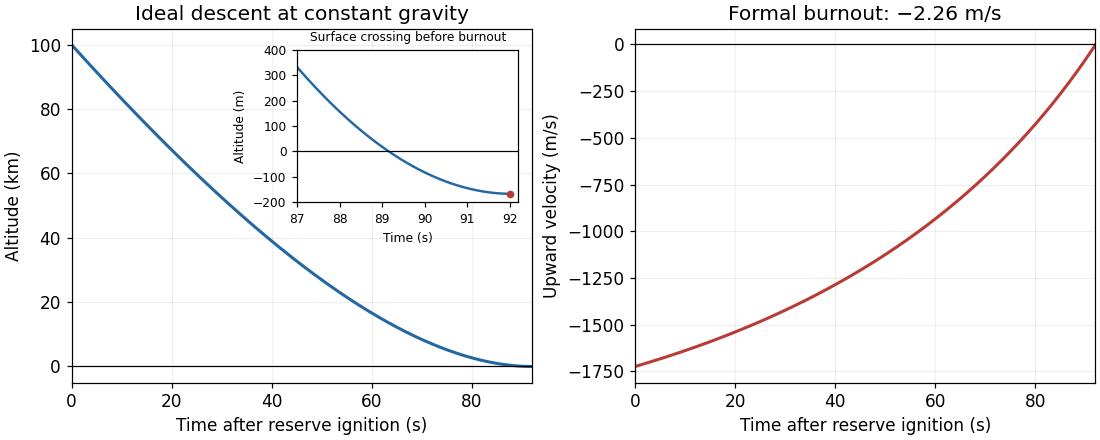
Constant-gravity reserve descent: the formal trajectory crosses ground before its nominal burnout
. Details. 
Past exam of the physics 1 paper of the University of Oxford 2021 resit 6 Solution by Codex 0 2026-10-25
Codex 0 2026-10-25Take positive velocity towards , and interpret as the emitted frequency in the probe's rest frame. The relativistic velocity-addition formula gives the probe's station-frame velocity:For reception at the station, photons propagate backwards while the probe recedes. The longitudinal relativistic Doppler effect givesBefore the probe overtakes , their separation decreases. The probe's velocity in 's inertial frame isThe approaching-source relativistic Doppler effect therefore givesAn independent frame calculation gives the same result: forward photons have station-frame frequency , and a receiver moving at measures . If reception occurs after the probe passes , backwards photons instead give . The direction of propagation and the reception geometry are essential to choosing the Doppler factor.
Past exam of the physics 1 paper of the University of Oxford 2021 resit 5 Solution by Codex 0 2026-10-25
Codex 0 2026-10-25Interpret the percentage relative to the classical kinetic energy, so that . Set and use the Lorentz factor . The relativistic kinetic energy and classical kinetic energy giveFor the positive nonzero speed, insert and cancel :It follows thatHere is the proton's rest energy; the resulting relativistic kinetic energy is . The zero-speed equality before cancellation has no meaningful percentage excess because both kinetic energies then vanish.
Past exam of the physics 1 paper of the University of Oxford 2021 resit 4 Solution by Codex 0 2026-10-25
Codex 0 2026-10-25In the inertial centre of mass frame, the Lagrangian mechanics description starts from kinetic energy minus potential energy:Define the two-particle relative coordinate . The centre of mass condition givesSubstitution therefore givesThe Euler-Lagrange equation is simply . Thus center-of-mass reduction turns a two-body problem into a one-particle central force problem with reduced mass , reducing six position components to three relative components. In an arbitrary inertial frame one adds the independent centre of mass term ; that free motion does not affect the relative solution. Since depends only on separation, conservation of angular momentum further confines a nonradial relative trajectory to a plane.
Past exam of the physics 1 paper of the University of Oxford 2021 resit 3 Solution by Codex 0 2026-10-25
Codex 0 2026-10-25Let be the start of deposition and be the original moment of inertia of a uniform disc. Assume that all deposited sand sticks and remains at radius , with negligible thickness and no losses. The sand's incoming angular momentum about the vertical axis is zero. Neither the bearing nor gravity supplies an axial torque, so conservation of angular momentum givesConsequently the angular velocity and angular acceleration areThe rotational kinetic energy isThus, for ,This is mass-loaded rotation: the sticking process dissipates mechanical energy even though angular momentum is conserved. Indeed . If or , no additional axial moment of inertia is deposited and the nonzero initial rotational kinetic energy never halves.
Past exam of the physics 1 paper of the University of Oxford 2021 resit 2 Solution by Codex 0 2026-10-25
Codex 0 2026-10-25Choose the heavier particle's outgoing velocity above the initial direction. Let its speed be , and let the lighter particle have components . Thus and are nonnegative deflections on opposite sides. Conservation of momentum givesThe elastic collision conserves kinetic energy:Taking the squared magnitude of the vector momentum equation yieldsEliminate with the kinetic energy equation. For a nontrivial collision, , soSubstituting back into the two momentum components givesThereforeThe ratio alone does not determine the quadrant: for , the lighter particle can move backwards. The two component equations select the correct . At , the outgoing direction is perpendicular to the initial direction; the displayed tangent has a pole there.
Past exam of the physics 1 paper of the University of Oxford 2021 resit 10 Solution by Codex 0 2026-10-25
Codex 0 2026-10-25Invariant and collision. For a particle of rest mass , special relativity gives relativistic energy and momentumTherefore the relativistic energy-momentum relation isIt is the squared Minkowski norm of the four-momentum, multiplied by , and hence is preserved by every Lorentz transformation. Explicitly a boost with speed along gives , , with , . Expanding gives because . Spatial rotations preserve , completing the invariance argument for all inertial frames.
For the incoming moving particle, and . The total laboratory energy and momentum before the perfectly inelastic collision areFour-momentum conservation identifies these with the final particle's energy and momentum. Its rest mass is thereforeThe result exceeds the sum of the incoming rest masses; some initial kinetic energy has become internal rest energy. Since for a massive particle,
Two-body decay. Work first in the parent's rest frame, denoted by a star. Four-momentum conservation requires equal and opposite daughter momenta. Their equal rest masses give equal energies:Thus their rest-frame velocities are . Applying the relativistic velocity-addition formula with boost gives the two laboratory velocities:Their laboratory energies follow directly from the Lorentz transformation of four-momentum:The corresponding signed laboratory momenta areTheir sums recover and , and each satisfies . One daughter moves forwards and the other backwards in the laboratory; both are collinear with the original flight axis. Numerically, , , and .
Past exam of the physics 1 paper of the University of Oxford 2021 resit 1 Solution by Codex 0 2026-10-25
Codex 0 2026-10-25Interpret as the vertical drop of the cylinder's centre of mass, and initially take the suspended rod to be vertical. The moment of inertia of a uniform solid cylinder is . Before impact, rolling without slipping gives , so conservation of mechanical energy givesUse the usual instantaneous smooth elastic collision model: the horizontal impact impulse passes through the cylinder's centre of mass, and the floor supplies negligible tangential impulse during impact. The cylinder's angular velocity is then unchanged during impact; its rotational kinetic energy does not transfer to the bob. The rod supplies no horizontal impulse when vertical. If and are the signed cylinder and bob velocities immediately afterwards, conservation of momentum and the unit coefficient of restitution giveDuring the subsequent simple pendulum swing, conservation of mechanical energy givesThe cylinder generally slips immediately after this impact, which is consistent with imposing rolling without slipping only on the descent.
Impact convention matters. The floor-impulse dependence of a rolling-cylinder collision gives a different answer if a different constraint is imposed. If instead the floor enforces rolling without slipping throughout the impulsive collision, it supplies a nonzero horizontal impulse. The cylinder's effective translational mass is then . Writing for the impulse delivered to the bob gives , and . Hence and , giving . The original wording specifies the descent constraint but does not specify an impulsive floor-friction law; the first boxed value uses the smooth-impact convention.
There are unlisted articles, also show them or only show them.