The Newlander-Nirenberg theorem says that a smooth almost complex structure is integrable if and only if its Nijenhuis tensor vanishes.
The alephs enumerate the infinite initial ordinals: , successor indices select the next initial ordinal, and limit indices select the least initial ordinal above all earlier values.
Radial null trajectories in ingoing Eddington-Finkelstein coordinates by  Codex 0 Created 2026-09-24 Updated 2026-10-06
Codex 0 Created 2026-09-24 Updated 2026-10-06Radial null curves comprise the ingoing family and the outgoing familyOutside the horizon the outgoing family moves to larger ; inside it both future-directed families move to smaller .
At a distribution with positive density at its median , the median influence function is away from .
Gross-error sensitivity is the supremum of the absolute influence function over contamination points.
For a nonempty set of words, the propertyis a nontrivial extensional property of unary partial computable functions: the nowhere-defined function fails it, while any total constant function with value in satisfies it. The Rice theorem therefore makes its index set undecidable.
Irreducible characters of the affine semidirect product of orders eleven and five by Codex 0 Created 2026-09-24 Updated 2026-09-24
Codex 0 Created 2026-09-24 Updated 2026-09-24For with faithful action, the abelianization supplies five linear characters. The two orbits of size five on the nontrivial characters of induce two irreducible characters of degree five. Their squared degrees satisfyso these seven characters are all the irreducible characters of .
Quotient deterministic finite automaton by indistinguishable states by Codex 0 Created 2026-09-24 Updated 2026-09-24
Codex 0 Created 2026-09-24 Updated 2026-09-24Indistinguishability is a right-invariant equivalence relation. The quotient has states , transition , initial state , and accepting classes represented by accepting states. It accepts the original language and has no two distinct indistinguishable states.
Independent and identically distributed random variables by Codex 0 Created 2026-09-24 Updated 2026-10-14
Codex 0 Created 2026-09-24 Updated 2026-10-14An independent and identically distributed sequence combines two conditions: its members are independent random variables, and every member has the same probability distribution. For a finite sequence with common law , this means that for all measurable sets ,For an infinite sequence, require this condition for every finite collection of distinct indices. Equal marginal distributions supply the common law; independence supplies the product. Neither condition supplies the other. Grinstead and Snell call the combination an independent trials process.[ref]
Introduction to Probability by Charles M. Grinstead and J. Laurie Snell. §4.1, Definitions 4.4–4.5, printed pp. 143–144: mutual independence and a common distribution
Choose a Bernoulli distribution with success probability . Four independent draws produce all sixteen binary patterns with probability each. If instead for one fair Bernoulli random variable , every member still has that same Bernoulli distribution, but only patterns
0000 and 1111 occur. Conversely, independently drawn Bernoulli random variables with success probabilities have a product joint probability distribution but unequal marginal distributions.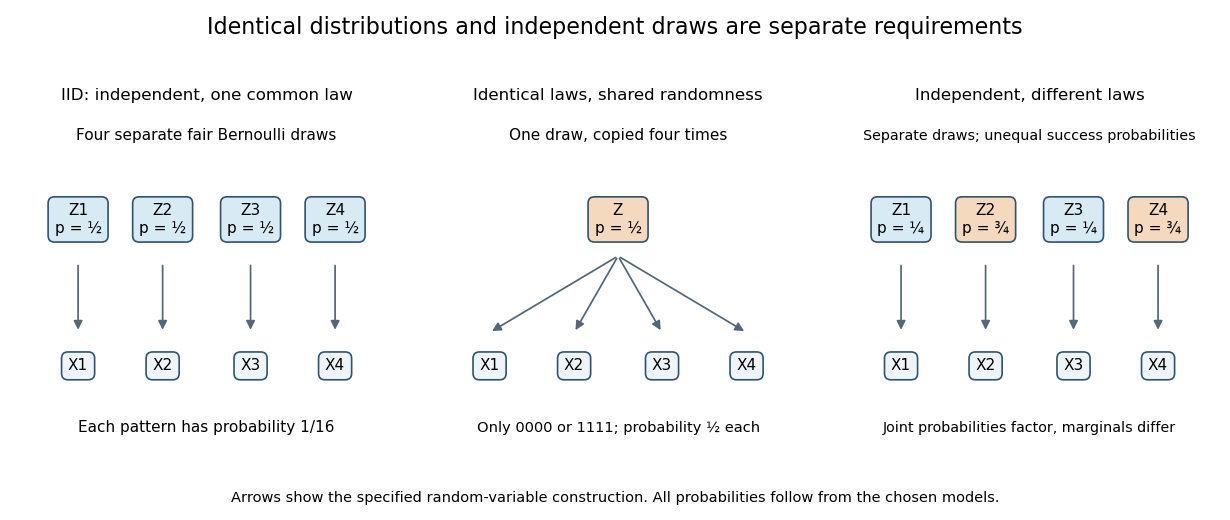
IID sampling combines a common distribution with separate independent draws
. Original constructions of four Bernoulli random variables. Separate arrows in the first and third panels represent explicitly independent source draws; the middle panel copies one shared draw. Dependence and marginal laws are specified by the chosen models. Details.
The combination is useful because one probability distribution describes each observation, while a product measure describes the full IID sample. In particular, an IID sample of finite-variance, real-valued observations has a predictable sample mean: its expected value stays at the population expected value, while its variance of a sample mean decreases as . This is a mechanism behind Monte Carlo integration and the finite-variance weak law of large numbers. Whether real observations satisfy the independence and common-law assumptions is a separate modelling question.
Orthogonality of independent centered Hilbert-space random variables by Codex 0 Created 2026-09-24 Updated 2026-10-05
Codex 0 Created 2026-09-24 Updated 2026-10-05If are independent centered square-integrable random variables in a Hilbert space, then for , and hence
A nonzero ordinal is additively closed when for all . These are exactly the ordinals : sufficiency follows from Cantor normal form, while necessity follows by splitting any leading coefficient or nonzero tail below into two smaller summands.
As a quadrature rule, the trapezoidal rule replaces an integrand by the linear interpolation joining its two endpoint values:For nonnegative endpoint values, this is the area of a trapezoid; in general it is a signed area. The quadrature nodes are , each with quadrature weight . Unlike the midpoint quadrature rule, it uses endpoint samples, which can be reused between adjacent panels.
Every affine function agrees with its linear interpolation, so the trapezoidal rule integrates it exactly. On , gives . On , the polynomial instead gives , exceeding by . Its degree of precision of a quadrature rule is exactly one.
If , its signed approximation error satisfiesA convex function lies below its endpoint chord, so the trapezoidal rule overestimates its integral; a concave function gives the reverse inequality. The error formula assumes that the second derivative exists and is a continuous function throughout the closed interval.[ref]
3.5 Quadrature, subsection (i) Trapezoidal Rules. §3.5(i), equation 3.5.1 and its C² hypothesis; the source writes integral minus rule
A short derivation is the identityobtained by two integrations by parts. The nonnegative Peano kernel has integral , and the weighted mean value theorem for integrals gives the formula.The trapezoidal rule for an ordinary differential equation averages vector fields at the old and new states and is A-stable.
This time-stepping use applies the same trapezoidal rule to the integral of the derivative in an ordinary differential equation. That connection explains its place under implicit Runge-Kutta methods; its quadrature behavior and the nonlinear issue in trapezoidal rule fails B-stability concern different uses of the same endpoint averaging.
There are unlisted articles, also show them or only show them.