A maximal coupling of two probability distributions maximizes the agreement probability among all their couplings. Equivalently, it minimizes . The coupling characterization of total variation distance identifies the minimum mismatch with the total variation distance of the two marginal laws. The term maximal concerns agreement, rather than the size of a correlation coefficient or closeness in a geometric metric.
On a finite set, retain all common probability mass at equal pairs and match the excesses elsewhere. The explicit four-outcome example in coupling characterization of total variation distance realizes this construction and checks its marginal distributions. A maximal coupling need not be unique: different joint arrangements of the residual mass can have the same optimal mismatch.
Cantor's diagonal argument shows that the set of all infinite binary sequences is an uncountable set. Suppose a proposed enumeration is , where is coordinate of row . Construct a new binary sequence byIt differs from row at coordinate , for every . It is consequently absent from the entire proposed list, regardless of how that list was chosen. The failure of an enumeration of all binary sequences follows from this precise point of disagreement, rather than from a claim that the list looks too small.
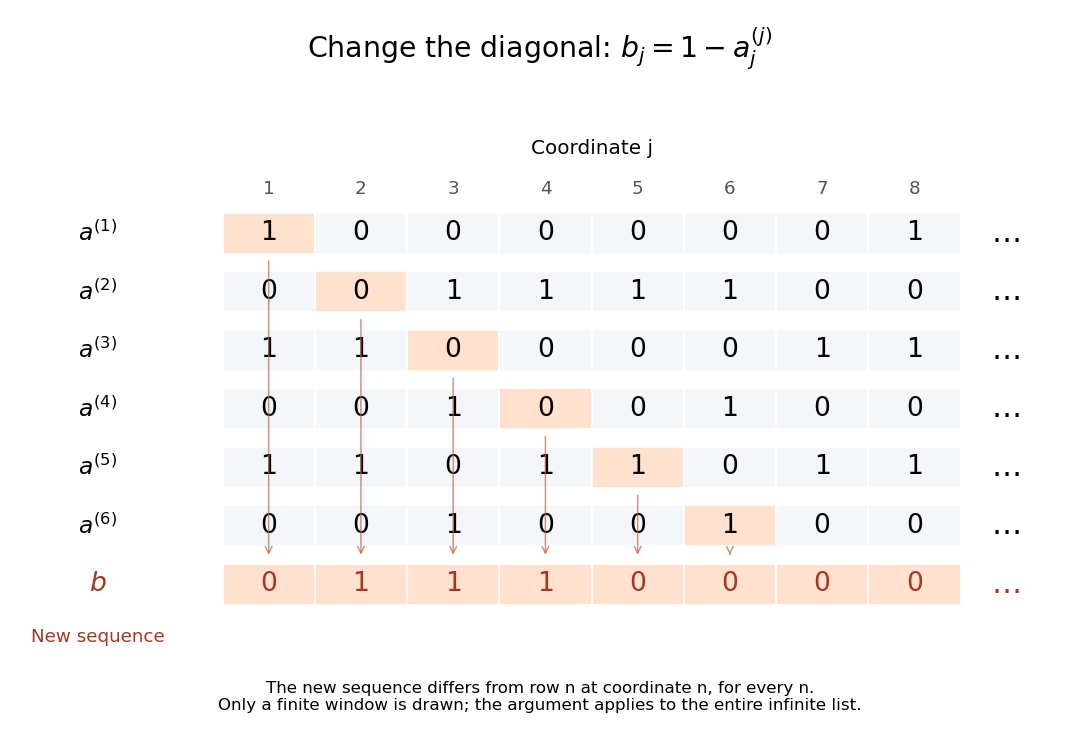
Flipping the nth coordinate of the nth row constructs a binary sequence missing from every proposed row
. Details. 
For the displayed window, the first six diagonal bits are , so the new sequence starts . The drawing shows only finitely many rows, but the rule defines every coordinate and excludes every row of an infinite list. This distinguishes the argument from the Cantor pairing function: that construction lists all pairs of finite indices, whereas this one concerns an entire infinite sequence as each object to be listed. Finite binary strings form a countable set; all infinite binary sequences do not.
The connection with power sets is exact: a subset corresponds to its indicator function, with a one in position exactly when . Changing the diagonal membership bit is the same mechanism as the Cantor's theorem construction . This reusable method turns a purported complete list into an explicit omitted object.
In his paper [ref]
https://onepagepapers.com/cantor-diagonal/read/. Cantor, Ueber eine elementare Frage der Mannigfaltigkeitslehre, pp. 75–78
, presented in 1891 and printed in the 1890–91 volume in 1892, Cantor uses infinite sequences of two symbols for the diagonal construction and then gives the broader comparison of cardinalities. The binary notation here is a modern presentation of that construction.The Cantor pairing function is an explicit bijection between and , with the natural numbers numbered from zero:If , there are pairs on earlier diagonals, and the pair is at offset along diagonal . The formula therefore gives exactly the enumeration above. For example, .
Free-electron fraction during hydrogen--helium recombination by  Codex 0 Created 2026-09-24 Updated 2026-10-14
Codex 0 Created 2026-09-24 Updated 2026-10-14Chemical equilibrium for givesafter neglecting the ion--atom mass difference in the translational prefactor.
A constant barotropic equation of state has . The cases and describe pressureless matter and radiation respectively.
A particle species thermally decouples when its interaction rate falls below the Hubble parameter. Its collisionless relativistic distribution subsequently redshifts with temperature proportional to , while annihilations among still-coupled species can heat the remaining plasma.
Effective number of relativistic degrees of freedom by Codex 0 Created 2026-09-24 Updated 2026-10-06
Codex 0 Created 2026-09-24 Updated 2026-10-06The effective number of relativistic entropy degrees of freedom is defined byA relativistic bosonic degree of freedom contributes one, while a relativistic fermionic degree of freedom contributes when all species share a temperature.
Before recombination, frequent Thomson scattering couples photons, electrons, and baryons into an acoustic fluid.
Thomson scattering of a local radiation quadrupole generates linear cosmic microwave background polarization. Its acoustic phase follows the photon velocity and is shifted by one quarter-period relative to the monopole temperature oscillation.
For a canonical scalar field with potential , slow roll reduces the field and Friedmann equations to
The positive semidefinite matrices form a convex cone because nonnegative combinations preserve nonnegative quadratic forms.
The convex hull of a set is the set of all finite convex combinations of its points, equivalently the smallest convex set containing it.
For a nonempty closed convex subset of a finite-dimensional inner-product space, is the unique point of minimizing .
This closest-point map is the metric projection onto a closed convex set. Repeated projections onto several sets form the separate projections onto convex sets method.
There are unlisted articles, also show them or only show them.