The Laplace-Beltrami operator is the intrinsic Laplacian determined by a Riemannian metric. In local coordinates it is
An immersion is a smooth map whose differential is injective at every point. A parametrized surface in is immersed when its two coordinate tangent vectors are linearly independent.
An exact differential is the differential of a scalar potential and integrates to zero around every closed curve.
The exterior derivative is the unique graded derivation that agrees with the differential on functions and satisfies .
On a smooth planar one-form , the product rule and antisymmetry of the wedge product of differential forms giveFor , the coefficient is : there is a nonzero integral around the boundary of every positively oriented rectangle. For , the coefficient is . More generally, the identity makes every exact differential form a closed differential form. It expresses cancellation between mixed partial derivatives locally; it does not imply that every closed differential form has a global potential.
A smooth map pulls a differential form on back to one on by applying its differential to each tangent vector argument. In particular, a parametrization of a curve pulls a one-form back to an ordinary integrand on an interval.
For and the parabola , , substitute and to obtainThe same endpoints gave and along the two square-edge paths in the introduction, so this third answer is consistent with path dependence. By contrast, gives integral , the same endpoint difference as before.
The pullback of a differential form commutes with the wedge product of differential forms and the exterior derivative: and . These identities make changes of coordinates and parametrizations compatible with differentiation and integration.
The wedge product combines a degree- differential form and a degree- differential form into one of degree . It is associative and graded-commutative:In particular, and . For planar vectors ,This determinant is the signed area of their parallelogram. Exchanging the edges reverses the sign; parallel edges give zero. Thus antisymmetry records the geometry of oriented area rather than adding an arbitrary algebraic convention. The wedge product of differential forms requires no Riemannian metric to define it. It obeys the graded Leibniz rule under the exterior derivative.
An ordinary differential equation relates an unknown function of one independent variable to its ordinary derivatives. Its order is the highest derivative appearing. Thus is first order, while the harmonic oscillator equation is second order. A first-order equation in explicit form isHere need not be time, and can be a vector, giving a system of coupled ordinary differential equations. A classical solution of a differential equation is a sufficiently differentiable function on an interval which satisfies the equation at every point. For the explicit first-order equation, if is continuous, this solution of a differential equation has a continuous derivative.
For Newton's law of cooling, the state is a single temperature; for a second-order differential equation, a first-order system also records its first derivative. This is why a starting position alone does not specify a harmonic oscillator trajectory: its starting velocity matters too.
The power of an ordinary differential equation is that one rule describes a whole family of histories. An initial value problem chooses one history when uniqueness holds. An autonomous differential equation has independent of ; its equilibrium points satisfy and give constant solutions of a differential equation. Equations with explicit time dependence can instead respond to a changing environment.
Existence of partial derivatives does not imply their continuity by  Codex 0 Created 2026-09-24 Updated 2026-10-14
Codex 0 Created 2026-09-24 Updated 2026-10-14A function can be differentiable even when its partial derivatives are discontinuous. For example,away from the origin, with value zero at the origin, is differentiable there while its partial derivatives oscillate along the coordinate axes.
Lie theory studies continuous symmetries through Lie groups, Lie algebras, and their representations. A rotation can change by an arbitrarily small angle: its parameter varies continuously, yet composing two rotations obeys an exact group operation. The central question is how such finite transformations are controlled by their velocities at the identity element.
An infinite group need not require infinitely many independent parameters. The planar rotation group has infinitely many elements but only one local angle coordinate. More generally, an -dimensional Lie group has an -dimensional tangent space at its identity element. A basis of this Lie algebra, together with the Lie brackets between its basis vectors, supplies finite data for infinitesimal composition. These brackets record the first correction to adding small transformation parameters. The Exponential map of a Lie group turns a chosen infinitesimal direction into an actual motion.
Finite tangent data consists of a finite basis and a finite table of Lie brackets. For planar rotation, every generator is with , using the quarter-turn matrix computed below: one real coefficient specifies any angular velocity. This Lie algebra has infinitely many vectors, but its dimension is one. Linear combinations of the chosen basis vectors supply all the possible infinitesimal motions.
This passage between geometry and algebra is useful because linear maps and matrix commutators are easier to compute than an entire family of transformations. The local information does not determine every global identification: the additive real line and the circle group have isomorphic one-dimensional Lie algebras, but only the latter wraps around. For the local-versus-global viewpoint and the connection with differential equations, see Meinrenken, Lie groups and Lie algebras, introduction and Section 4.
Periodic points are dense when every nonempty open set contains a point fixed by some positive iterate.
Deutsch-Jozsa test with an arbitrary uniform-state unitary by Codex 0 Created 2026-09-24 Updated 2026-10-07
Codex 0 Created 2026-09-24 Updated 2026-10-07 Reduced density operator of a weakly coupled oscillator pair by Codex 0 Created 2026-09-24 Updated 2026-10-14
Codex 0 Created 2026-09-24 Updated 2026-10-14If a weak interaction changes to a normalized state proportional to , tracing out either oscillator gives eigenvalues and .
The purity of a density operator is . It equals one exactly for a pure state; in finite dimension it lies between and . The minimum occurs exactly at the maximally mixed state .
A worked qubit family interpolates between the mixed state and the pure state , where :The eigenvectors are , with eigenvalues . Squaring and summing these eigenvalues givesHere is the Born rule probability of the positive outcome in an projective measurement. The Bloch vector is , since with one of the Pauli matrices. At the purity is ; at it is , with ; at it is one. Within this family, is a pure state and every is a mixed state. Extending the formula to produces a negative eigenvalue , so it ceases to be a density operator despite remaining Hermitian with trace one.
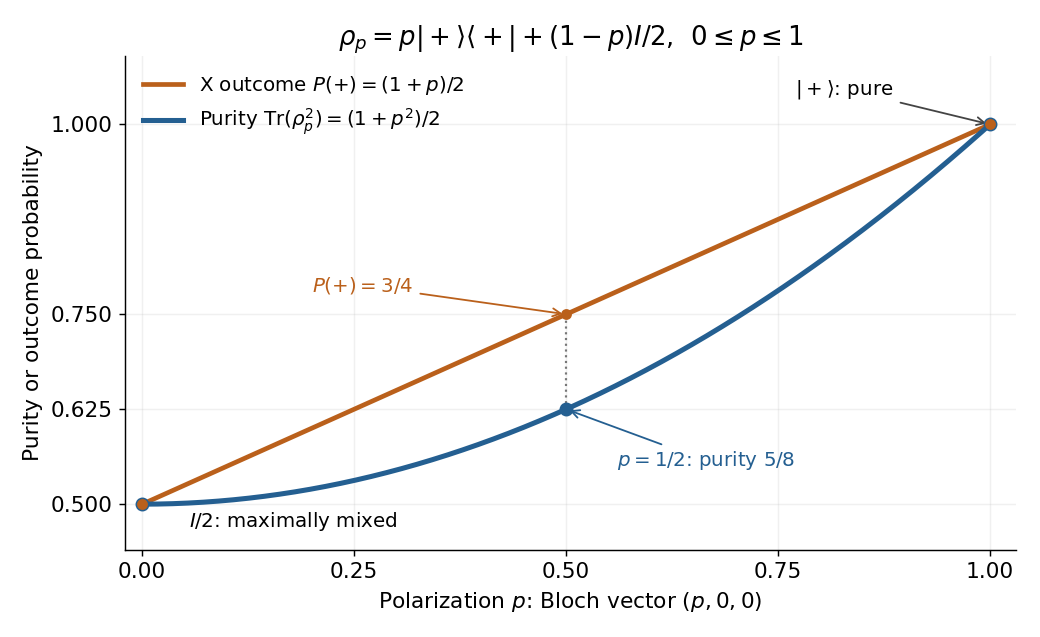

The Bloch vector length measures polarization: for any qubit density operator, . This connects the interior of the Bloch ball with mixed states and its boundary, the Bloch sphere, with pure states. [ref]
For a short proof of the general bound, use the spectral theorem: the nonnegative eigenvalues sum to one, so . ThenThe lower bound is attained only when all eigenvalues equal ; the upper bound is attained only when exactly one eigenvalue is nonzero, and hence equals one. Purity is therefore a simple quantitative test of mixedness, invariant under a unitary operator. It does not specify the entire density operator: even distinct pure states all have purity one. [ref]
The Von Neumann entropy of a density operator isIt vanishes for a pure state and measures mixedness and quantum entanglement in reduced states.
For delta interactions at points , a Green-function solution reduces the Schrodinger equation to a finite linear system for the values .
There are unlisted articles, also show them or only show them.