A convex polytope is a bounded intersection of finitely many closed half-spaces, equivalently the convex hull of finitely many points.
This is the non-strict version of a half-space; replacing the inequality by a strict one gives the open version.
A convex combination is a finite weighted average of points in a real vector space. For , it has the formThe nonnegative coefficients forbid subtracting a component, and their unit sum keeps the result on the same affine scale as the inputs. With two points it parametrizes their line segment; equal coefficients give their centroid. A convex set contains every finite convex combination of its points. Conversely, the two-point case already gives the defining property of a convex set.[ref]
Convex Optimization by Stephen Boyd and Lieven Vandenberghe. §2.1.4, p. 24: finite combinations, weighted-average interpretation and convex hull
The distinction from a linear combination is concrete. Combining and with coefficients and gives , outside their line segment, despite the unit coefficient sum. Using two coefficients both equal to one gives here, but their sum is two, so it is not a convex combination with those coefficients. A numerical output may happen to coincide with a point admitting a different convex representation; the definition applies to the specified coefficients.
The nonnegative orthant consists of vectors whose coordinates are all nonnegative. Its interior is the positive orthant, where every coordinate is positive.
This is the proximal gradient method when the nonsmooth term is the indicator of the feasible convex set, whose proximal operator is the metric projection.
For a real matrix , exactly one of the following holds: there is with and , or there is with . Separating from the standard simplex proves the result; may then be normalized to sum to one.
The product of any family of connected spaces is connected. For two factors, fix and use the connected setsThey cover and all contain the connected horizontal slice .
Integer-valued function criterion for connectedness by  Codex 0 Created 2026-09-24 Updated 2026-09-29
Codex 0 Created 2026-09-24 Updated 2026-09-29A topological space is connected exactly when every continuous map from it to the discrete space is constant. A disconnection produces a nonconstant indicator map, while the continuous image of a connected space in must be a singleton.
If is a continuous map and is a connected space, then its image , with the subspace topology from , is a connected subset of . The whole codomain need not be connected; the assertion concerns the values actually attained. No injectivity is required.[ref]
For example, the continuous function maps the connected closed interval onto the connected closed interval , even though opposite inputs have the same output. The same continuous function maps the disconnected union onto . Thus a connected image does not imply a connected source: a continuous map can merge different connected components.
For a continuous function representing a continuous reading, and force some input with . Its image is a connected subset of the real line, hence a real interval containing both endpoint readings. For the synthetic model , the missing-value test is explicit: . A step reading equal to for and for skips , but fails continuity at .
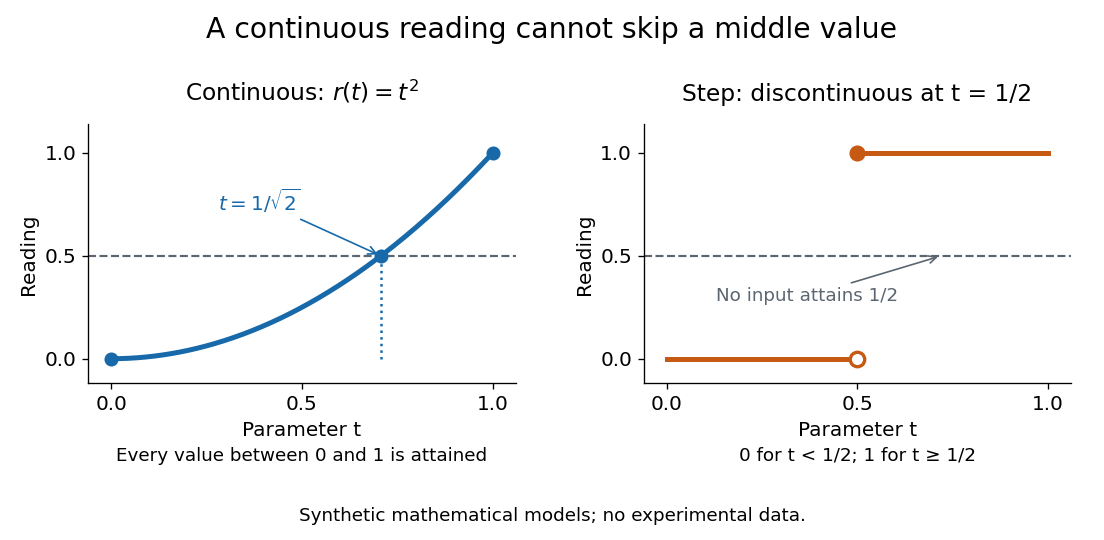

Proof outline: a separation of a topological space of into nonempty open subsets pulls back under to nonempty open subsets of . Their intersection is empty and their union is , contradicting connectedness. This also shows why a continuous map sends each connected component of its source into a single connected component of its target.
A connected component of a topological space is a nonempty connected subset that is maximal under subset inclusion. If is a connected component and with a connected subset, then . Maximality means that no larger connected subset contains ; it does not mean largest cardinality among all connected subsets.
For example, the connected components of in the usual subspace topology of the real line are and . Each is a real interval, and no connected subset of the real line can meet both without containing the missing point . For the finite set in the same subspace topology, the three connected components are its singleton sets.
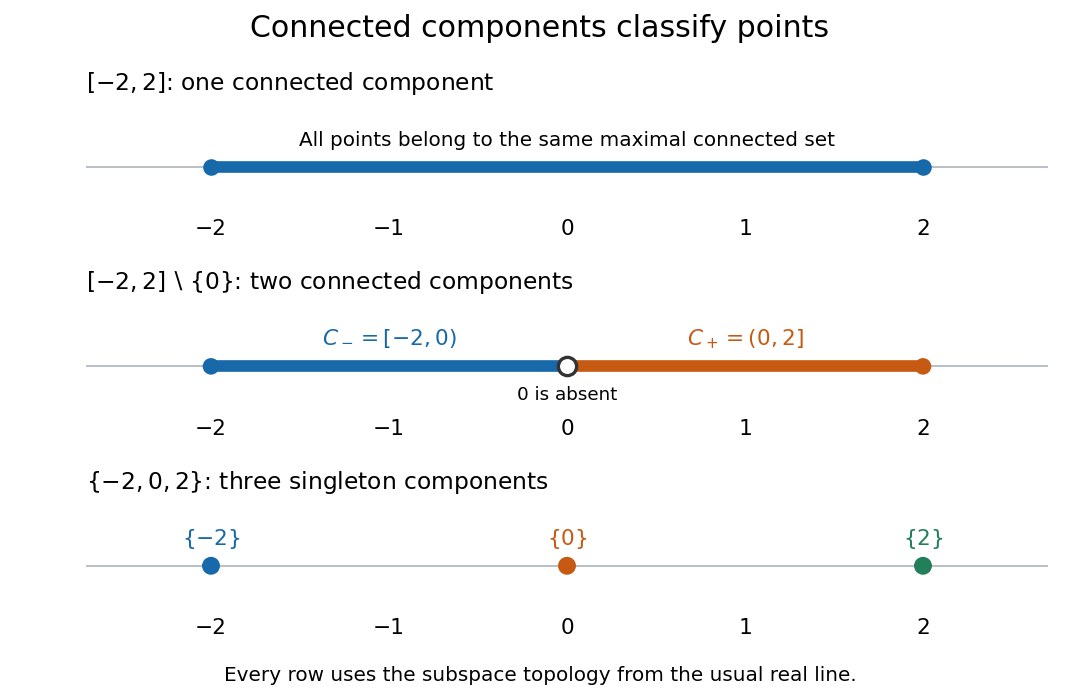
An intact real interval, an interval with an interior point removed, and a finite set have one, two, and three connected components in the usual subspace topology of the real line
. Details. 
Every point lies in exactly one connected component, constructed by taking the unionAll members contain , so their union is connected by connected union with a connected hub. The union includes every connected subset through , so it is maximal. Equivalently, defineThis is an equivalence relation: singleton sets give reflexivity, symmetry is immediate, and two connected subsets sharing the middle point have a connected union, giving transitivity. The equivalence classes are precisely the connected components. They form a partition of a set: they cover and any two are either equal or disjoint.[ref]
Chapter 3: Connected and compact spaces. Proposition 3.1.11, Definition 3.1.12 and Remark 3.1.16: maximal connected subsets and equivalence classes
Every nonempty connected subset lies within one connected component. Moreover, every connected component is closed in : closure of a connected set makes its closure connected, and maximality forces that closure to equal the original connected component. A connected component need not be open. For example, in with its usual subspace topology from the real line, all connected components are singleton sets, but is not open: every neighbourhood of in contains some .[ref]
If a holomorphic function satisfies , then it has a holomorphic local inverse near and is conformal there. Its possible failures of local conformality are therefore its critical points.
There are unlisted articles, also show them or only show them.