
A helicoid is a ruled minimal surface swept out by a line that rotates while translating along its perpendicular axis.
Riemannian geometry studies smooth manifolds equipped with a Riemannian metric: an inner product at each tangent space, varying smoothly with position. This local measuring rule determines angles, arc length, Riemannian distance and geodesics. An inhabitant of a surface can discover its geometry by measuring within it, without knowing how it sits in a larger Euclidean space.
A circular cylinder is a particularly useful example. Its surface bends in space, yet unrolling it preserves the induced metric: a small patch has the geometry of a flat sheet. By contrast, a round sphere has positive Gaussian curvature. The distinction between intrinsic flatness of a circular cylinder and extrinsic curvature separates the geometry an inhabitant measures from the way an outside observer sees the surface bend.
Geodesics supply the analogue of straight lines. On a round sphere they follow great circles; on a circular cylinder they become straight lines when lifted to an unrolled sheet. Their arc length lets us compare candidate routes, as in great-circle distance and Riemannian distance on a circular cylinder. The same measuring rule also defines differential operators such as the Laplace-Beltrami operator, connecting geometry with diffusion and spectral geometry.
Bernhard Riemann's 1854 inaugural lecture proposed studying spaces of arbitrary dimension through their infinitesimal measuring rules, including a positive quadratic expression for the squared line element. This moved the subject beyond a particular surrounding space: the measuring rule itself became part of the geometry. [ref]
https://www.maths.tcd.ie/pub/HistMath/People/Riemann/Geom/. Riemann's original lecture and Clifford's English translation, collected by Trinity College Dublin
.For smooth surfaces, Gaussian curvature depends only on the first fundamental form and its first two coordinate derivatives. Consequently any smooth local isometry satisfies . The surprise is that is defined using the shape operator, which describes bending in space, yet its value can be recovered from measurements made entirely within the surface.
In his 1827 paper, Carl Friedrich Gauss expressed Gaussian curvature through the metric coefficients and their partial derivatives in Article 11, then stated its invariance under development in Article 12. Article 13 explicitly compares a plane with surfaces developable onto it, including cylindrical surfaces. The paper was presented on 8 October 1827 and printed in 1828; the Morehead–Hiltebeitel English translation appeared in 1902. [ref]
https://www.gutenberg.org/files/36856/36856-pdf.pdf. Gauss's original paper in English translation, Articles 11–13 and title pages
A plane and a circular cylinder can have different principal curvatures while both have . Their matching first fundamental forms exhibit the actual local isometry. In contrast, no nonempty open patch of a sphere of radius can be flattened smoothly into a plane while preserving its first fundamental form: cannot become zero. Making the patch small reduces practical distortion, but never produces an exact local isometry. This is a geometric obstruction to a perfectly distance-preserving flat map of a spherical world, independent of where one places a seam.
The following proof outline connects the two descriptions of Gaussian curvature. For a parametric surface with metric coefficients , decompose its second derivatives by the Gauss formulaTaking tangent vector inner products determines the lowered Christoffel symbols solely from the Riemannian metric:Comparing and gives the Gauss equationConsequentlywhere is the corresponding component of the intrinsic Riemann curvature tensor, with the sign convention in the displayed Gauss equation. The final expression uses only and its first two derivatives.
The inverse image of a regular value of a smooth map is a submanifold of codimension equal to the target dimension.
For a unit-speed curve on an oriented surface with unit normal , let and let denote tangential covariant differentiation. Its signed geodesic curvature isIt vanishes exactly when the curve is a geodesic.
Steiner symmetrization replaces every chord perpendicular to a chosen axis by a centered chord of the same length.
A curve may be described by a parametric equation; smoothness requires its coordinate functions to be differentiable to all orders.
The first fundamental form of a smooth surface is the restriction of the ambient inner product to each tangent space . For a regular parametric surface , it is
Here means , not a componentwise square. The coefficients form the Gram matrix of the two coordinate tangent vectors. Regularity makes this a positive-definite matrix, so and .
To calculate the length of a curve , apply the chain rule and integrate its speed:The same inner product gives the angle between nonzero tangent vectors through , and gives the area element as a positive density. One compact expression therefore supplies rulers, protractors, and surface area measurements.
For the lateral surface of a circular cylinder, take the circumferential arc length rather than the angle:Direct inner products give , hence . This is exactly the Euclidean metric on the unrolled plane. For instance, a path with , , has length on either surface. Every corresponding path retains its length, not merely this example, so sufficiently small neighborhoods retain their intrinsic distances. The local isometry preserves angles and surface areas too. Globally is periodic with period : unrolling requires a seam, and the whole circular cylinder is not a single planar manifold chart.
An orientation of a regular surface is a continuous choice of unit normal. Reversing orientation replaces by .
A normal vector at a point of an embedded smooth manifold is orthogonal to every tangent vector in its tangent space, using the surrounding dot product. Its direction describes departure from the local tangent geometry. For a regular level set with nonzero gradient, is a normal vector: differentiation of along any curve on the level set gives .
For a plane curve, the normal direction is a straight line perpendicular to its unit tangent vector; the two unit normals differ by sign. For a curve in three-dimensional Euclidean space, the orthogonal directions form a two-dimensional plane. A principal normal vector selects one of them using curvature, so it must be distinguished from an arbitrary normal vector.
A tangent vector at a point of a smooth manifold without boundary records an instantaneous velocity through . Its base point is part of the data; measuring its length additionally requires a Riemannian metric. Intrinsically, a smooth curve with defines its tangent vector by how every local smooth function changes along it:This is a derivation at a point. Two smooth curves through represent the same tangent vector if these derivatives agree for every such smooth function; equivalently, their coordinate velocity vectors agree in one manifold chart. The chain rule makes that agreement independent of the chosen manifold chart. [ref]
For an embedded submanifold of Euclidean space, the intrinsic tangent vector is represented by the ordinary derivative , with its base point retained. A drawn arrow starting at represents that tangent vector; its endpoint need not lie on the embedded submanifold. Nor is a tangent vector required to be a unit tangent vector: a stationary smooth curve gives the zero vector, which belongs to the tangent space but has no direction to normalize.
Here are explicit calculations. In , and have different routes but the same tangent vector at . For , both give . For a circle of radius , has tangent vector at : changing changes the speed or reverses travel without changing the circle.
A reparametrization with gives, by the chain rule, . A regular change of curve parameter has . The singular choice instead givesBoth describe the same parabola, whose tangent line at the origin is still the horizontal axis. The zero velocity diagnoses this singular change of curve parameter, whose inverse is not differentiable at zero; it does not show that the geometric tangent line is absent. The regular curve supplies its nonzero direction.
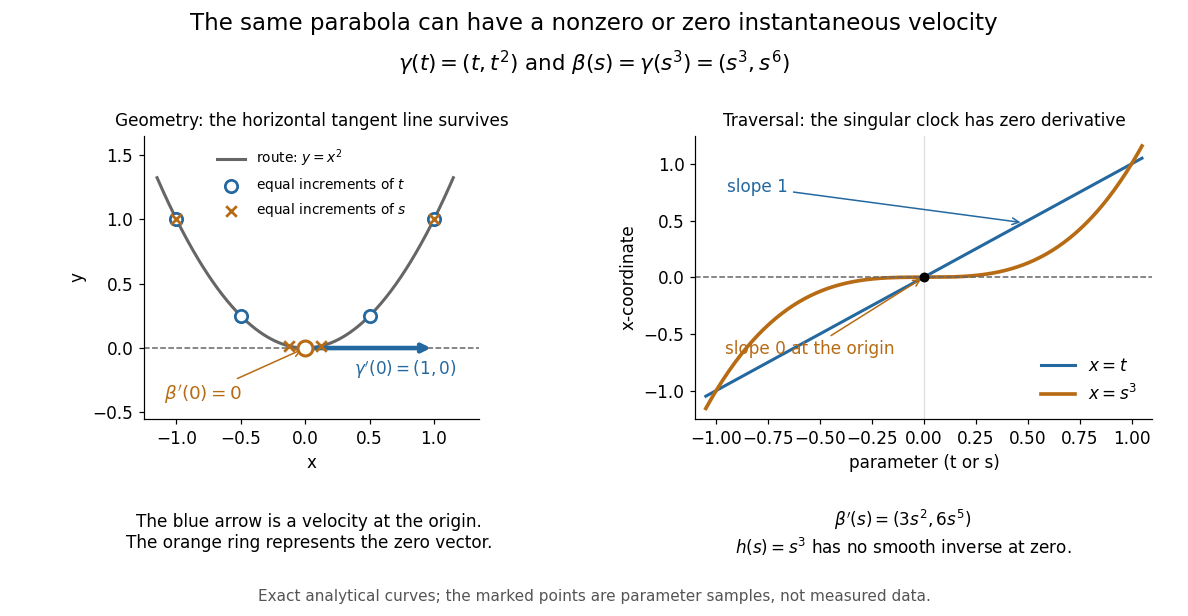

The diagram is an analytical illustration of these exact parametric curves, with equal parameter increments marked on each route. It separates geometry from traversal: the tangent line depends on the route, while a velocity vector also depends on how the curve parameter advances.
A Riemannian metric is a smoothly varying positive-definite inner product on each tangent space of a smooth manifold. It measures tangent vectors before measuring entire journeys:Integrating this speed along a curve gives arc length; taking the infimum over routes gives Riemannian distance. A smooth manifold together with this measuring rule is a Riemannian manifold.
In a coordinate chart , the rule is represented by a smooth positive-definite symmetric matrix :The notation describes the squared infinitesimal line element, rather than an ordinary distance between distinct points. Changing coordinates changes the matrix entries; it preserves the measured norm of the same tangent vector.
For the plane with , the vector has norm and has norm . The coordinate change turns this into : coefficients that look different can describe the same geometry. On a circular cylinder the induced metric similarly becomes Euclidean when unrolled. On a round sphere, polar coordinates give , away from the poles; the apparent degeneracy at a pole belongs to this coordinate choice, not to the Riemannian metric.
The point of the construction is that measurements make sense intrinsically, even without a chosen surrounding Euclidean space. It gives a common starting point for geodesics, curvature encoded by the Riemann curvature tensor, and the Laplace-Beltrami operator. [ref]
https://www.math.ucla.edu/~petersen/RG.pdf. Peter Petersen, Riemannian Geometry, §1.1: smoothly varying tangent-space inner products
.A smooth -manifold is a Hausdorff second-countable space locally homeomorphic to , equipped with smoothly compatible coordinate charts.
A smooth surface in is a two-dimensional smooth embedded submanifold. Locally it is parametrized by two coordinates with linearly independent tangent vectors.
A smooth surface is a two-dimensional smooth manifold whose underlying space is a topological surface. Its underlying topological space is a surface, but the smooth structure is extra data.
There are unlisted articles, also show them or only show them.