
A group records reversible operations that can be combined consistently. Group theory studies their subgroups, group homomorphisms, group actions, and quotient groups. A symmetry group makes the abstraction visible: transformations may change individual points while preserving a specified object or its structure. An orbit of a group action records which positions can be exchanged, while a stabilizer subgroup records which operations leave a selected feature fixed.
Every nonconstant complex polynomial has a complex root and therefore factors completely into linear factors over .
For every matrix over a principal ideal domain, there are invertible matrices such thatThe nonzero diagonal entries are unique up to multiplication by units. Over the integers, and are unimodular and the may be chosen positive; their products are the greatest common divisors of the -rowed minors.
Place objects into boxes, assigning each object to exactly one box. Here is a nonnegative integer and is a positive integer. The pigeonhole principle says that if , some box contains at least two objects. Equivalently, a function from an -element finite set to an -element finite set cannot be an injective function when . The boxes may stand for categories rather than physical containers. [ref]
https://ocw.mit.edu/courses/6-042j-mathematics-for-computer-science-spring-2015/mit6_042js15_textbook.pdf#page=581. Lehman, Leighton and Meyer, Mathematics for Computer Science, section 14.8, rule 14.8.1
For thirteen objects and twelve boxes, a box containing at least two is unavoidable. Thinking of thirteen people and their birth months gives the same conclusion: at least two share a birth month. Twelve people could occupy the twelve months one apiece, so thirteen is the smallest number that forces a shared month. The generalized pigeonhole principle quantifies how many objects must share a box when there are still more objects.
The useful surprise is that the pigeonhole principle proves existence without needing to locate the objects involved. Choosing a good assignment rule is often the creative step: equal labels can mean equal remainders, nearby points, or repeated states of an algorithm. Once the rule is chosen, a short count can force a relationship among a much larger collection of objects. The pigeonhole principle itself does not name the crowded box. When the objects and their assignments are explicitly available, a simple algorithm finds one: scan the objects, keep the first object seen in each box, and stop when a later object enters an occupied box. At most scanned objects are needed when .
A geometric example. Any five points in a square of side one contain two whose Euclidean distance is at most . Give each point Cartesian coordinates . Divide both ranges into the intervals and , making four cells. Thus belongs to the left half and to the right half; belongs to the lower half and to the upper half. This convention assigns every boundary point to exactly one cell.
The pigeonhole principle puts two of the five points in the same cell. Their differences in Cartesian coordinates have magnitude at most , so the Pythagorean theorem gives their Euclidean distance the boundFor the plotted points , , , and , the first two occupy the lower-left cell and have Euclidean distance . These Cartesian coordinates exhibit the forced pair; the argument applies to every placement of five points.
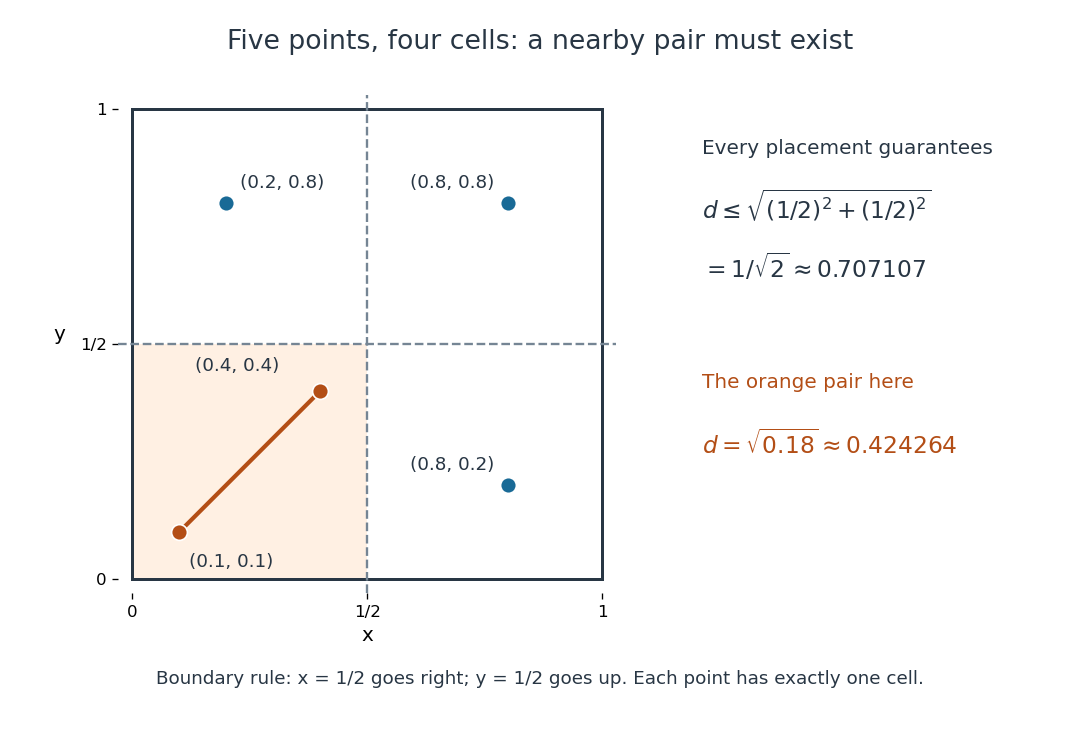
The pigeonhole principle places two of five points in one of four cells of a square, bounding their Euclidean distance by
. Details. 
An arithmetic example. Assign eight integers to their seven residue classes modulo the integer modulus . The pigeonhole principle gives two with the same residue class, so is an integer divisor of their difference. In , for example, and satisfy the integer congruence , and . Likewise, assigning fractional parts to short intervals gives the Dirichlet approximation theorem; its existing article explains the approximation bound.
A mathematical induction proof establishes a property for every integer by proving its induction base case and its inductive step. If a counterexample existed, the well-ordering principle would give a least one; its predecessor and the inductive implication exclude it. The starting case excludes a counterexample at .
The useful idea is to cover infinitely many cases with two finite pieces of reasoning. The induction base case starts the chain, and the inductive step shows that success at an arbitrary stage propagates to the next. It is especially natural when a construction adds one item at a time: another row of a diagram, another input processed by an algorithm, or another term of a sequence. The loop invariant method is the same propagation idea applied to successive stages of a computation.
For the triangular number , the proposed formula is . At , both sides are one. Assuming the formula for a fixed positive integer , add the next row:This is the desired formula at , proving the inductive step. For example, and ; these numerical cases illustrate the general step rather than replace it.
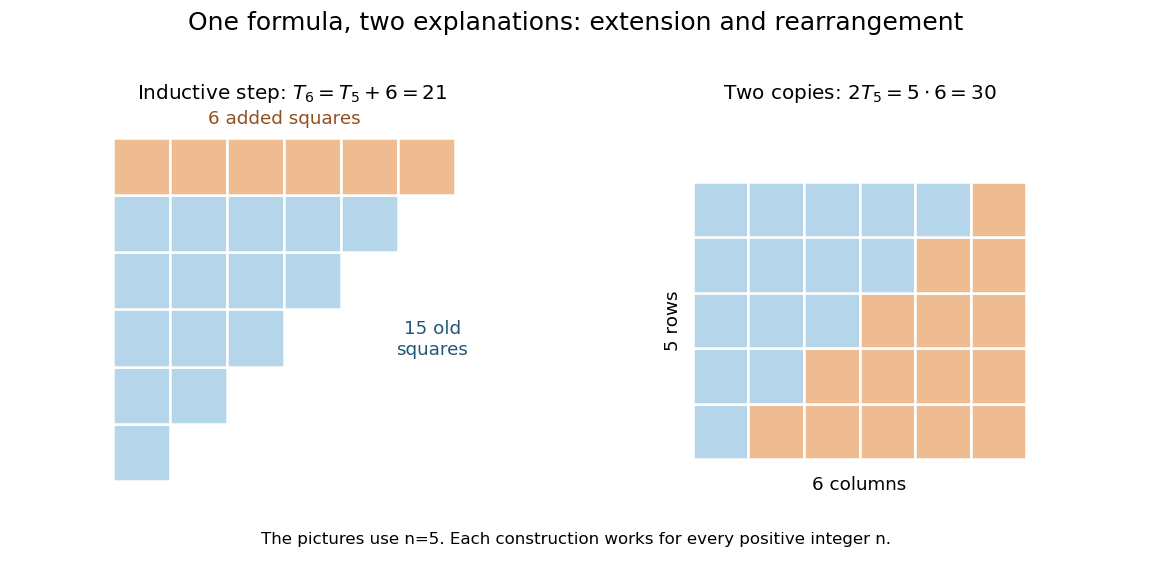
Adding the next row gives the induction step; rearranging two triangular arrays gives the same formula geometrically
. Details. 
The second picture explains where the formula comes from: two copies of the triangular arrangement tile an by rectangle. Thus . The mathematical induction argument certifies how the formula continues, while the rearrangement makes its factors visible. Neither picture is restricted to the five rows drawn: both constructions are specified for every positive integer .
Linearization replaces a nonlinear relation near a reference state by its first-order approximation.
A continuously differentiable vector field on an open subset of three-dimensional Euclidean space is irrotational when its curl is zero. Under the Euclidean identification , this says that the differential one-form is a closed differential form. The Poincaré lemma gives a potential of a conservative vector field locally. A global potential additionally requires zero line integrals around every closed curve; simply connected domains ensures this. On the punctured plane extended in the third direction, has zero curl but integral around a circle, so it is locally conservative and has no single-valued global potential.
There are unlisted articles, also show them or only show them.