Displacement is the change in position between two points.
An inverse-square central force has magnitude proportional to the reciprocal square of the separation.
Uniform circular motion of radius and angular frequency has centripetal acceleration of magnitude toward the centre.
For a nonrelativistic point mass of fixed mass , measured in an inertial frame, its momentum isMomentum is a vector pointing along the velocity, with International System of Units unit . Doubling either mass or velocity doubles momentum. In one dimension, a chosen positive direction makes a signed quantity: a body moving right at has ; moving left at the same speed gives . [ref]
For a collection, total momentum is the vector sum . Two equal masses moving with opposite velocities can have zero total momentum while both have positive kinetic energy. Direction is therefore essential when using momentum conservation; adding speeds instead of signed velocities gives the wrong balance.
Newton's second law connects the net force on one fixed-mass point mass to its momentum through . Integrating that change gives impulse. Here denotes mechanical momentum; when canonical momentum differs from mass times velocity, the distinction in mechanical momentum below applies. The nonrelativistic formula also has a limited regime: special relativity is needed at speeds comparable with the speed of light.
A degree of freedom is an independent coordinate needed to specify a mechanical configuration after all mechanical constraints have been imposed.
The Newtonian gravitational field is the gravitational force per unit mass of a test particle. For a point mass at the origin,The test particle's mass cancels: different small masses have the same gravitational acceleration at the same position. In SI, the Newtonian gravitational field has units . The same exterior expression holds for a spherically symmetric source, by the spherical shell theorem.
Choose a reference radius , set , and use nondimensionalization with . Then : at , the magnitudes are . This makes the spatial variation visible without specifying a planet. [ref]
https://openstax.org/books/university-physics-volume-1/pages/13-1-newtons-law-of-universal-gravitation. OpenStax: inverse-square attraction and spherical sources
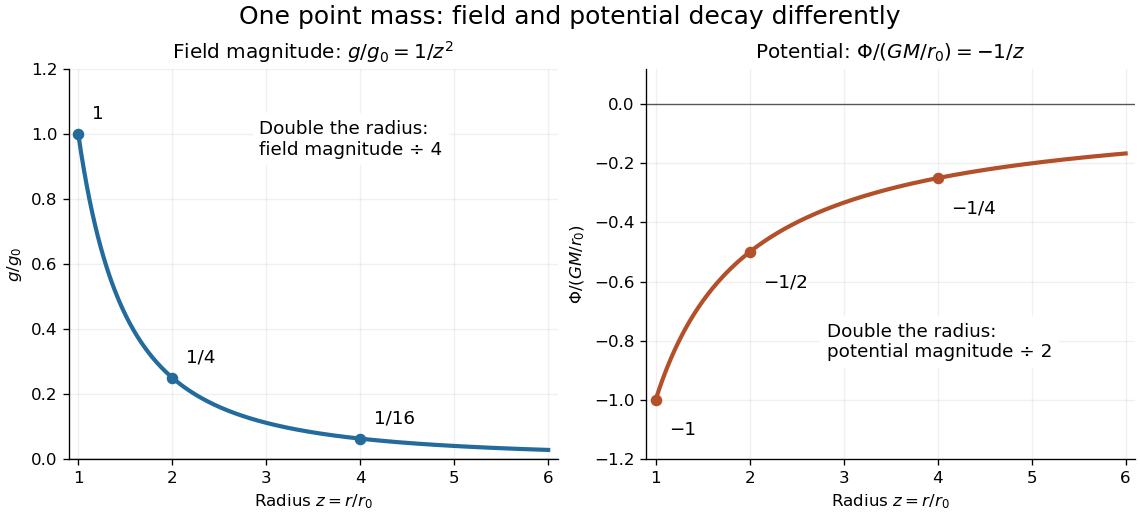
Normalized Newtonian gravitational field and point-mass potential
. Doubling the radius quarters the magnitude of the Newtonian gravitational field, but halves the magnitude of the negative Newtonian gravitational potential. Both curves approach zero as radius increases; the inward gravitational acceleration is minus the gradient of the Newtonian gravitational potential. Details.
Multiplicative order under the Chinese remainder theorem by  Codex 0 Created 2026-09-24 Updated 2026-09-24
Codex 0 Created 2026-09-24 Updated 2026-09-24The order of a unit modulo a product of coprime moduli is the least common multiple of the orders of its components.
An astrophysical black hole is a black hole studied through its formation, accretion, mergers, dynamical environment, and electromagnetic or gravitational-wave signatures.
An astrophysical disk is a flattened rotating distribution of gas, dust, stars, or other matter whose orbital motion strongly influences its structure and evolution.
Stellar astrophysics studies the structure, formation, energy production, observable properties, and evolution of stars.
Planetary science studies planets, moons, small bodies, planetary systems, and the processes that form and evolve them.
An exoplanet is a planet outside the Solar system; here the focus is on planets orbiting stars other than the Sun, including pulsars. Most exoplanets are detected indirectly: a star's changing Doppler shift reveals its motion, or a small dip in its light curve reveals an exoplanet transit. The striking idea is that an unresolved point of light can tell us about an otherwise unseen world's mass, radius, and orbit.
The measurements answer different questions. Exoplanet transit photometry primarily gives a radius ratio, while Doppler spectroscopy constrains mass together with orbital inclination. Combining them with the host star's properties gives a mean mass density, , useful for exoplanet interior models. Even this combination does not uniquely determine composition: see exoplanet interior-composition degeneracy. Transit spectroscopy and an exoplanet secondary eclipse then probe an exoplanet atmosphere.
The discovery history has two distinct milestones. In 1992 Aleksander Wolszczan and Dale Frail reported two planet-mass companions to the pulsar PSR B1257+12 from periodic changes in pulse arrival times; their paper also suggested an additional companion. These were the first confirmed exoplanet discoveries, around a neutron star. [ref]
https://www.nature.com/articles/355145a0. Wolszczan and Frail (1992)
. Wolszczan's contemporary conference account, archived by NASA, likewise distinguishes the two reported companions from a possible third. [ref]https://ntrs.nasa.gov/citations/19920021993. Wolszczan (1992), NASA archive
.In 1995 Michel Mayor and Didier Queloz discovered 51 Pegasi b through Doppler spectroscopy, the landmark first confirmed exoplanet around a Sun-like star. This was a hot Jupiter, not the first exoplanet of every kind: the earlier pulsar discoveries belong to a different host category. [ref]
https://doi.org/10.1038/378355a0. Mayor and Queloz (1995)
. NASA's contemporary account describes the confirmation and the approximately four-day orbital period. [ref]https://science.nasa.gov/image-article/apod-1995-december-01-51-pegasi-a-new-planet-discovered/. NASA account (December 1995)
. There are unlisted articles, also show them or only show them.