Non-Archimedean analysis studies fields whose distance is induced by an ultrametric absolute value, especially local fields and valued function fields.
An arithmetic progression is a sequence with constant successive difference . It is nonconstant when .
Multiplication combines two factors into their product of numbers. For a natural number , is the sum of copies of ; with no copies the result is zero. This repeated-addition interpretation directly explains integer grouping, while multiplication of arbitrary real numbers also describes scaling by noninteger factors.
A rectangle of side lengths and has area . Split the second side into lengths and . The two areas are and , giving the visible identityRotating the same rectangle interchanges the sides without changing its area, explaining . These pictures illustrate distributivity and commutativity for ordinary positive numbers; matrix multiplication and other operations require their own rules.
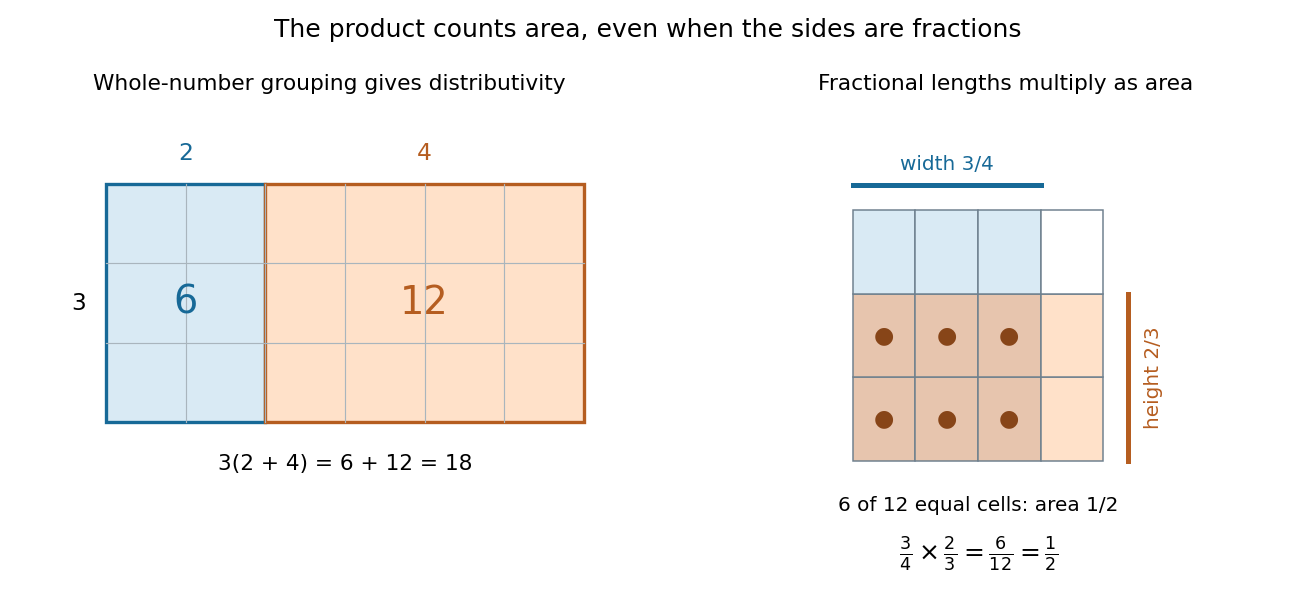
Partitioning a rectangle explains distributivity; partitioning a unit square gives an exact product of fractions
. Details. 
For a fractional example, take of a quantity and then of that result: the combined scale is . The two fractions are multiplicative inverses. In the unit square on the right, the overlap of a strip occupying of the width with one occupying of the height contains six of twelve equal cells. Its area is . The product stays exact even though the decimal expansion of repeats. [ref]
https://openstax.org/books/prealgebra-2e/pages/4-1-visualize-fractions. OpenStax, Prealgebra 2e, equal-part models of fractions
Subtraction adds the additive inverse: . On the number line, is a shift three units left from . Reversing the two inputs changes the sign: , so subtraction is generally not commutative. Solving gives the same answer by adding to both sides; the operation preserves equality while undoing the added amount.
Addition combines two numbers into their sum. For natural numbers, joining disjoint collections of sizes gives a collection of size . On a number line, adding shifts a starting position by : rightward when and leftward when .
Starting at and adding reaches . Starting there and adding returns to , because . Additive inverses turn this return move into an algebraic rule. With real numbers, addition is commutative and associative: exchanging two shifts or grouping several shifts differently leaves the final position unchanged.
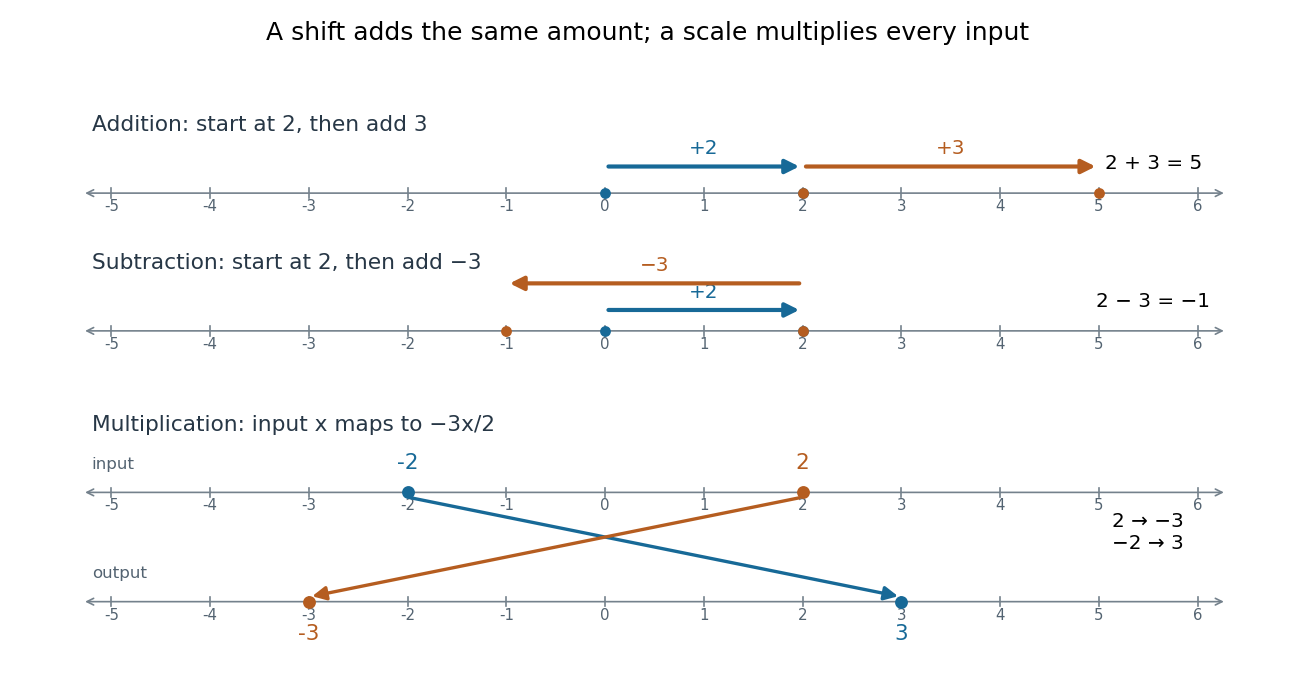
Addition shifts positions on a number line, while a negative multiplication factor changes both scale and direction
. Details. 
The bottom panel applies . Input becomes , and input becomes . Multiplication by a negative real number rescales distances from zero and reverses direction, giving a reflection in mathematics as well as a scale change. This is a different operation from shifting every input by one fixed amount.
Uniform approximation minimizes the supremum norm of the difference between a target function and an approximant.
The error is measured uniformly over the domain using the supremum norm. A sequence of approximants whose uniform error tends to zero converges by uniform convergence; the optimization problem and the convergence notion are distinct.
Calculus of variations finds stationary points of functionals, often among functions or regular curves.
Distribution theory extends functions to continuous linear functionals on test functions, allowing generalized derivatives and point sources.
A partial differential equation relates an unknown function of several independent variables to its partial derivatives. For , the notation means changing time while holding position fixed; measures how its spatial slope changes. Unlike an ordinary differential equation, a partial differential equation can describe an entire evolving profile rather than a single trajectory.
The heat equation smooths spatial variations, the transport equation moves them, and Laplace's equation describes a spatial equilibrium. Here is a diffusivity, is a velocity, and is the Laplacian. The periodic heat and transport comparison makes the difference visible using identical initial conditions.
A partial differential equation usually supplies a local rule rather than a complete answer. For example, every satisfies the heat equation with zero PDE source term; data select which profile is relevant. A complete problem specifies its domain of a function, coefficients, initial conditions, boundary conditions, and meaning of solution of a partial differential equation. A well-posed problem has existence, uniqueness, and continuous dependence on initial data in stated spaces; the equation alone guarantees none of these.[ref]
Real analysis studies limits, continuity, differentiation, integration, and convergence of sequences and functions taking values in the real numbers. Its central question is how finite approximations determine an exact answer: what does an arbitrarily small error mean, and which operations respect that error? A derivative is a limit of quotients, while a Riemann integral is obtained from increasingly fine Riemann sums. Both need conditions that make the answer independent of the approximations chosen.
Two organizing ideas are completeness of the real numbers, which ensures that suitable approximations have a destination, and uniform convergence, which controls approximation error over an entire domain. Pointwise convergence supplies separate guarantees at separate inputs; uniform convergence supplies one guarantee for all inputs. This distinction explains why replacing an approximating function by its limit can preserve continuity or integrals under appropriate hypotheses, yet fail without them.
For historical context, Cauchy's 1821 Cours d'analyse explicitly discusses convergence of series. Its Note VII treats double series and compares summing by rows and by columns under stated convergence assumptions: controlling an infinite process was already a concrete problem. This is historical context for questions about limits, rather than an attribution of the modern definitions below. [ref]
https://www.e-rara.ch/download/pdf/8543076.pdf. Cauchy, Cours d'analyse (1821), Note VII, pp. 537–539, original scan
. Uniqueness theorem for ordinary differential equations by  Codex 0 Created 2026-09-24 Updated 2026-09-24
Codex 0 Created 2026-09-24 Updated 2026-09-24 There are unlisted articles, also show them or only show them.