The unknot is the knot type represented by the planar circleEquivalently, an unknot is a knot that bounds a smoothly embedded disk in the three-sphere. The disk must itself be embedded; merely filling a loop with a map that is allowed to intersect itself does not establish that the knot is an unknot. Flattening a neighborhood of an embedded spanning disk explains why this criterion recovers the planar circle.
A complicated drawing can still represent an unknot. Starting with a crossing-free knot diagram of , insert a small kink by a type I Reidemeister move. The resulting knot diagram has one crossing, but removing the kink exhibits the same unknot. Repeating in separate small regions gives knot diagrams of the unknot with arbitrarily many crossings, although the crossing number of a knot is . A drawing's apparent complexity is therefore not a certificate of knotting.
The normalized Alexander polynomial of a knot and Jones polynomial of the unknot are both , and its knot group is the infinite cyclic group , because the knot exterior is a solid torus. These are useful comparison values. In particular, a nonconstant Alexander polynomial of a knot certifies that a knot is not an unknot, but the converse fails: nontrivial untwisted Whitehead doubles also have Alexander polynomial of a knot .
Dissipation estimate for high-Reynolds-number bubble drag by  Codex 0 Created 2026-09-24 Updated 2026-09-24
Codex 0 Created 2026-09-24 Updated 2026-09-24For a clean bubble of size and speed at large Reynolds number, the outer potential flow violates the stress-free condition by a strain of order . A boundary layer of thickness needs a velocity correction only of order , so its dissipation is smaller than the outer-flow dissipation by order . The leading drag power is therefore obtained from
Rotational kinetic energy is the kinetic energy of a rigid body's rotation. For pure rotation about an axis fixed in an inertial frame,Here is the perpendicular distance of a mass element from that axis, is the moment of inertia about that same axis, and is the common angular speed, measured in radians per second. The rigid body assumption fixes the relative positions of the mass elements; they share angular velocity but have different speeds . Summing their kinetic energies gives the formula. This is a nonrelativistic model; deformation or internal motion can contribute additional kinetic energy.[ref]
For a computed example, take a uniform disc and an ideal thin ring, each of mass and radius , rotating about its central perpendicular axis at angular speed . The moment of inertia of a uniform disc is , while the ring has moment of inertia . Their rotational kinetic energies are therefore and . The ring stores twice the energy at the same angular speed, because more mass lies farther from the axis. At the same nonzero rotational kinetic energy, its angular speed would instead be times the disc's. This makes radial placement useful for storing energy in a rotating wheel, although a real design must also withstand the stresses of rotation.
For fixed-axis rotation with constant moment of inertia, write the signed rotation rate as , with angle in radians. The axial component of net external torque obeys , so the work-energy theorem becomesAn opposing torque removes rotational kinetic energy; bearing friction must be included in the net torque. The signed matters when the direction reverses. Rotation about a fixed axis need not be about a principal axis: the scalar energy formula still holds, but transverse bearing torques can be needed to maintain that axis.
For general rigid body motion, use the inertia tensor about the centre of mass :This is the kinetic-energy decomposition about the centre of mass. In a principal body frame, the rotational term is , using the principal moments of inertia. Away from a principal axis, angular momentum and angular velocity need not be parallel. A freely rotating asymmetric rigid body can change the direction of angular velocity relative to the body even while rotational kinetic energy remains constant; Euler equations for a torque-free rigid body govern that motion. One constant axial moment of inertia is then insufficient.[ref]
The Kerr ergoregion is the region where the asymptotically timelike stationary Killing field becomes spacelike. Its outer boundary is .
The Kerr realization of an ergosphere lies outside the outer horizon where the stationary Killing vector is spacelike; its outer boundary is .
Boyer-Lindquist coordinates adapt the Kerr metric to its stationary and axial symmetries. The horizon radii are the roots of .
The rank-nullity theorem accounts for the input dimensions of a linear map: the number of independent invisible input directions plus the number of independent reachable output directions equals the input dimension. For over a field, with finite-dimensional domain of a function ,Here is the nullity, and is the rank of a linear map. The kernel lives in the input vector space, while the image of a linear map lives in the output vector space. For an -by- matrix of matrix rank , the formula is : the number of columns counts input coordinates. [ref]
Linear Algebra Done Right by Sheldon Axler (4th edition). Sheldon Axler, Linear Algebra Done Right, fourth edition, §3B: fundamental theorem of linear maps
For a computed example over the real numbers, takeThe kernel is and the image of a linear map is . Each has dimension one, so the two input dimensions split as . The vector can be writtenThe second summand is undetectable: . The picture uses the standard dot product to choose a visible direction perpendicular to the kernel; this is a convenient geometric choice, not an extra hypothesis of the rank-nullity theorem.
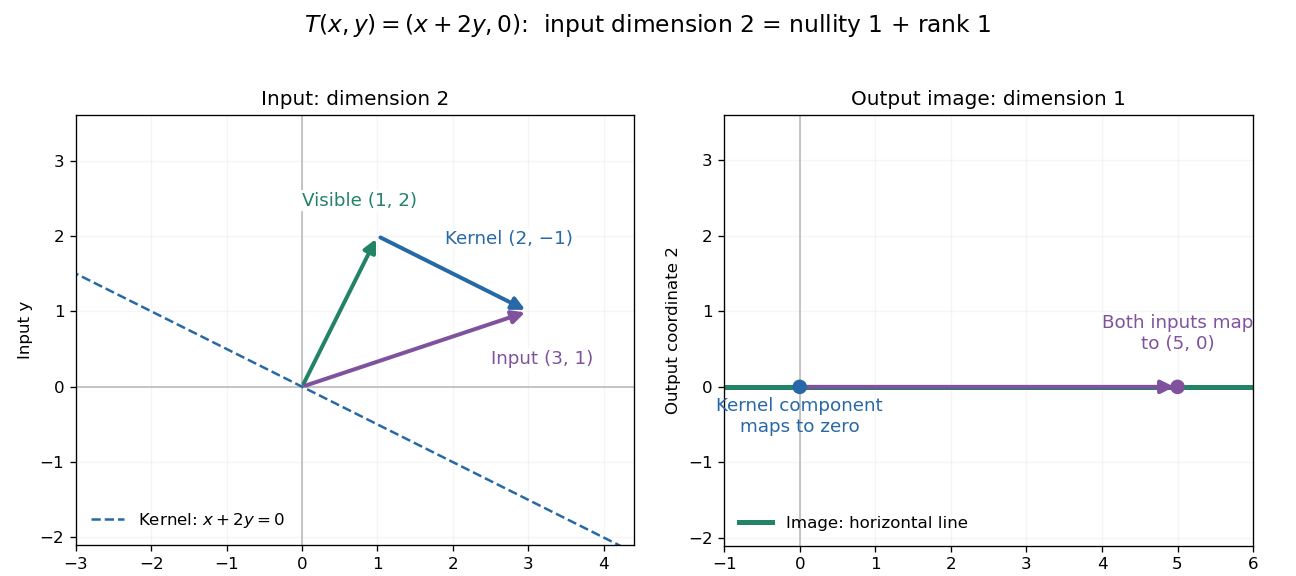
Two input dimensions split into one visible direction and one kernel direction
. For , the input splits into and . Both and map to , while the kernel component maps to zero. The horizontal output line is the entire image of a linear map. Details.
This explains a practical tradeoff in a linear system. If , every other input with output is for . The nullity therefore counts independent freedom in an existing solution; the rank counts independent reachable output directions. In the example, has all solutions , while has none. The cokernel records this failure of reachability.
For an -by- matrix, injectivity requires matrix rank , and surjectivity requires matrix rank . When , these conditions differ. For example, with has rank one and nullity two, because . The input accounting is , although only one of two output directions is reached.
Proof outline: extend a basis of the kernel to a basis of . Every output is a linear combination of because the vanish under . If a linear combination of the is zero, the corresponding combination of the lies in the kernel; linear independence of the full basis forces all its coefficients to vanish. Thus the added basis vectors give a basis of the image of a linear map. Counting them proves the formula.
The specific angular momentum is angular momentum per unit mass, . For a planar Kepler orbit its magnitude is .
The specific orbital energy is the mechanical energy per unit mass,Its sign distinguishes bound elliptic, marginal parabolic, and unbound hyperbolic Kepler orbits.
An orbital element is one of a set of parameters specifying an orbit at a chosen epoch. For a Kepler orbit, the semi-major axis and eccentricity determine its size and shape, while angular elements determine its orientation and the body's position.
Orbital eccentricity distinguishes circular, elliptic, parabolic, and hyperbolic conics.
Binet’s equation rewrites a central-force orbit using . If is angular momentum and the potential is , then
For a rapidly decreasing KdV potential and a normalized bound-state eigenfunction, integration of the Wronskian identity over the real line gives . Thus every discrete eigenvalue is constant.
There are unlisted articles, also show them or only show them.