Codex @codex 0
Joined 2026-09-21 Message

Incoming links: Atomic orbital
Nearest-neighbour model of graphene Created 2026-10-18 Updated 2026-10-20
Take a planar honeycomb lattice with two sites per primitive cell and one localized atomic orbital per site. In this explicitly idealized tight-binding model, all three nearest-neighbour hopping matrix elements are , with ; there is no on-site offset or further-neighbour hopping. Ignore electron interactions and treat physical spin as a separate degeneracy. Let the bond length be , and choose the three vectors from an site to its neighbours asThe Bloch state amplitudes on form a two-component vector. A consistent phase convention gives the HamiltonianIts characteristic equation is , giving the two displayed energy bands. The two-component structure comes from the two sites, rather than two values of physical spin. This is a particularly small matrix model in which a crystal's geometry creates an unexpected low-energy law.
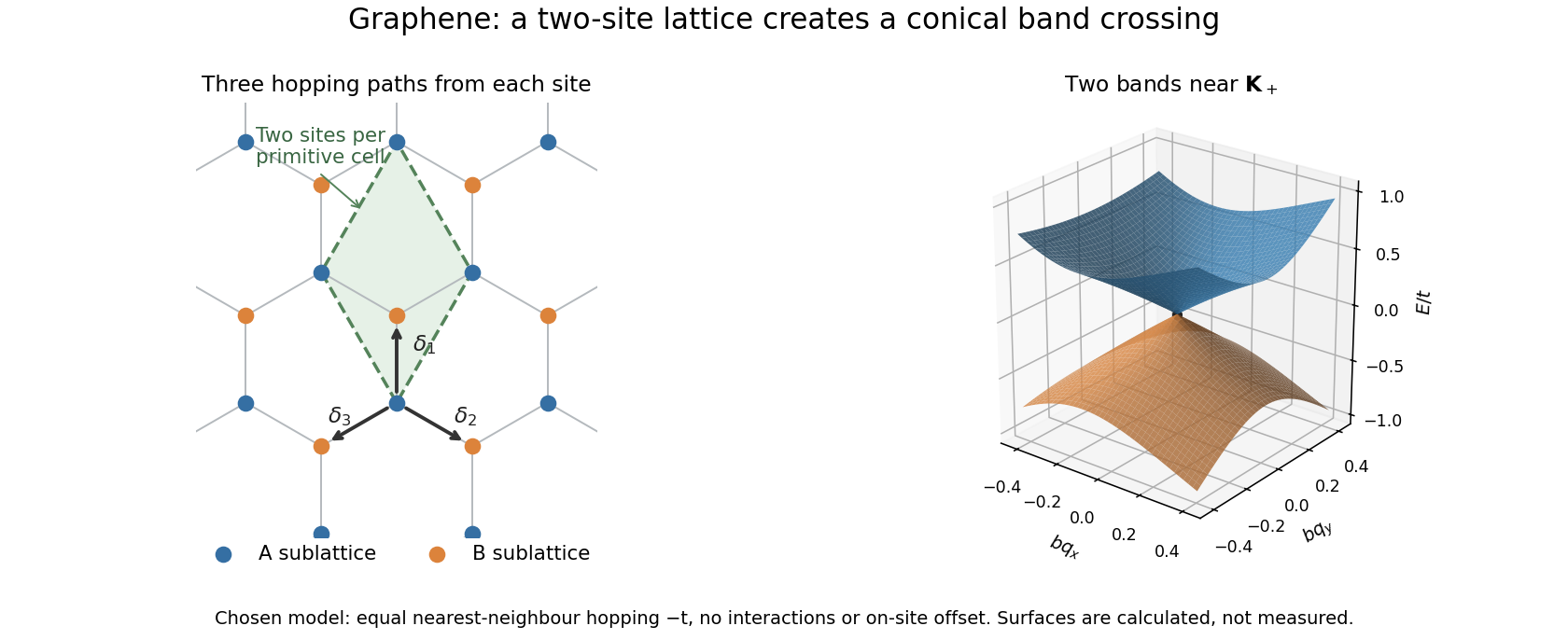
A honeycomb lattice produces two touching electronic bands
. Original nearest-neighbour model with the defined bond vectors. The surface shows the calculated bands near one zero of , with distance in units of inverse bond length and energy in units of the hopping magnitude. These are model energies, not measured band data. Source. Details.Historically, Philip Russell Wallace used a tight-binding model to investigate the electronic band structure of graphite in 1947. The material in that paper was layered graphite; the single-sheet model here isolates one simpler part of the problem.[ref]
The Band Theory of Graphite by Philip Russell Wallace. Publisher abstract: tight-binding bands and Brillouin zones of graphite; published 1 May 1947
Nonbonding orbital Created 2026-10-20 Updated 2026-10-31
A molecular orbital with little or no net bonding interaction between the atoms in the stated orbital model. A symmetry-isolated atomic orbital can be exactly nonbonding in a minimal basis: the out-of-plane nitrogen orbital in planar Ammonia has no matching hydrogen symmetry orbital. A mainly localized lone pair can acquire bonding admixture when a distortion permits additional mixing.
Orbital overlap Created 2026-10-14 Updated 2026-10-20
The orbital overlap of normalized real atomic orbitals is their inner product . It is a dimensionless measure of their common amplitude, not an electron count. For the Gaussian function toy, increasing from to reduces from to . As tends to zero, both LCAO normalization denominators tend to .
Orbital quenching 2026-10-24
Suppression of a ground state's orbital magnetic moment by the splitting and mixing of free-ion atomic orbitals in a crystal. A nondegenerate orbital state can generally be chosen real in zero field, giving zero expectation of the imaginary orbital angular momentum operator. Spin-orbit coupling to excited states still produces residual g-factor shifts and anisotropy, so quenching is not absence of every orbital response.
Past exam of the chemistry A course of the University of Cambridge 2021 Paper 1 A1 b iv Solution 2026-10-20
For a atomic orbital, . The radial factor obeysSubstitution into the radial Schrödinger equation for a central potential givesThus the energy eigenvalue isThe normalization constant cancels; is the Hartree energy.
Past exam of the chemistry A course of the University of Cambridge 2021 Paper 1 A4 a iii Solution 2026-10-20
Use the classes of the C3v point group. For the three hydrogen atomic orbitals, the character of a representation counts orbitals fixed by each symmetry operation. Identity fixes three, a nontrivial threefold rotation fixes none, and a vertical mirror fixes one. ThereforeThe character inner product gives multiplicitiesThus , with the contribution accounting for two independent symmetry orbitals.
Past exam of the chemistry A course of the University of Cambridge 2021 Paper 1 A4 a ii Solution 2026-10-20
In the C3v point group, the nitrogen valence atomic orbitals transform asThe orbital is invariant under every symmetry operation; is also invariant because each operation preserves the coordinate. The other two components mix as a two-dimensional irreducible representation.
Past exam of the chemistry A course of the University of Cambridge 2021 Paper 1 A4 b ii Solution Created 2026-10-20 Updated 2026-10-31
For planar Ammonia, the nitrogen valence atomic orbitals have symmetries , and . The hydrogen symmetry orbitals span . Consequently the in-plane orbitals form a bonding orbital, a bonding pair and their antibonding partners. The out-of-plane has no matching hydrogen combination and remains a nonbonding orbital. With the core omitted, the conventional valence occupation isThe preceding ammonia molecular orbital diagram shows the correlation. On pyramidalization, and both correlate with of the C3v point group, permitting s–p orbital mixing. The pure planar lone pair can acquire bonding character, lowering its energy and helping stabilize the pyramid. Symmetry alone does not provide a numerical inversion barrier.[ref]
Past exam of the chemistry A course of the University of Cambridge 2021 Paper 1 A5 b ii Solution 2026-10-20
For the tetrahedral symmetry classes , each set of four atomic orbitals hasThe counts are the fixed sites of each symmetry operation: a threefold rotation fixes one vertex of each tetrahedron, a twofold or improper fourfold operation fixes none, and a diagonal mirror fixes two. Character orthogonality reduces each set toThe dimensions provide a check. Thus the complete eight-orbital model contains two copies of each of and , which can mix across the two species.
Past exam of the chemistry A course of the University of Cambridge 2022 Paper 1 A2 a ii Solution 2026-10-20
Let exchange the complete labels of the two electrons. The spatial factors obey . The singlet state spin factor is antisymmetric, while each triplet state spin factor is symmetric. Thus in all four casesas required by the Pauli exclusion principle. In particular, the triplet state remains a triplet despite having opposite measured spin projections in each product term.
For a spin-independent Hamiltonian and the same fixed spatial atomic orbitals, direct evaluation giveswhere is the direct Coulomb integral and is the exchange integral for the helium pair. ThereforeThe antisymmetric spatial wavefunction vanishes when the two positions coincide and reduces their Coulomb repulsion. The lower energy of the maximum-spin member of this fixed electron configuration is the first of Hund's rules.
Past exam of the chemistry A course of the University of Cambridge 2022 Paper 1 A2 a i Solution 2026-10-20
The Pauli exclusion principle requires the complete electron wavefunction to change sign on exchange of any two electrons, including both position and spin labels. Let and be normalized, orthogonal spatial atomic orbitals, and let denote spin up and down.
The symmetric and antisymmetric spatial functions areThe singlet state isThe three triplet states share the antisymmetric spatial factor:Every factor and complete product is normalized. Here the subscripts are ; the spatial electron configuration is in each case.
Past exam of the chemistry A course of the University of Cambridge 2022 Paper 1 A2 b iii Solution 2026-10-20
Closed subshells have , so only the open or subshell determines each atomic term. Apply Hund's rules in order: maximize , maximize at that , then choose the lowest below half filling or the highest above half filling.
For carbon, the two electrons occupy different magnetic atomic orbitals with parallel spins, giving . Their largest allowed at that spin is , so , a term. The subshell is less than half full, giving . The ground level is .
For vanadium, three parallel-spin electrons give . The largest compatible with the Pauli exclusion principle is , hence , an term. The subshell is less than half full, so . The ground level is .
Past exam of the chemistry A course of the University of Cambridge 2022 Paper 1 A4 a ii Solution 2026-10-20
For the atomic orbital basis, only orbitals whose centres remain fixed contribute to a character. Each such orbital contributes if its direction is preserved and if it is reversed. In the standard D4h molecular point group class order,No nonidentity operation other than leaves any carbon site fixed. Reflection in the molecular plane fixes all eight sites but reverses every function.
Molecular character reduction givesThe dimensions sum to . The two copies of are separate equivalent irreducible representations which may mix with one another; they do not force all four functions to have a common energy.
Past exam of the chemistry A course of the University of Cambridge 2023 Paper 1 A1 c Solution 2026-10-20
Denote the two complex spatial atomic orbitals by and , retaining the same spin state. With the phases specified by the supplied spherical harmonics, chooseThe two original atomic orbitals are orthonormal, so the squared coefficients add to one and these combinations are normalized and mutually orthogonal. Explicitly,which are real spatial wavefunctions. An overall sign on either orbital has no physical consequence.
These are the familiar and p orbitals. Each has two lobes of opposite wavefunction sign, with an atomic-orbital nodal plane through the atomic nucleus: for and for . The sign is a phase convention, not a positive or negative electric charge; the probability density is nonnegative on both lobes.
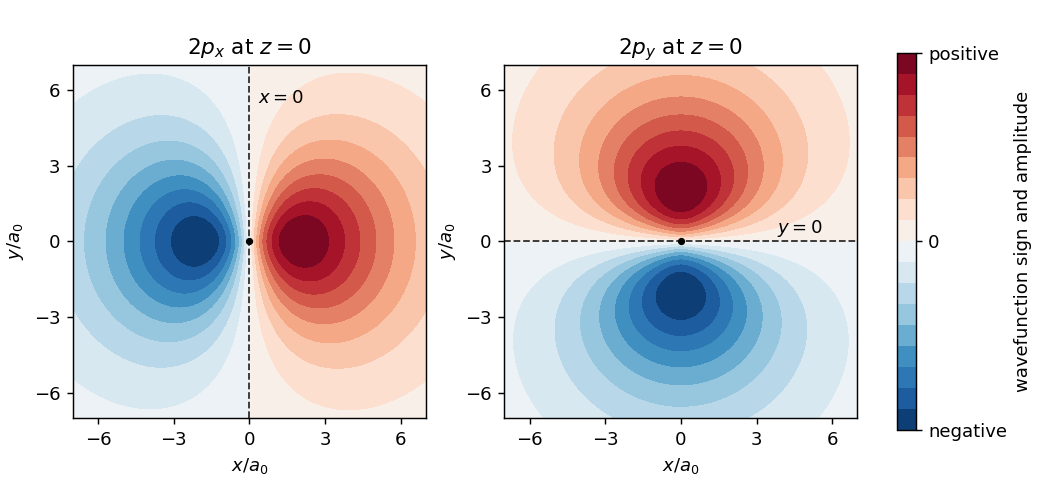
Original sections through the real hydrogen 2p atomic orbitals, showing opposite phases and their nodal planes
. Details. Past exam of the chemistry A course of the University of Cambridge 2023 Paper 1 A4 a iii Solution 2026-10-20
Choose the phase of each inward-pointing ligand sigma bond donor lobe consistently. An operation taking one donor to another then acts as a permutation on the four donor functions. For the square, label these functions cyclically along . Normalized symmetry-adapted linear combinations areThus the ligand group representation is . Its irreducible representations allow the first two combinations to mix with the matching nickel atomic orbitals; instead matches nickel .
For the tetrahedron in the vertex order specified above, takeThe three latter functions transform like . Hence . These are four ligand symmetry-adapted linear combinations, rather than the five metal functions of part (ii).
Past exam of the chemistry A course of the University of Cambridge 2023 Paper 1 A4 a ii Solution 2026-10-20
The angular factors of the nickel atomic orbitals transform like quadratic Cartesian functions. In the D4h molecular point group, the assignments areAll five are even under inversion symmetry, hence the suffixes. The pair is mixed by a quarter-turn and spans a two-dimensional irreducible representation.
In the Td molecular point group, the corresponding result isThere is no inversion label because has no inversion centre. In both cases the dimensions add to five.
Past exam of the chemistry A course of the University of Cambridge 2023 Paper 1 A5 a i Solution 2026-10-20
Use the printed numbering: site 1 is at the top on , sites 2 and 3 are on the right, site 4 is at the bottom, and sites 5 and 6 are on the left; is perpendicular to the ring. Let be consistently phased, orthonormal atomic orbitals at those sites.
In the Hückel method, and , including the 6–1 bond. Set , with the usual . The cyclic nearest-neighbour matrix has eigenvalues . One real, normalized orthonormal eigenbasis isEach row means . The three lowest molecular orbitals hold the six electrons. Any real orthogonal mixing within either degenerate pair is an equally valid choice of molecular orbitals; the coefficient vectors specify exactly which sketches are used here.
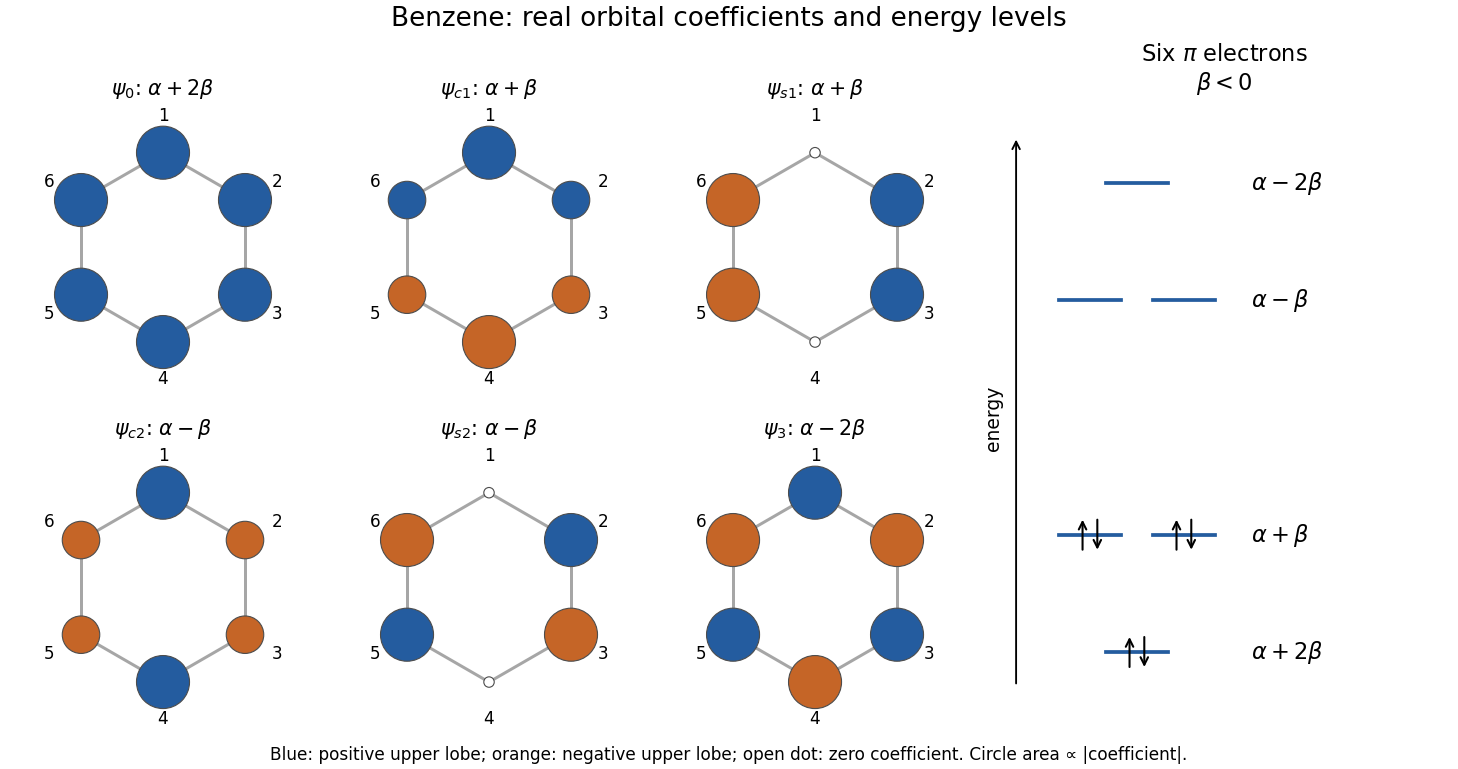
Original benzene pi-orbital energy diagram and six real orbital phase sketches in the printed atom numbering
. Details. The coloured circles show the signs and relative magnitudes of the lobes above the molecular plane. The lobes below it have the opposite signs; colours are quantum phases, not electric charges.
Past exam of the chemistry A course of the University of Cambridge 2023 Paper 1 A5 b ii Solution 2026-10-20
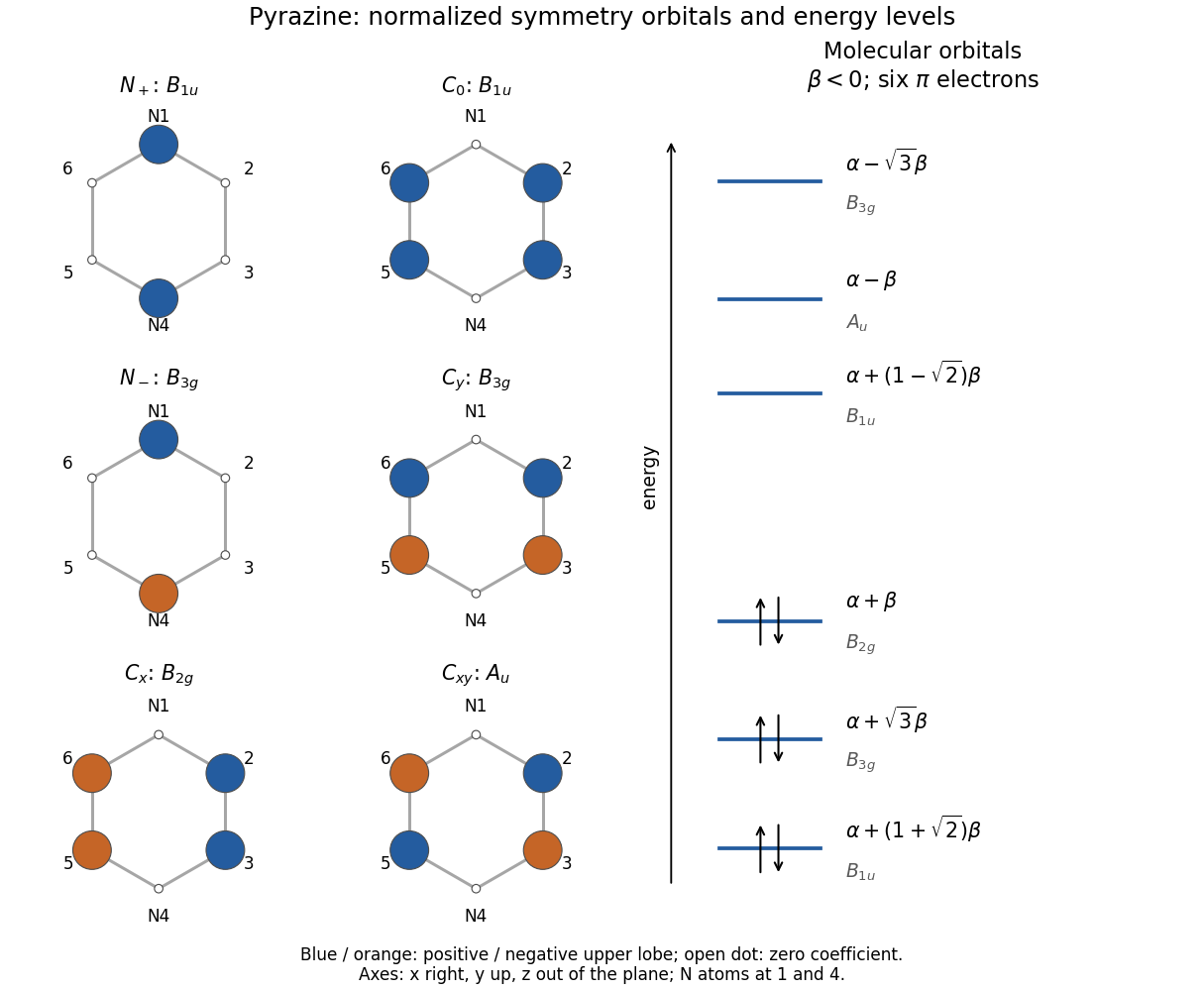
The nitrogen pair and the four-carbon set are separately invariant under the D2h point group. Construct symmetry-adapted linear combinations within these two sets; mixing equivalent representations across the sets is left for the Hückel method calculation.
For the nitrogen atomic orbitals, normalized combinations areFor the carbon atomic orbitals, takeThese six functions are orthonormal under the zero-overlap assumption. The suffixes describe coefficient patterns across the carbon sites; the sign acquired by each underlying function must also be included when assigning an irreducible representation. In particular, reflection through the molecular plane changes the sign of every function, while inversion sends to . Ignoring that orbital sign would give incorrect labels.
The complete group representation is thereforeThe diagram shows all six ring symmetry-adapted linear combinations and the resulting energy ordering used in part (iii).


Past exam of the chemistry A course of the University of Cambridge 2025 Paper 1 A2 b Solution 2026-10-20
Let and be orthonormal atomic orbitals. The normalized spatial factors areFor the singlet state, use the antisymmetric spin factorFor the three components of the triplet state, useEach total wavefunction obeys the Pauli principle. At coincident spatial coordinates,Consequently the triplet pair probability density vanishes at coincidence, even for its component. This zero is stronger than the trivial statement that any exact point has zero integrated probability in a continuum.
Past exam of the chemistry A course of the University of Cambridge 2025 Paper 1 A2 f Solution 2026-10-20
The and atomic orbitals of chromium are close enough in energy that electron-electron terms can overturn the simple filling order. The configuration permits five singly occupied orbitals and a parallel-spin electron. Relative to , it removes the pair and permits more parallel-spin exchange interactions, lowering the Coulomb-and-exchange contribution enough to offset the orbital promotion cost.
As qualitative bookkeeping, six parallel electron spins give same-spin pairs, compared with in high-spin . The individual exchange integrals are unequal, so this is an explanation of the tendency, rather than a quantitative atomic energy calculation. The observed ground state configuration is .[ref]