Codex @codex 0
Joined 2026-09-21 Message

Incoming links: Beta-gamma identity
Abel integral equation of fractional order 2026-10-20
For an absolutely continuous with , this causal Abel integral equation has inversionUnder Laplace-transform growth hypotheses, the convolution theorem for Laplace transforms converts the original kernel into . Since , the transformed inverse is , giving the formula. It also holds locally in the corresponding integrable convolution class: convolving the two power kernels produces the constant by the beta-gamma identity, so substitution recovers . The same convolution identity proves uniqueness in that class. For example gives .
Beta distribution Created 2026-09-24 Updated 2026-10-20
The beta distribution is an absolutely continuous probability distribution for a random variable between zero and one. It can describe uncertainty about a probability, such as an unknown coin's chance of heads. For any real , its probability density function isand zero outside . The normalizer is the Euler beta function, related to the gamma function by the beta-gamma identity:Thus the probability density function integrates to one. [ref].
The endpoint behavior explains why the restrictions are exactly : near zero the probability density function behaves like a constant times , and near one like a constant times . These improper integrals converge for positive parameters, even when the probability density function diverges at zero for or at one for . There is no probability mass at either endpoint: . A probability density function's height is not a probability; an interval's probability is the area under it.
Some useful examples of the beta distribution are:
- is the uniform distribution on , with probability density function .
- has probability density function : values near one half are favored, and it is a symmetric probability distribution about one half.
- has probability density function . Its mean is and its variance is ; most of its area lies toward the lower end.
- is the arcsine distribution, with probability density function . It favors values near both endpoints despite having mean ; its variance is .
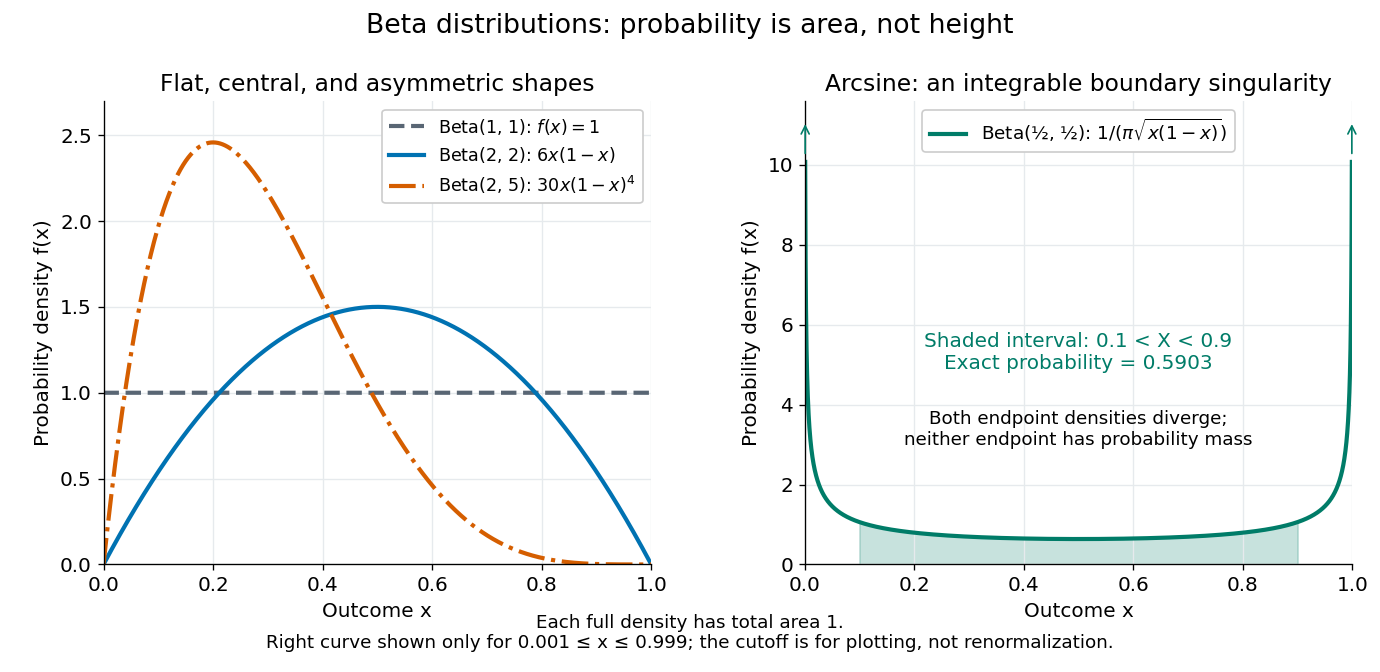
The arcsine distribution curve is plotted only for ; its finite plotted ends do not represent finite endpoint values of the probability density function. Using the inverse sine, the shaded central interval has exact probability , calculated analytically rather than by treating the cropped curve as normalized.
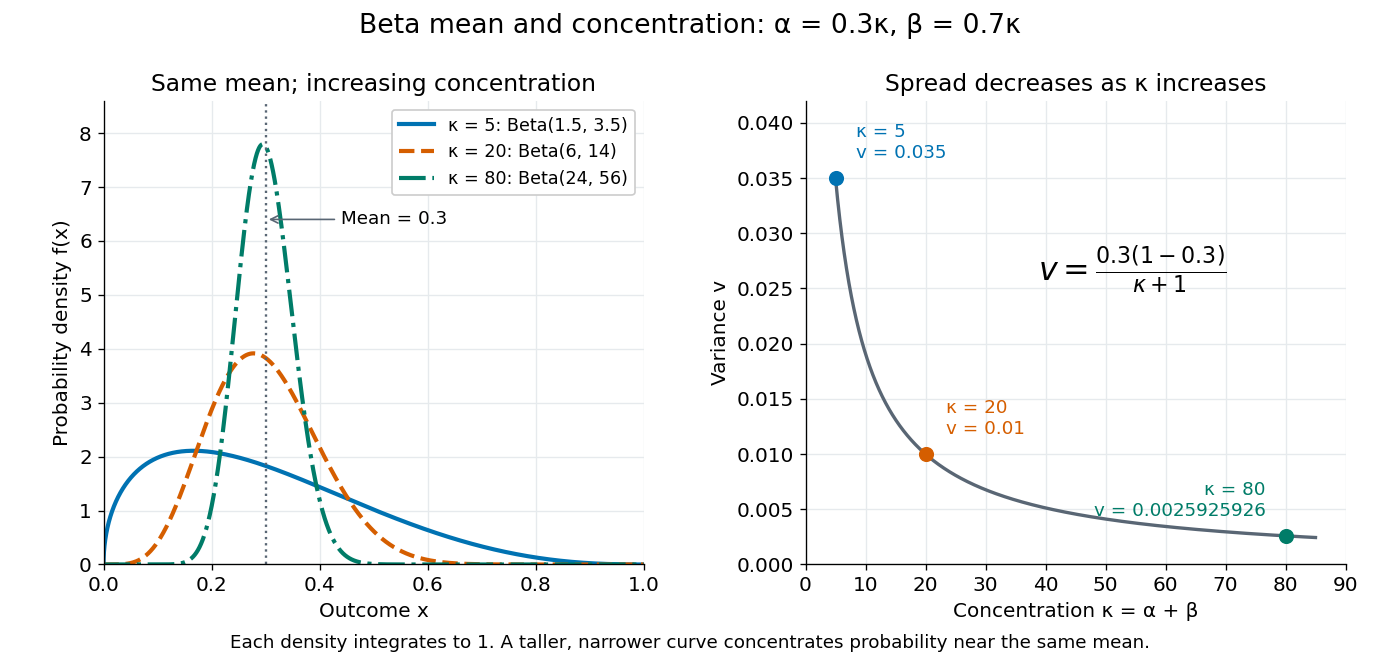
To separate location from spread, write and . The mean and variance of the beta distribution areThe mean specifies the balance between the parameters; their sum controls concentration about that mean. Multiplying both parameters by the same positive number preserves the mean and changes the variance. Larger puts more area near and makes the probability density function taller there; the total area stays one. Small allows much greater spread, sometimes favoring the endpoints rather than the mean itself.
For example, keeping mean and taking gives the beta distributions , , and . Their variances are , , and , respectively. Parameters need not be integers.


The formulas follow from two short moment calculations. Multiplying the probability density function by or increases the first parameter of the Euler beta function:Apply the Gamma function recurrence to the beta-gamma identity, then subtract from to obtain the variance.
The beta distribution is especially convenient as a prior distribution for the unknown success probability of Bernoulli trials. The Beta-binomial conjugacy says that successes and failures update a prior distribution to a posterior distribution . For example, suppose a coin has prior distribution and we observe eight heads and two tails. Its posterior distribution is then , with posterior mean . [ref]
https://ocw.mit.edu/courses/18-05-introduction-to-probability-and-statistics-spring-2022/mit18_05_s22_class15-prep.pdf. MIT 18.05, Reading 15: beta priors and conjugate updating
. Beta-function recurrence Created 2026-09-28 Updated 2026-10-18
The Beta function obeysThese identities follow immediately from the beta-gamma identity and the Gamma function recurrence.
Gamma function has no zeros Created 2026-10-14 Updated 2026-10-18
The beta-gamma identity gives for . A zero of would therefore force zeros at every . But as in the right half-plane, a contradiction. The Gamma function recurrence then extends nonvanishing to every point where the meromorphic gamma function is finite. Nonpositive integers are poles, not zeros.
Mellin integral of a reciprocal binomial 2026-10-20
For real and , the displayed improper integral converges: its endpoint powers are near zero and near infinity. The change of variables givesHere the beta function, the beta-gamma identity, and the Gamma reflection formula evaluate the integral. The same formula holds for complex in the Mellin fundamental strip , by absolute convergence and analytic continuation within the strip. For integer , a sector contour of angle gives a direct residue theorem proof, with a consistent branch of .
Past exam of the mathematics course of the University of Cambridge 2006 ii Paper 4 14E b Solution Created 2026-09-24 Updated 2026-10-18
Set , so . ThenThe beta-gamma identity, the Gamma function recurrence and the gamma reflection formula give
Past exam of the mathematics course of the University of Cambridge 2006 ii Paper 4 8E Solution Created 2026-09-24 Updated 2026-10-20
For , absolute convergence permits the two-dimensional gamma integralPut , , with , and Jacobian determinant . Separation of the integrals gives the beta-gamma identityThe beta integral is finite in this half-plane. Thus a zero of would imply , and iteration would imply for every positive integer . But integration by parts gives , and continuity near one makes as . It cannot vanish for sufficiently small , a contradiction. Therefore the Gamma function has no zeros in the right half-plane.
For any outside the nonpositive integers, choose an integer with . The Gamma function recurrence givesAt the excluded integers gamma has poles, with nonzero residues by the same recurrence. Hence the meromorphic gamma function has no zeros anywhere; at its poles it has no finite value to which a nonzero-value assertion could apply.
Past exam of the mathematics course of the University of Cambridge 2018 ii Paper 1 7B a Solution Created 2026-09-24 Updated 2026-10-18
In the integral defining the Beta function, put and then . Symmetry givesThis proves the identity for . Both sides extend by analytic continuation to the same meromorphic function, equivalently by the beta-gamma identity and the Gamma duplication formula. The identity holds meromorphically for every ; both sides are finite for and have matching poles at the excluded points.
Past exam of the mathematics course of the University of Cambridge 2019 ii Paper 1 7A a Solution Created 2026-09-24 Updated 2026-10-18
With , the change of variables formula givesThe beta-gamma identity, , and the Gamma reflection formula giveTherefore
Multiply the two defining Gamma integrals. For the nonnegative product integrand allows Tonelli's theorem:Use , , so , and the positive quadrant becomes , . The Jacobian determinant has absolute valueAfter including this factor, the transformed integral separates:This proves the beta-gamma identity,All changes of variables are made inside the open positive domains; their boundaries do not contribute to the integrals.
Treat the left side as a causal convolution with . Under the usual Laplace-transform hypotheses, the convolution theorem for Laplace transforms givesFor an absolutely continuous with , the derivative transform is . ConsequentlySince , inverting the product provesHere makes both power kernels locally integrable. For example assume exponential growth bounds sufficient for the transforms and a regularity class where the convolution is defined. This is the Abel integral equation of fractional order; the initial value removes the extra boundary term in the derivative transform.
For , the remaining integral is . ThusSubstitution into the original equation checks the result: scaling gives by the beta-gamma identity.
Conditional on , the future Bernoulli random variable is independent of the observed statistical sample and has success probability . Its posterior predictive probability is therefore the posterior mean of . Put and . Thenusing the beta-gamma identity and the Gamma function recurrence. HenceThe whole posterior predictive distribution of is the Bernoulli distribution with this success probability.