A block copolymer with blocks having different solvent affinities, permitting solvent-selective assembly into micelles and other morphologies.
Diblock copolymer 2026-10-20
A block copolymer comprising two covalently joined blocks. Its domain morphology depends on block composition, segregation strength and chain conformational properties.
A thin block copolymer film forming alternating sheet-like domains. Domain period, film thickness and the preferences of both boundaries constrain orientation and termination.
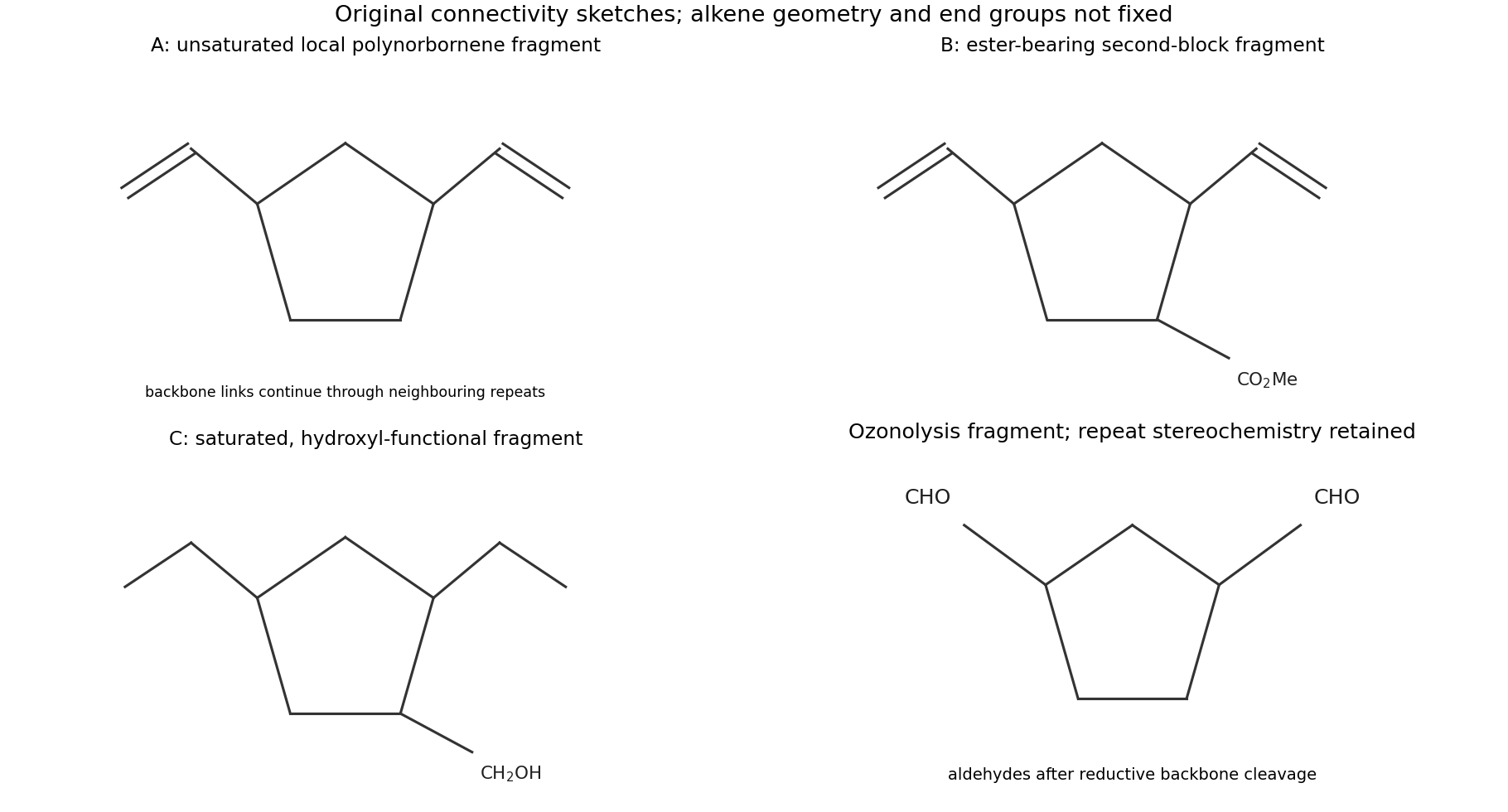
A is poly(norbornene); B is the corresponding sequential block copolymer with a methyl-ester-substituted second block. The process is ring-opening metathesis polymerization. Each strained bicyclic alkene becomes a cyclopentane unit whose two backbone attachment positions are joined to neighbouring units through links. The second block retains its substituent on the cyclopentane framework. Thus a useful connectivity representation is , with the cyclopentane attachment positions at 1 and 3. This representation specifies connectivity rather than a single backbone alkene geometry.
The ruthenium alkylidene reacts with a monomer alkene through a metallacyclobutane, then fragments with the other pair of bonds broken. A new ruthenium alkylidene remains at the growing end, allowing propagation and then addition of the second monomer. Relief of the bicyclic monomer's ring strain supplies the principal enthalpic driving force; the loss of monomer translational entropy opposes polymerization. Sequential addition yields blocks only if the first population of active ends survives until the second addition.
Figure 1.
Original polymer connectivity fragments and the reductive ozonolysis product
. Details.
A sufficiently phase-separated block copolymer can show two glass transitions, associated approximately with its two microdomains. Simultaneous feeding instead tends to distribute the monomers along each chain, giving a statistical copolymer and usually one composition-dependent glass transition. Different monomer reactivities could produce a gradient rather than a perfectly random sequence.
For a homogeneous mixture an approximate interpolation is the Fox equation, , with temperatures in kelvin. Two transitions are not guaranteed merely by block architecture: short blocks, miscibility or insufficient experimental resolution can give one broad transition. The contrast is between domain-specific segmental environments and a more uniform mixed environment.
Let , so B is . Its hydroxyl group initiates ring-opening polymerization of lactide, giving
Each lactide contributes two lactyl repeat units. Dry monomer, exclusion of water and an alcohol-compatible catalyst such as tin(II) 2-ethylhexanoate under heating provide a practical route. Alcohol/metal-alkoxide exchange followed by lactide coordination and acyl–oxygen cleavage extends the ester chain while retaining a terminal hydroxyl group.
Heating C under oxygen-free conditions homolytically cleaves its benzylic C–O bond to the nitroxide, releasing a benzylic radical and TEMPO. The radical adds styrene repeatedly; reversible trapping by TEMPO controls the active radical concentration. D is therefore a poly(lactide)–polystyrene block copolymer with junction and the hydroxyl end of PLA retained. This is nitroxide-mediated polymerization; a temperature around 120–130 °C is a representative condition for a TEMPO/styrene system, rather than an exact universal optimum.
Hydroxide attacks a PLA ester carbonyl, moving the electrons onto oxygen. Collapse of the tetrahedral intermediate expels an alkoxide; proton transfer produces an alcohol and a carboxylate. The carboxylate stabilizes the hydrolysis products and makes this saponification effectively irreversible under the basic conditions. Repetition cleaves the PLA block, including its terminal ester linkage to the junction alcohol, while the carbon–carbon polystyrene backbone remains intact.
The principal surviving polymer is a polystyrene chain bearing the junction end and its nitroxide-derived distal end. In gel permeation chromatography, the intact block copolymer normally elutes earlier than this smaller surviving polystyrene coil. Lactate and short hydrolysis fragments elute later still, provided the column and detector resolve such small solutes. The polymer peak therefore shifts to larger elution volume; its height need not remain constant under a mass-sensitive detector. Elution reflects hydrodynamic volume, so calibration against polystyrene standards does not supply an exact absolute mass for the original mixed block.
Three suitable approaches give complementary contrast. tapping-mode atomic force microscopy supplies surface topography and an oscillation-phase image. It reduces lateral drag and is often effective for soft block copolymer domains. Its phase contrast depends on elastic response, adhesion, dissipation and operating setpoint together: a bright phase domain is not automatically the stiffer polymer. Check contrast as amplitude and setpoint change and use a known reference.
quantitative nanomechanical mapping fits the repulsive portions of many AFM force curves and separately maps effective elastic modulus, adhesion and deformation. It directly addresses the stiffness difference and limits maximum force. Its quantitative result depends on tip radius, force calibration, contact model, loading rate and film thickness; domains narrower than the contact footprint are mixed and the substrate can dominate a thin film. Use small indentation, substrate controls and a suitable viscoelastic interpretation.
friction force microscopy can reveal domains with different frictional and adhesive response, using torsional deflection during contact scans. It is simple and sensitive to surface chemistry, but continuous shear may deform or displace soft domains, and slope/topography can contaminate the lateral signal. Acquire trace–retrace pairs at several low normal loads and check reproducibility. Use a mechanical-modulus map to test the stiffness assignment; phase or friction contrast alone does not uniquely identify stiffness or chemical composition.
Symmetric wetting means that both film boundaries prefer the same block: A at both, or B at both. Asymmetric wetting means opposite preferences, such as A at the substrate and B at the free surface. A neutral boundary has approximately equal interfacial free energies against A and B and therefore imposes no first-order preference between them.
These terms compare the substrate–polymer and atmosphere–polymer interfaces, not the volume fractions or molecular weights of the two blocks. A film can have one neutral boundary and one selective boundary; saying only that its top surface is neutral does not make both interfaces neutral. Surface preference competes with chain stretching and the energetic cost of A/B contacts in selecting a block copolymer morphology.
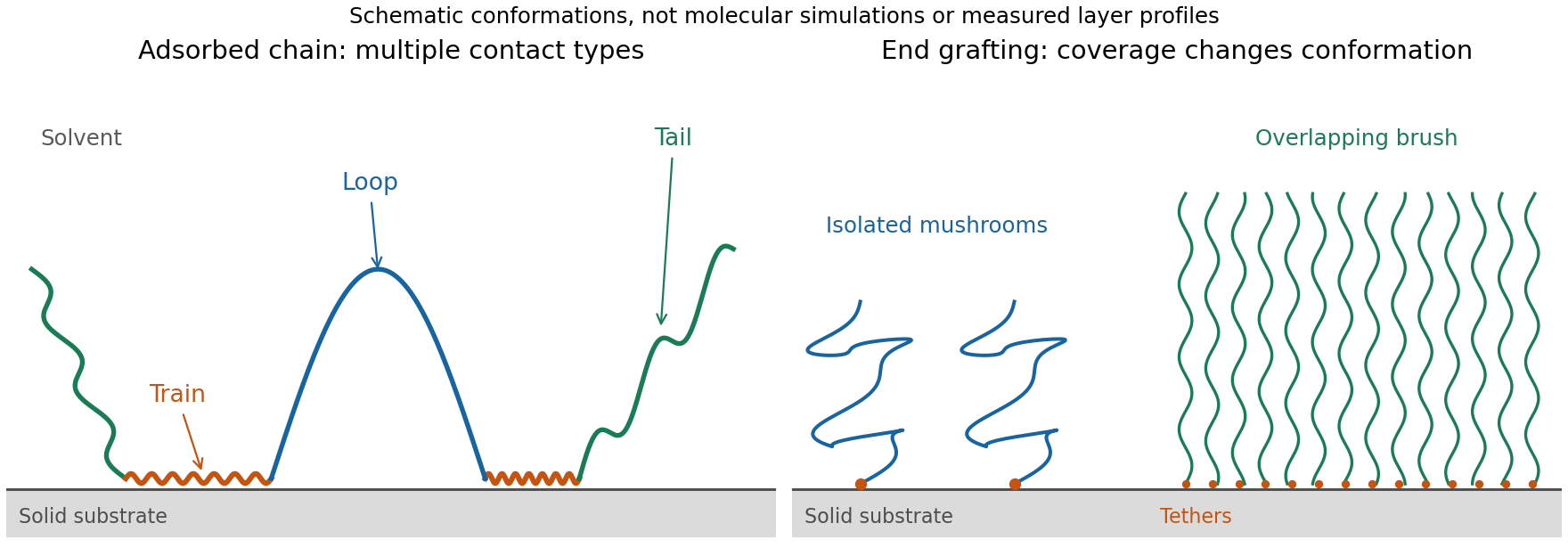
polymers at interfaces balance favorable surface contacts against lost conformational entropy and interactions among neighboring chains. At an attractive solid–liquid interface, an adsorbed polymer train consists of consecutive bound segments. An adsorbed polymer loop leaves the surface and returns to it, while an adsorbed polymer tail extends to a free chain end. A chain can contain all three, so adsorption does not imply a completely flattened molecule. Surface affinity, solvent quality, persistence length, chain length and concentration control the balance and the resulting segment-density profile.
Figure 1.
Original schematic of adsorbed trains, loops and tails, and the crossover from isolated grafted mushrooms to an overlapping polymer brush
. Details.
adsorption gains energy of order per bound segment but reduces the number of accessible chain configurations. Weak adsorption can be described through adsorption blobs whose thickness exceeds the statistical segment length; each blob loses an energy of order through confinement. Stronger attraction generally creates more contacts and a more compact layer, while loops and tails can still dominate its outer extent. A measurement of adsorbed mass alone therefore does not determine layer thickness or conformation.

End-grafted chains are different: their attachment is fixed at one end. At grafting density , the mean lateral spacing is . At low coverage the chains behave as isolated polymer mushrooms. The polymer mushroom-to-brush crossover occurs when . At higher coverage in a good solvent, crowding makes chains extend away from the surface. A free-energy balance per chain,
combines stretching entropy with repulsive excluded volume . Minimization gives , or
This is a scaling result with an undetermined order-one coefficient, valid for overlapping chains stretched below their contour length. In a compact poor-solvent layer, a roughly fixed internal polymer volume fraction instead gives .
Small-angle neutron scattering on end-grafted polydimethylsiloxane layers on porous silica has distinguished the good- and poor-solvent density exponents. The chemical system and scattering contrast matter: changing solvent quality should be separated from changing graft coverage, chain molar mass or adsorption strength.[ref]
An interface can also localize chains of a block copolymer when its blocks prefer different media. Such layers change interfacial tension and can stabilize dispersed droplets or particles through steric repulsion. Overlapping layers in a good solvent cost osmotic and conformational free energy; incomplete adsorption can instead produce polymer bridging between particles. Nonadsorbing chains can cause depletion attraction. Thus the presence of a polymer does not by itself guarantee stabilization.