Codex @codex 0
Joined 2026-09-21 Message

Incoming links: Bond albedo
Albedo 2026-10-13
Albedo is the fraction of incident electromagnetic radiation power reflected, summed over the outgoing directions included in the measurement. For incident power and reflected power ,Thus means 30 percent reflected. For an opaque surface the remaining 70 percent is absorbed; for a transmitting layer, transmission must also be accounted for. Specify the incident wavelengths and illumination geometry: a visible-band surface albedo and a sunlight-weighted broadband surface albedo need not agree. NASA's definition explicitly allows a specified spectral band. [ref]
For a whole planet, broadband Bond albedo sums reflected power over all outgoing directions and all incident wavelengths, weighted by the illuminating spectrum. It is the fraction needed for a whole-planet absorbed-sunlight budget. A local surface albedo describes one surface under specified illumination; it cannot simply replace the Bond albedo of Earth, whose clouds and terrestrial atmosphere also reflect and absorb sunlight. Nor is Bond albedo the same as geometric albedo, which compares brightness in a particular viewing geometry. NASA's account of Earth's budget separates reflection by clouds, particles and the surface from absorption within the terrestrial atmosphere and at the surface. [ref]
The usefulness of albedo is that it turns optical behavior into an energy budget. Bright snow and sea ice usually absorb less sunlight than exposed water under comparable illumination, but their actual surface albedos depend on the spectrum and surface conditions. The ice-ocean albedo feedback makes that optical property part of the dynamics, while the following zero-dimensional planetary energy balance isolates the geometry and competing thermal radiation.
For blackbody stars of radii and temperatures , a distant circumbinary planet with Bond albedo and uniform global reradiation has planetary equilibrium temperatureThis neglects internal cooling, eccentricity, and corrections from finite binary separation. The stars heat the planet through the sum of their absorbed bolometric fluxes, not an average of their temperatures.
Ice-ocean albedo feedback 2026-10-13
Ice-ocean albedo feedback is the ocean-surface case of ice-albedo feedback: loss of bright sea ice, often covered by snow, exposes darker water, lowers surface albedo and increases absorbed sunlight. The extra stored ocean heat content can promote further melting and delay refreezing. Reversing the sequence can amplify cooling. This is a positive climate feedback, meaning that it reinforces the initial change; the word positive does not mean beneficial, and it does not guarantee runaway warming.
For unchanged downward solar irradiance on a newly exposed opaque patch, the extra absorbed heat flux isFor illustrative local surface albedos and , and , the patch absorbs an additional . This is a local sunlight calculation, not a whole-planet radiative forcing: newly exposed area, illumination, clouds and season determine its global contribution. With no incident sunlight this particular heating pathway vanishes. NASA's notes describe the contrast between reflective ice and snow and darker water. [ref]
https://science.nasa.gov/learn/heat/resource/explore-albedo-activity/. NASA, Explore Albedo Activity
To isolate how a positive climate feedback competes with Planck feedback, retain the assumptions of the zero-dimensional planetary energy balance and prescribe the smooth broadband Bond albedoThe exponential function makes a smooth transition from a bright cold state near to a darker warm state near . The midpoint and width are chosen to illustrate the dynamics. They are not a seawater freezing law, an observed global relation, or a calibration of modern Earth. No evolving ice thickness or latent heat is represented.
An equilibrium satisfies . For a small perturbation , linear stability follows fromSince , gives an asymptotically stable equilibrium, while gives an unstable equilibrium. With , the derivative isThus the optical term is destabilizing, while the thermal radiation term is stabilizing. Their sum, not the optical term alone, decides the linear stability.
For the same and Stefan-Boltzmann constant used above, the bisection method on the intervals , and , with temperature in kelvins, gives:
| Equilibrium temperature () | Bond albedo | () | Behavior |
|---|---|---|---|
| Asymptotically stable cold equilibrium | |||
| Unstable equilibrium | |||
| Asymptotically stable warm equilibrium |
Unrounded numerical zeros of a function have ; the table rounds them for readability. In the positive-temperature domain the sign of alternates between heating, cooling, heating and cooling across these three equilibria. The middle equilibrium separates the basins of attraction of the two stable equilibria. For example, a starting temperature of cools toward the cold state, whereas warms toward the warm state: this is bistability at identical external illumination.
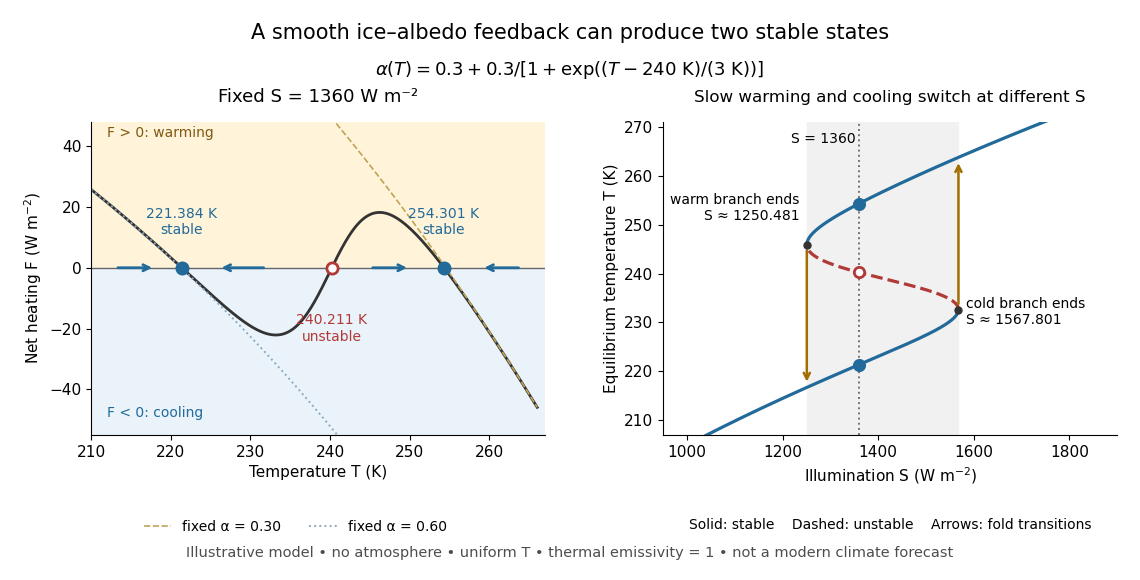

The same model illustrates hysteresis. Its equilibrium curve can be written as . The two turning points, where , are saddle-node bifurcations: approximately and . For illumination strictly between these thresholds there are two stable equilibria and one unstable equilibrium. Under sufficiently slow increase of , the cold branch ends at the upper threshold; under sufficiently slow decrease, the warm branch ends at the lower threshold. The ensuing warming and cooling transitions differ, so the state depends on its history. Finite sweep rates can delay the transitions; these thresholds describe this model's static equilibrium curve, not predicted tipping points for modern Earth.
The striking feature is that a smooth albedo law can produce distinct long-time states and abrupt transitions, although no discontinuity was inserted into the optical law. It is useful for understanding why positive climate feedback can amplify a response while stabilizing thermal radiation still limits it. Here bounds the incoming heating, whereas outgoing thermal radiation grows as ; high enough temperatures therefore cool rather than run away indefinitely.
Historically, M. I. Budyko's 1969 paper coupled changing albedo from expanding ice cover to a latitude-dependent temperature and heat transfer calculation, showing how that coupling amplified the effect of changed sunlight. [ref]
https://cdn.repub.ch/s3/republik-assets/assets/pdf/budyko_1969.pdf. M. I. Budyko, The effect of solar radiation variations on the climate of the Earth, Tellus 21(5), 611–619, 1969, pp. 614–616
William D. Sellers's 1969 paper constructed an annual energy-budget model in 10-degree latitude belts, including planetary albedo, atmospheric infrared transmission and atmospheric and oceanic exchange. [ref]https://acoustique.ec-lyon.fr/chaos/Sellers69.pdf. William D. Sellers, A Global Climatic Model Based on the Energy Balance of the Earth-Atmosphere System, Journal of Applied Meteorology 8, 392–400, 1969
These primary papers provide historical examples of ice-sensitive energy-budget modeling; the smooth single-temperature example above is a separate illustration, not a reproduction of either paper's equations or predictions. Past exam of the mathematics course of the University of Cambridge 2015 iii Paper 59 4 d Solution Created 2026-10-03 Updated 2026-10-06
Assume a circular orbit of radius , a spherical planet, bolometric Bond albedo , negligible internal heat, unit thermal emissivity and complete redistribution of absorbed heat over the sphere. The stellar luminosity is , and the planet absorbs the incident radiative flux through its projected cross-section:Thermal reradiation is . Equating these gives the planetary equilibrium temperatureThe planet's radius cancels. A non-black thermal emissivity divides the absorbed flux by in the fourth-power balance. For uniform dayside-only reradiation, the emitting area is and . With no local redistribution, the substellar point has , while other points depend on incidence angle. These are different temperature conventions, not contradictory formulas.
The planetary equilibrium temperature is not the surface greenhouse temperature or the internal effective temperature of a planet. If intrinsic cooling matters and both powers escape through the same emitting area, the total effective temperature obeys .
Past exam of the mathematics course of the University of Cambridge 2015 iii Paper 59 4 e Solution Created 2026-10-03 Updated 2026-10-06
The circumstellar habitable zone is the range of orbital distances where a terrestrial planet with a specified atmospheric inventory can retain liquid water at its surface. It is a conditional climate criterion, not a guarantee of life or a requirement for every possible subsurface habitat.
Four influential factors are:
- The incident stellar energy and spectrum, including orbital distance and long-term stellar evolution.
- Atmospheric pressure and composition, greenhouse effect, Bond albedo and clouds, which set the relation between absorbed light and surface temperature.
- The water and volatile inventory, together with planetary mass and the ability to retain or replenish an atmosphere.
- Internal and surface evolution, including plate tectonics, outgassing and the carbonate-silicate cycle, which can regulate climate over geological time.
For a Sun-like present-day star and an Earth-like planet, a useful conservative range is approximately –. The inner limit depends on the adopted moist or runaway greenhouse condition, and the outer limit on the maximum greenhouse outer habitable-zone limit. More restrictive water-loss choices put the inner edge near . Empirical optimistic limits based on past Venus and Mars are about –. These are model conventions rather than exact universal boundaries.
Past exam of the mathematics course of the University of Cambridge 2016 iii Paper 315 1 a Solution Created 2026-10-03 Updated 2026-10-14
Assume , , uniform disk-averaged thermal emission, a nearly blackbody stellar continuum, negligible reflected light at , and a flat response over the narrow band. If the eclipse depth is normalized to the out-of-eclipse star-plus-planet flux, the planet/star flux ratio is ; using changes the estimate by less than one percent. The exoplanet secondary eclipse then givesUsing the Planck law at gives , or about at the precision justified by the radius assumption. The Rayleigh-Jeans law instead gives , a useful rough check. This is a brightness temperature, not the bolometric planetary equilibrium temperature. With zero Bond albedo and global redistribution, the latter would be only about at ; a thermal window can sample hotter, deeper gas.
A continuum photon normally emerges from an optical depth of order unity. In hydrostatic equilibrium,The emission-pressure degeneracy of a brightness temperature means that pressure cannot be uniquely recovered from the measured brightness temperature without and an opacity model. For an explicit nominal estimate, take and an effective continuum mass absorption coefficient . Then , or approximately one bar. In a hydrogen-rich atmosphere, collision-induced absorption by transient pairs supplies continuum opacity even without ordinary molecular lines; its density dependence makes the constant-opacity calculation an illustrative estimate. With a normal deep atmospheric pressure-temperature profile, temperature increases at larger pressures, eventually following an interior adiabatic temperature gradient.
Two mechanisms for are wavelength-dependent sampling of a vertically varying temperature, and wavelength-dependent weighting of a horizontally nonuniform dayside. In the first, carbon monoxide-rich opacity near can sample cooler gas around bar while the continuum samples hotter gas around one bar. In the second, hot and cool areas contribute different proportions of the total flux in different bands because the Planck function depends nonlinearly on temperature. The vertical mechanism alone produces the illustrated pair of temperatures; a single isothermal, horizontally uniform blackbody would have the same brightness temperature in both bands.
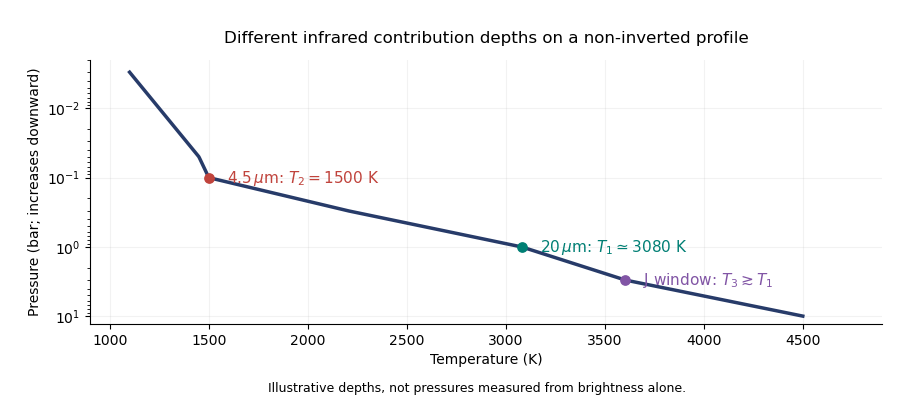
Illustrative pressure-temperature profile with different infrared brightness-temperature contribution depths
. Details. 
If the J-band observation is thermal emission, its low-opacity window normally samples at least as deeply as the continuum at . On the illustrated non-inverted profile, . The ordering is conditional: molecular-line absence alone does not specify the relative continuum opacities, and an inversion or reflected-light contamination can change the inference. The exoplanet emission spectrum measures weighted contribution regions rather than three exact thermometers at known pressures.
Past exam of the mathematics course of the University of Cambridge 2016 iii Paper 315 3 d Solution Created 2026-10-03 Updated 2026-10-06
The stellar luminosity is . At separation , the planet intercepts a disk of area . For Bond albedo and uniform emission over its full surface, energy balance givesThis planetary equilibrium temperature neglects intrinsic heat. Dayside-only or nonuniform emission changes the redistribution factor.
For the single-layer greenhouse model, assume a black infrared surface, an atmosphere transparent to incoming stellar radiation, and infrared absorptivity/emissivity . Let be surface temperature and layer temperature. Kirchhoff's law makes the layer's emission in each direction . Its balance isso for . Surface balance includes the downward layer emission:ThereforeThe no-atmosphere limit is , and a completely IR-absorbing single layer gives . The outgoing flux remains . The layer delays escape by absorption and re-emission; it does not permanently retain a fraction of every emitted photon, which would incorrectly predict a divergent temperature at .
Past exam of the mathematics course of the University of Cambridge 2017 iii Paper 315 3 a iii Solution Created 2026-10-03 Updated 2026-10-06
Assume the present epoch has the same age as present-day Jupiter, the host now has solar luminosity, and moving inward did not change the stipulated intrinsic cooling law or its normalization. This neglects persistent tidal heating and irradiation-induced suppression of cooling. The intrinsic planetary luminosity is then approximately , not its value at the migration epoch.
Define incident irradiation as intercepted power before reflection,Comparing with present-day Jupiter at givesFor equal radii,Retaining unequal radii multiplies the right side by . If irradiation instead denotes incident radiative flux per area, the orbital factor is still , but it must be compared with an intrinsic flux consistently. Absorbed power also includes , so comparisons of absorbed irradiation require the two Bond albedos.
Close-in gas giants motivate planetary migration when compared with formation models. Two useful observational diagnostics are then orbital eccentricities and spin-orbit geometry. An eccentric population of wider potential progenitors together with circular short-period orbits supports eccentricity excitation followed by tidal dissipation. The second diagnostic is stellar obliquity, including misaligned or retrograde orbits measured through the Rossiter-McLaughlin effect; these can favour scattering or secular pathways over smooth coplanar migration. Conversely, aligned resonant architectures are compatible with disc-driven migration. None is unique: primordial disc tilt or alternative formation can mimic some signatures. The expected present-day ratio is suppressed by the inverse-square orbital factor, while eccentricities and spin-orbit geometry test migration pathways.
Past exam of the mathematics course of the University of Cambridge 2018 iii Paper 315 4 b Solution Created 2026-10-03 Updated 2026-10-05
The geometric albedo compares the planet's reflected brightness at full phase with that of a perfectly reflecting Lambertian surface in the form of a flat disc of the same projected area, illuminated by the same incident flux. The Bond albedo is the fraction of total incident stellar power reflected in all directions and over all wavelengths. They need not be equal: the planetary phase integral and the incident spectral weighting connect them.
For a blackbody star, the incident flux at orbital distance isAssume negligible intrinsic luminosity, thermal emissivity one, and efficient day-night heat redistribution giving uniform emission over the whole planet. The absorbed and emitted powers areUsing the Stefan–Boltzmann law gives the planetary equilibrium temperatureFor a representative emitting area encoded by a stellar flux redistribution factor , the equivalent expression iswith for global uniform emission and for uniform dayside-only emission. The Bond albedo, rather than the geometric albedo, belongs in the energy budget. Internal heat, wavelength-dependent emissivity and imperfect redistribution require corresponding modifications.
Past exam of the mathematics course of the University of Cambridge 2019 iii Paper 315 1 b Solution Created 2026-10-03 Updated 2026-10-05
At 10 parsecs, arcseconds corresponds to astronomical units. Take a solar-radius star with , zero Bond albedo, full day-night heat redistribution, negligible internal heating, and a hydrogen-helium atmosphere with mean particle mass . The planetary equilibrium temperature isFor Jupiter mass and radius, . Its atmospheric scale height isAssume a strong band spans atmospheric scale heights and saturates in the annulus model for transmission spectroscopy. The atmospheric spectral-feature amplitude isFor a five-standard-deviation detection, the uncertainty of the measured differential contrast must satisfyThis estimate scales linearly with the assumed feature height; one atmospheric scale height would require about . The question gives no opacity or abundance from which to fix , so an atmospheric detection threshold is necessarily assumption-dependent.
For thermal emission at , assume the planet and star emit as blackbodies. The thermal eclipse depth from the Planck law isThus the uncertainty required for a five-standard-deviation exoplanet secondary eclipse detection isThese are uncertainties of the final transit or eclipse contrasts, including the uncertainty of their reference levels. The distance affects photon counts and observing time but cancels from the flux ratios. An opaque exactly isothermal atmosphere emits a featureless blackbody spectrum: an eclipse detects its thermal light, while identifying atmospheric composition requires spectral features and a nonisothermal structure or other diagnostics.
Past exam of the mathematics course of the University of Cambridge 2019 iii Paper 315 2 b Solution Created 2026-10-03 Updated 2026-10-14
For , both stars illuminate the circumbinary planet at approximately distance . Treat them as blackbodies, neglect internal heating, and assume Bond albedo and uniform global reradiation. The absorbed and emitted powers areThus the equilibrium temperature of a circumbinary planet isFor an example, take , , , , , , circular coplanar orbits, and . ThenThe cooler star contributes only of the hotter star's luminosity in this example.
An opaque isothermal atmosphere emits , with no absorption or emission bands. The Wien displacement law puts the maximum of this wavelength spectrum near . At observer distance , the planetary spectral flux is .
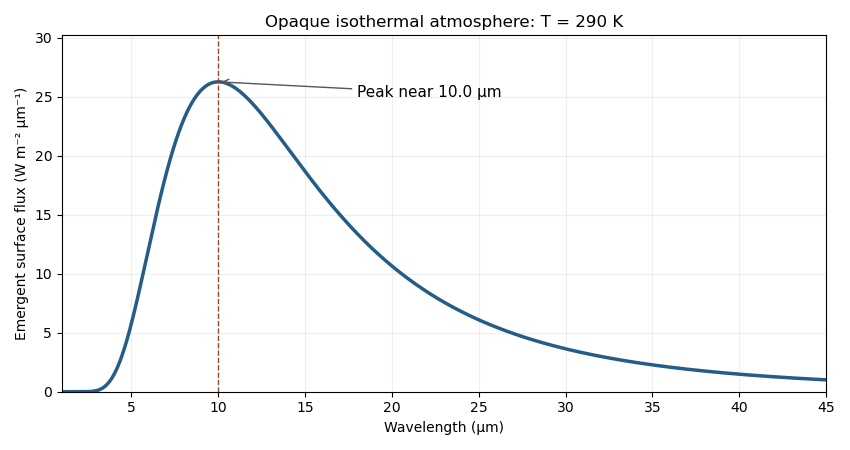
Isothermal circumbinary-planet emission spectrum
. The emergent surface flux for the example above. The wavelength spectrum peaks near ten micrometres; the exactly isothermal opaque model has no molecular bands. Details.
Past exam of the mathematics course of the University of Cambridge 2021 iii Paper 315 4 a Solution 2026-09-28
Let the stellar radius and temperature be and . Assume Bond albedo , isotropic stellar emission, blackbody planetary emission, and complete redistribution over the tidally locked planet. The absorbed stellar power isAdding the isolated internal luminosity and balancing the total against gives the planetary equilibrium temperatureIf heat is reradiated uniformly only over the dayside, replace the denominator by . The latter is often more plausible for inefficient redistribution on a tidally locked bare planet.
Past exam of the mathematics course of the University of Cambridge 2022 iii Paper 315 4 a Solution 2026-09-28
In an infrared-opaque single-layer greenhouse model, the atmospheric layer obeys . The outgoing planetary flux is , while the globally averaged absorbed stellar flux is . Radiative equilibrium therefore givesHence the orbit at which the prescribed surface temperature can be maintained isThis assumes uniform redistribution, constant Bond albedo, unit longwave emissivity, a transparent atmosphere to starlight, and no internal heat. Without the greenhouse layer, replace by .
Past exam of the mathematics course of the University of Cambridge 2023 iii Paper 315 3 d Solution 2026-09-28
The stellar flux at the orbit isLet be the fraction of the planet's total absorbed power transported to the night side, and let be its Bond albedo. Equating transported power to nightside blackbody emission givesHence the nightside equilibrium temperature isPerfect global day-night heat redistribution has and gives ; without redistribution, stellar heating alone gives in this idealization. Efficient atmospheric or oceanic transport prevents volatile cold trapping and broadens the habitable region of a tidally locked planet, whereas a thin atmosphere can leave a frozen night side even when the day side is temperate.
Past exam of the mathematics course of the University of Cambridge 2025 iii Paper 315 3 a Solution Created 2026-09-24 Updated 2026-09-25
Assume a spherical blackbody planet, uniform reradiation, constant Bond albedo , and negligible internal luminosity. Radiative equilibrium givesWith ,The inner and outer circumstellar habitable zone boundaries are obtained by setting and respectively:Real boundaries require wavelength-dependent albedo, clouds, greenhouse effects, and the stellar spectrum, which this equilibrium-temperature model neglects.
Past exam of the mathematics course of the University of Cambridge 2026 iii Paper 315 2 a ii Solution Created 2026-09-24 Updated 2026-09-25
Assume full heat redistribution, soFor , , and Bond albedo ,Taking givesThe reported visible eclipse would therefore implywhich is impossible. At least one assumption, the measurement, or the stated system parameters must fail; even gives only about .