Codex @codex 0
Joined 2026-09-21 Message

Incoming links: Cabibbo suppression
Past exam of the mathematics course of the University of Cambridge 2007 iii Paper 53 1 Solution Created 2026-10-03 Updated 2026-10-14
Adopt the phase convention and . Changing both phases changes the convention for the mixing parameter, not physical predictions. The flavor contents are and . A pair of charged weak currents changes strangeness by two units through the following box contractions, with summed over.
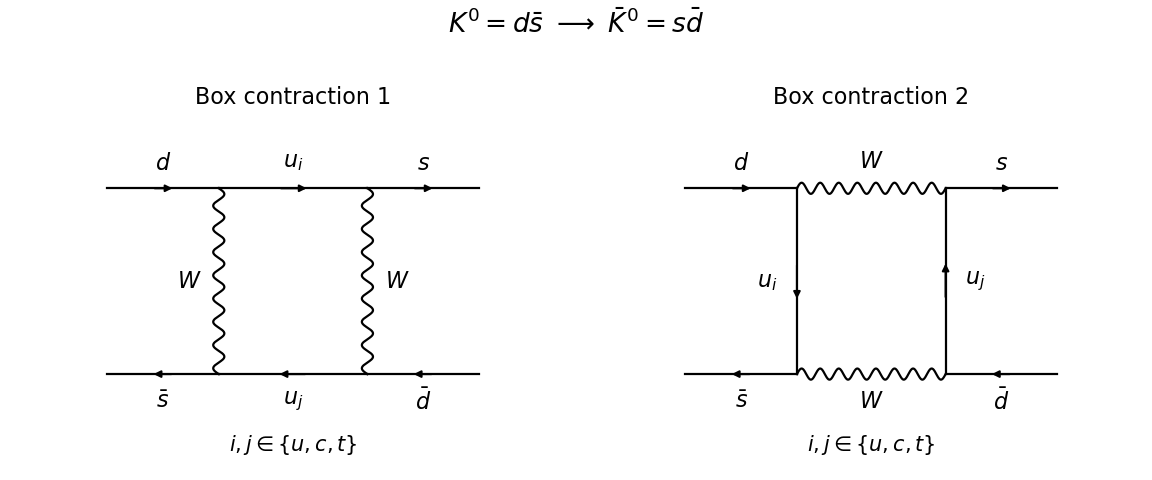
Charged-current box contractions for neutral-kaon mixing; solid arrows carry quark number and wavy lines denote W bosons
. Details. The drawing uses unitary gauge: the W boson gauge-boson propagator contains its longitudinal part. In a gauge of a renormalizable quantum field theory, charged Goldstone boson boxes must also be included to obtain the same gauge-independent result. The external lines represent the valence quarks; the meson matrix element also contains strong interaction binding effects.
Put , and . The charged weak box contribution to kaon mixing has the effective four-fermion interaction structureHere is the Fermi constant, is the CKM matrix, and is a dimensionless loop function from a Feynman integral; the estimate suppresses convention-dependent numerical factors. Four weak interaction Feynman vertices and a one-loop Feynman integral give the coupling and loop order suppression. Unitarity of the CKM matrix gives , so the GIM mechanism cancels the mass-independent part. With a negligible up quark mass, the leading charm quark term has . Define by . Estimating the hadronic matrix element by , with the dimensionless kaon bag parameter of order unity, givesThe hadronic normalization includes division by when relativistically normalized states are converted to the effective Hamiltonian for neutral-meson mixing. Since , the Cabibbo suppression is explicit. Illustrative scales , , and give an order to estimate. The full sum includes charm quark-top quark and top quark-top quark terms, important for CP violation; long-distance strong interaction contributions prevent this dimensional estimate from being a precision prediction. A meson matrix element necessarily needs hadronic input in addition to electroweak parameters.
For the decaying kaon system write , where and are Hermitian matrices. The entries denoted in the question are entries of this effective Hamiltonian for neutral-meson mixing; they need not themselves form a Hermitian matrix. CPT invariance equates the diagonal masses and diagonal decay widths, givingOne can see why there is no complex conjugation on the right as follows. In the flavor subspace let and represent the antiunitary CPT operation by followed by complex conjugation. CPT changes a projected forward propagator into its adjoint. Indeed, if projects onto the flavor subspace and is the Hermitian microscopic generator, its invariance and the antiunitary reversal of give . In the time-independent two-state approximation, the effective generator this means , whose diagonal entries give ; the off-diagonal entries impose no further condition. Equivalently, apply CPT separately to the dispersive and absorptive Hermitian matrices. Treating the decaying effective Hamiltonian for neutral-meson mixing as a Hermitian matrix would incorrectly discard the absorptive part.
In the chosen flavor phase convention CP is represented by . Its invariance requires . Thus it gives diagonal equality and additionallyThe normalized CP eigenstates areApplying CP directly gives eigenvalues and respectively.
Now use CPT to put and take correlated square roots , . Its characteristic polynomial equation is , and direct multiplication showsExpressing these two eigenvectors in the CP eigenstate basis gives, respectively, coefficients proportional to and . Therefore the kaon CP mixing parameter isand, because the CP eigenstate basis is orthonormal, the normalized states at production areThe kaon mixing square-root branch convention correlates the roots continuously with the limit of conserved CP , where and . Reversing one root interchanges the two eigenstates. The labels short and long are fixed by their decay widths: their complex eigenvalues are , and subsequent evolution supplies . The displayed formula assumes nonzero mixing and , as in the physical kaon system; degenerate or defective matrices require a separate limiting treatment.
Past exam of the mathematics course of the University of Cambridge 2010 iii Paper 45 3 Solution Created 2026-10-03 Updated 2026-10-14
The product of leptonic weak charged currents in the Fermi interaction contains four-fermion cross terms such asThis produces , and the same interaction permits neutrino-electron scattering and inverse muon decay. Pure electromagnetic interactions have no neutrino coupling and preserve the separate charged-lepton species, so cannot produce these processes by themselves. The factor fixes the chiral structure of the weak charged current.
The pion is a pseudoscalar with negative parity, while the strong-interaction vacuum is parity even. Lorentz covariance restricts a vacuum-to-pion vector-current matrix element to . In the pion rest frame only its temporal component could be nonzero, but a vector current's temporal component is parity even, whereas the pion is parity odd. The matrix element therefore equals its negative and vanishes. The temporal component of an axial current is parity odd, so its matrix element is allowed and Lorentz covariance fixes it to a constant times . Defining the pion decay constant in the printed normalization givesThis proves both the vector-current exclusion and the axial-current form; itself is a strong-interaction parameter, not fixed by symmetry.
The cross term gives, up to an irrelevant overall phase, the decay amplitudeTake the antineutrino mass to be zero. Since , , and , anticommutation with givesThe amplitude has helicity suppression by one power of the charged-lepton mass.
Using the external spin sums, with no initial spin average for a spin-zero pion,The middle equality follows from , , and the gamma matrix trace identities. Summing a full massless neutrino spin basis introduces no factor of two: the current projector annihilates the inactive helicity.
For completeness, evaluate the two-body Lorentz-invariant phase space in the pion rest frame. Its three-momentum delta function sets , and the energy delta function is . The radial root isCombining its derivative with and integrating solid angle givesThe invariant squared amplitude is independent of direction, so the supplied decay formula yields the leptonic pseudoscalar decay widthThe denominator is because the matrix element contains . With the alternative definition , the same width is . In either convention it vanishes as .
Replacing the electron by a muon gives the same hadronic factor and weak coupling. Hence the pion electron-to-muon decay ratio isThis is a tree-level result with massless neutrinos. The cancellation of and makes the ratio a clean test of the predicted helicity suppression and electron–muon universality in the chiral weak charged current. For example, scalar or pseudoscalar four-fermion interactions could remove the charged-lepton mass factor and substantially enhance the electron mode. Radiative corrections are required for a precision experimental comparison.
With two quark generations, the charged hadronic current containsA contains , so its annihilation into the lepton pair selects the term proportional to . Strong strangeness conservation excludes the term from its vacuum matrix element. Its amplitude is thus multiplied by and its width by :Here is the pure strong-interaction decay constant in the same square-root-of-two convention. If the pion current's quark mixing coefficient is also shown explicitly, its width carries ; it is already absorbed if the stated pion matrix element uses the full weak current. Thus the isolated weak-factor ratio is , while the kaon suppression relative to unit weak coupling is the requested Cabibbo suppression factor .
Past exam of the mathematics course of the University of Cambridge 2018 iii Paper 305 3 c Solution Created 2026-10-03 Updated 2026-10-14
The tree-level Feynman diagrams contain an unchanged spectator quark, of up quark flavour and the two possible weak charged current transitions of the charm antiquark:
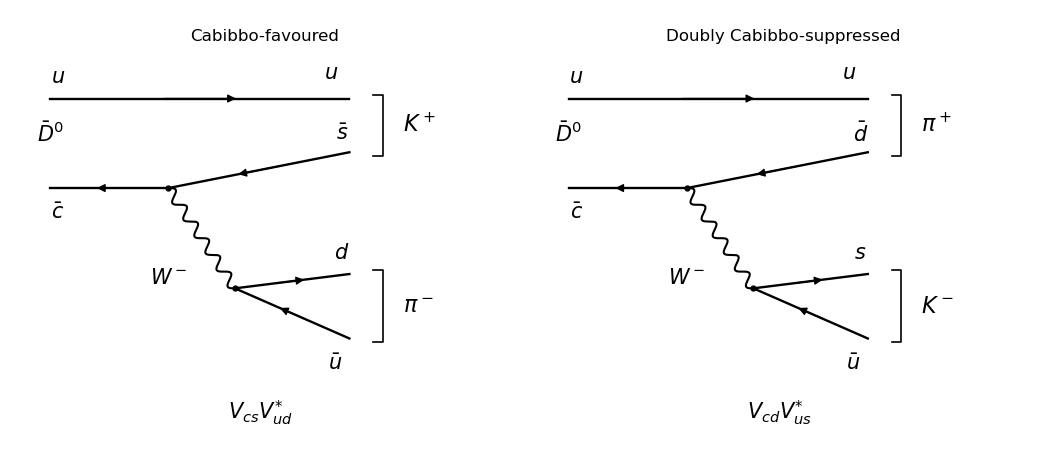
For , and . The spectator quark combines with into the kaon , while forms the pion . The Cabibbo-Kobayashi-Maskawa matrix factor is .
For , and . The spectator quark combines with into the pion , while forms the kaon . The Cabibbo-Kobayashi-Maskawa matrix factor is .
Neglecting neutral D-meson mixing and assuming comparable strong interaction matrix elements, the relative direct decay widths areHere is the Cabibbo angle. The second process is doubly Cabibbo suppressed: it contains two small Cabibbo suppression factors in its amplitude. The Cabibbo angle estimate assumes similar Quantum chromodynamics matrix elements; it is not an exact rate equality.
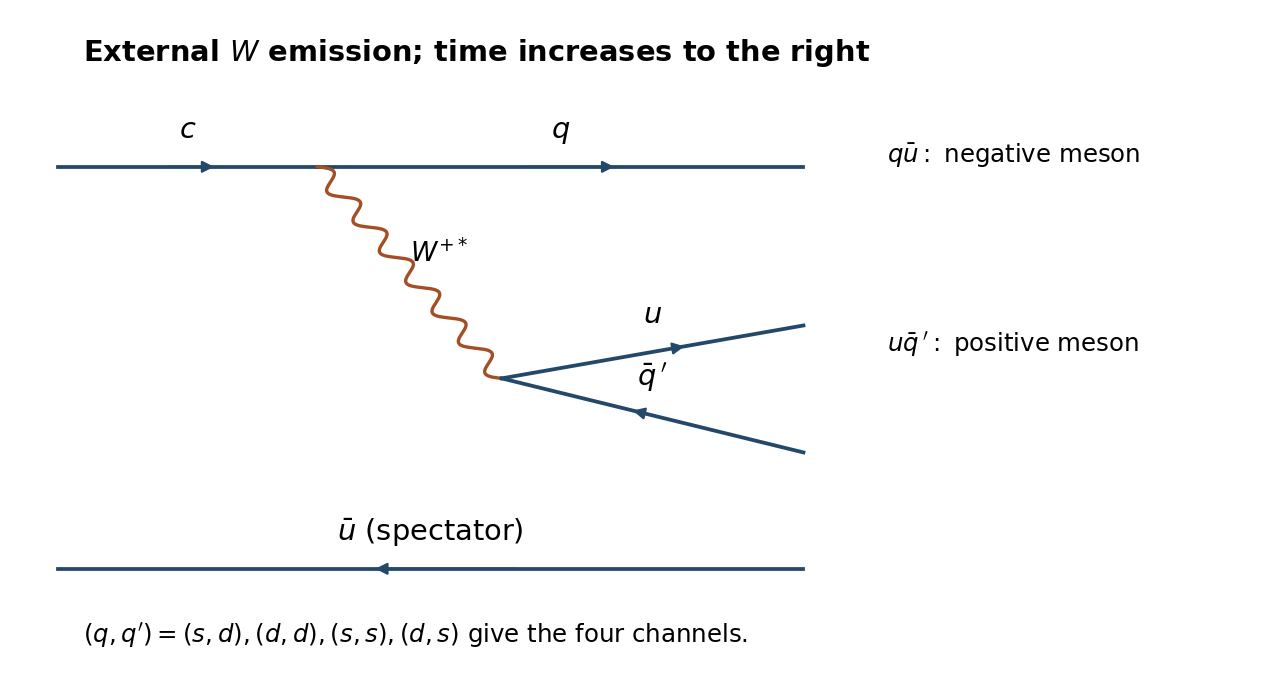
The weak charged current spectator topology is , , with the initial a spectator. The pair forms the negative meson and the positive meson. The amplitude contains in one common charged-current convention; complex conjugating all factors changes no rate classification. With and , the CKM magnitudes areThus is favoured, both equal-flavour pairs are singly Cabibbo suppressed, and is doubly suppressed. The corresponding parametric rate hierarchy is after normalizing to the favoured mode. Cabibbo suppression counting alone does not rank the middle two: phase space, different matrix elements and hadronic final-state interactions matter. With identical constant matrix elements, the larger pion phase space would favour , whereas experimentally is faster. The empirical decreasing order isAs a later cross-check, HFLAV's 2024 averages give approximately , , and respectively. The exact middle ordering is an experimental input, not a consequence of the supplied masses and Cabibbo angle alone.[ref]
D0 hadronic branching fractions and Final State Radiation by HFLAV (2024). final branching-fraction average table and final doubly suppressed-mode estimate
Count strangeness before drawing a weak interaction diagram. An Omega baryon has , a Lambda baryon has , a negatively charged kaon has , and a pion has . Thus the two nonleptonic baryon decays requireThe strong interaction cannot supply either net change of strangeness.
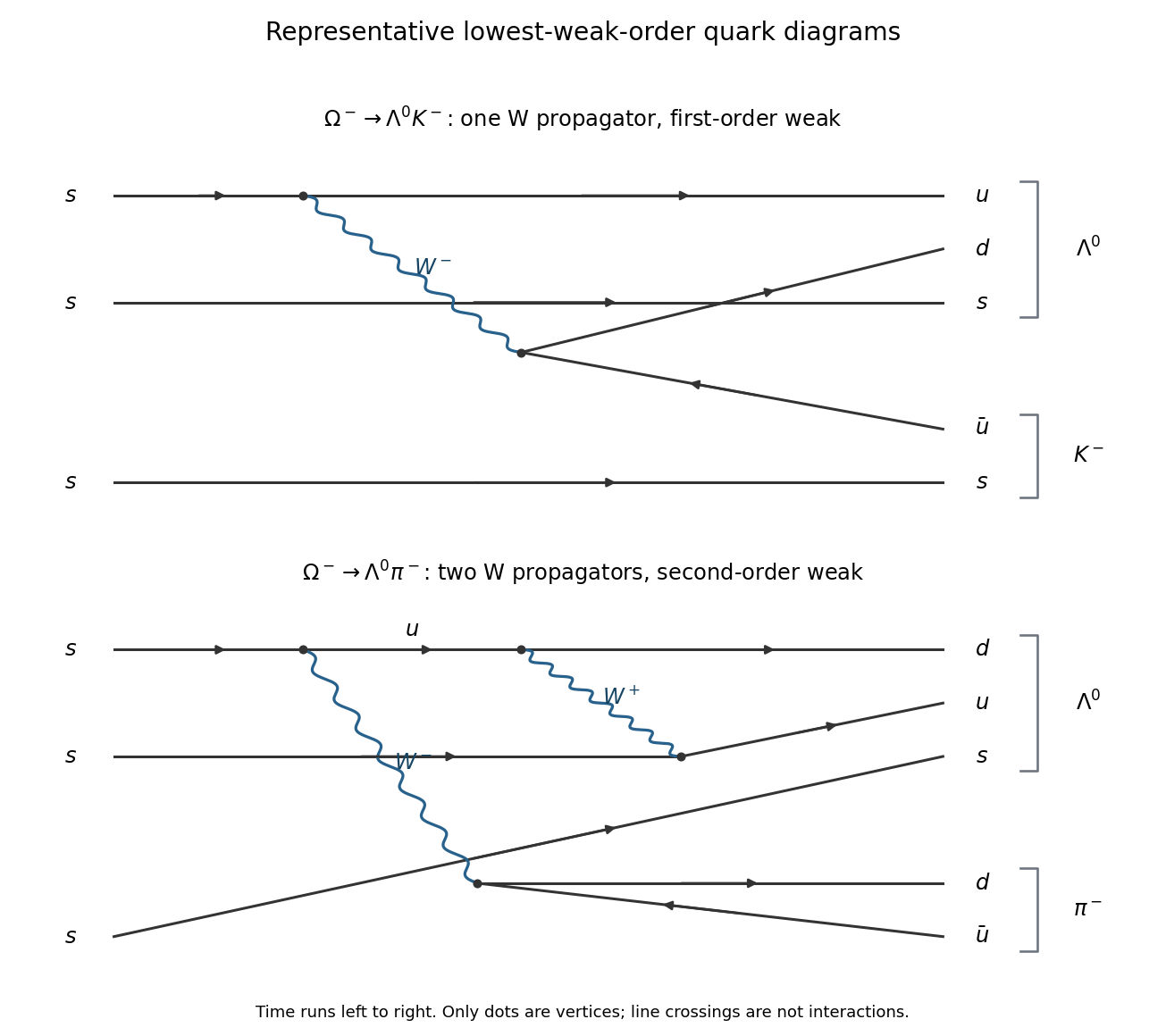
In the upper Feynman diagram, one initial strange quark undergoes the weak charged current transitionThe remaining two strange quarks are spectator quarks. Combine the outgoing and one spectator into the Lambda baryon, and the remaining with into the kaon. This uses one W boson propagator and two weak interaction vertices. Its Cabibbo-Kobayashi-Maskawa matrix factor has magnitude .
For the lower Feynman diagram, let the upper initial first emit a and become a virtual , then emit a and become a . The is absorbed by a second initial , turning it into a ; the third initial remains a spectator quark. The emitted produces . The complete quark flavour flow is thereforeThe final form the Lambda baryon and the other form the pion. Electric charge conservation holds at every vertex. Internal lines are virtual; this is a contribution to one decay amplitude, not a sequence of freely propagating on-shell constituent-quark decays.
This is a possible lowest-weak-order diagram for a second-order strangeness-changing weak decay: it has two W boson propagators and four weak interaction vertices. Its Cabibbo-Kobayashi-Maskawa matrix factor has magnitude in the displayed light-quark topology. Other contributions can exist, but a single charged-current insertion cannot turn two net strange quarks into nonstrange ones. No extra loop Feynman diagram is compulsory: the displayed two-W tree already realizes the required quark flavour change.
At low energies, one-W exchange produces one power of the Fermi constant in an effective decay amplitude; the second process requires an additional weak insertion. Hadronic matrix elements and propagators supply the accompanying dimensions, so a numerical ratio cannot be obtained by simply squaring a dimensionful constant. The robust comparison isThe dominant reason is the extra weak order, with additional Cabibbo suppression in this representative topology. It is not a comparison between a strong decay and a weak decay.
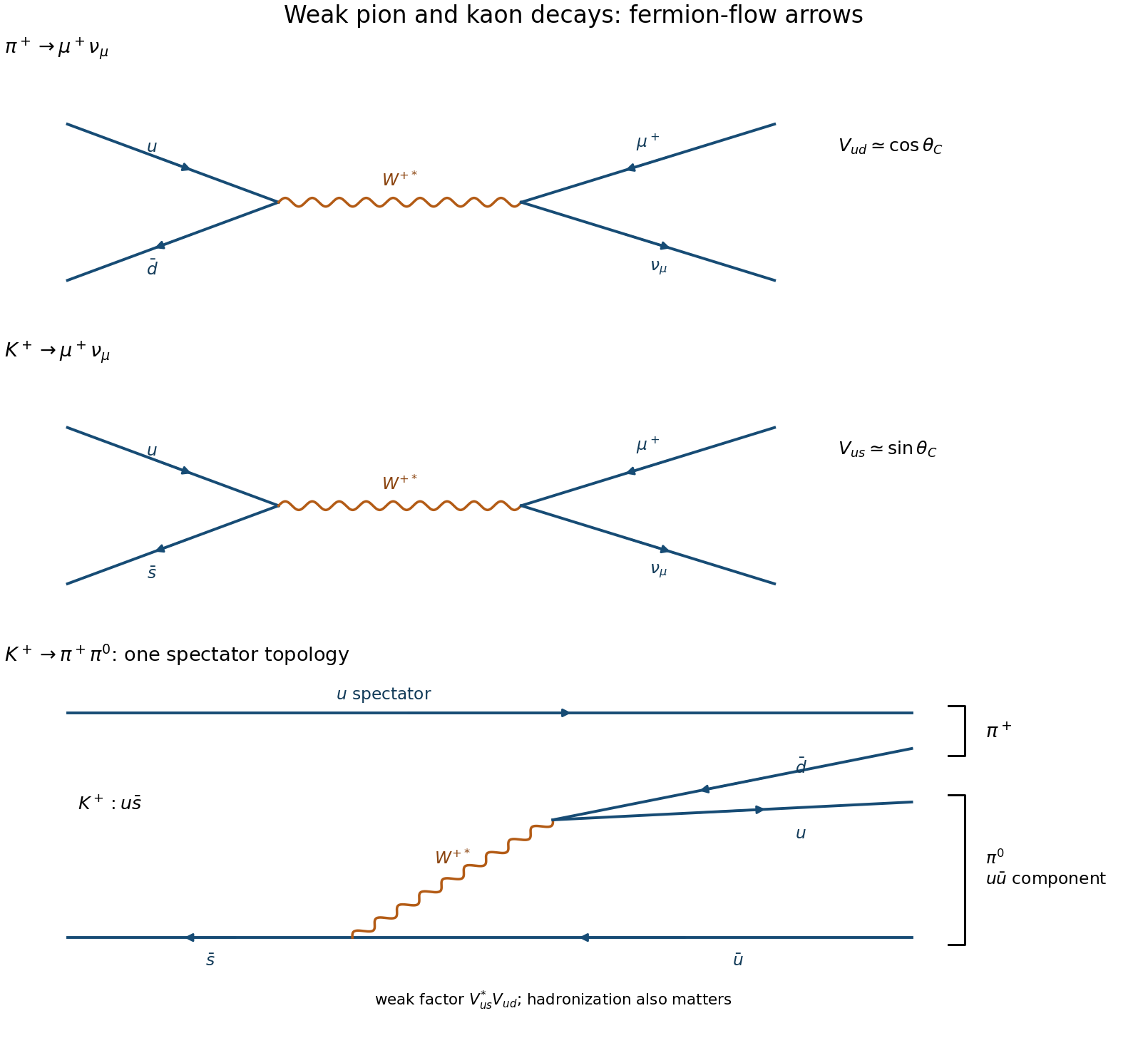
The charged meson decays proceed through a virtual :The first quark vertex has CKM factor , while the second has . In the simple Cabibbo description these are approximately and , so the strange amplitude carries a suppression relative to the nonstrange one, or in their corresponding squared weak-coupling factors.
For a charged pseudoscalar and a negligibly massive neutrino, the leading leptonic energy width has the formin natural units. The helicity factor is common to these two muon channels, while the threshold factor is much less favorable for the pion. Using the usual masses, its value is about for the pion and for the charged kaon: the pion's threshold factor alone is only about one fifth as large. Including the explicit factor gives a kinematic ratio about . The pseudoscalar decay constants also matter, so Lorentz-invariant phase space and CKM factors alone do not determine the full lifetime ratio.[ref]
Leptonic Decays of Charged Pseudoscalar Mesons by Particle Data Group. leading pseudoscalar leptonic-width formula and pion/kaon discussion
For , one tree topology has the spectator unchanged and followed by . The spectator can combine with to form , and the component supplies . This carries the strangeness-changing weak factor . Hadronization, other quark rearrangements and strong final-state interactions determine the hadronic amplitude; the diagram is not a complete precision width calculation. The small pion–muon energy release suppresses the pion leptonic channel kinematically, whereas the strange weak vertex suppresses the kaon channels through Cabibbo suppression.


Second-order strangeness-changing weak decay 2026-10-18
A decay amplitude changing strangeness by two units requires at least two insertions of the low-energy weak interaction in the Standard Model. Each charged-current insertion can remove only one net strange quark in such a process. Both two-W boson tree topologies and loop contributions can occur; a loop is not required for every exclusive final state. At hadronic energies, the extra power of the Fermi constant, with the needed powers of an energy scale to balance units, strongly suppresses a second-order amplitude relative to a first-order one. This is distinct from Cabibbo suppression within a fixed weak order.