Let be a piecewise smooth contour forming a simple closed curve, positively oriented: travel counterclockwise, with the interior on the left. Suppose is holomorphic on an open set containing and its interior, except at finitely many isolated singularities strictly inside. ThenNo isolated singularity may lie on : the ordinary contour integral must be defined there. Reversing the direction of the contour reverses the sign of the answer. The theorem applies to essential singularities as well as poles. [ref]
Return to . A counterclockwise circle encloses both simple poles, soYet is nonzero everywhere it is defined. A zero contour integral does not imply a zero function, or even absence of poles: the enclosed residues can cancel. By contrast, the counterclockwise circle encloses only , givingThe picture compares these two selections. Changing the shape of a contour while keeping the same enclosed poles leaves the contour integral unchanged, provided the contour deformation stays where is holomorphic.
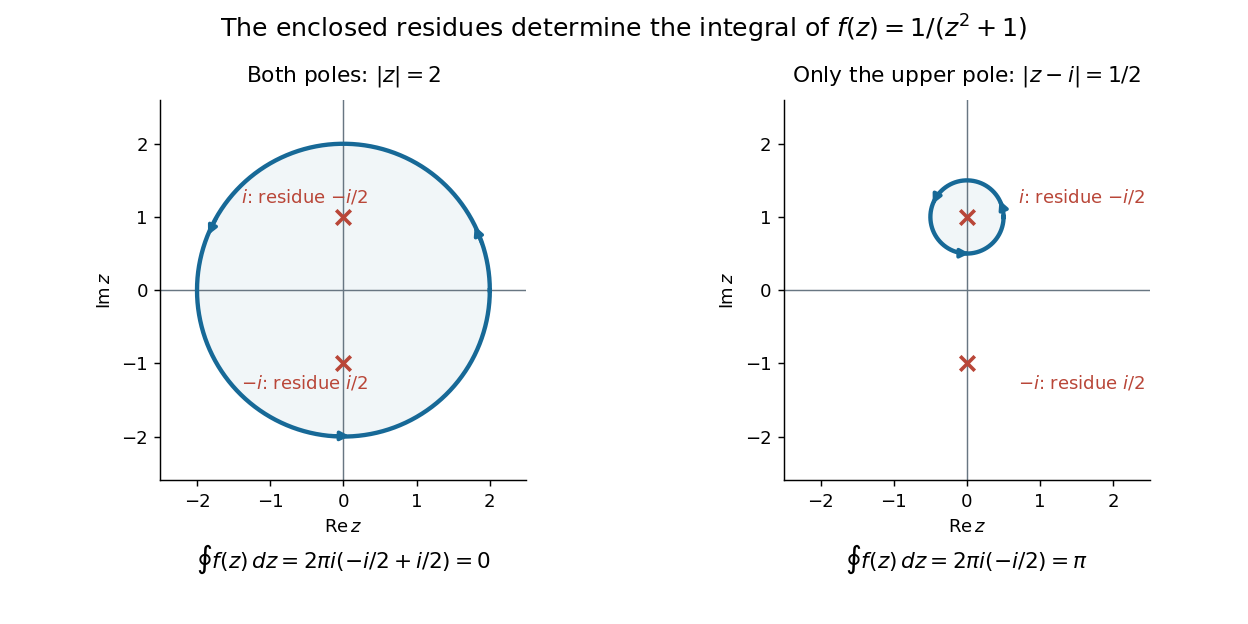
This is the practical appeal of the residue theorem: local Laurent coefficients determine a global contour integral. For a rational function, a few simple pole computations can replace a long parametrized calculation. It also makes real improper integrals accessible by treating the real line as part of a closed contour in the complex plane.
To compute , take and travel along the real line from to , then return along the upper semicircle , parametrized by for . This contour is positively oriented and encloses the simple pole only; is outside. HenceThe added arc must be controlled before taking a limit. On , the reverse triangle inequality gives , and the arc length is . The estimation lemma therefore yieldsThe denominator grows quadratically while the arc length grows only linearly. This quantitative comparison, rather than a sketch alone, explains why closing the contour does not alter the limiting real improper integral. It even supplies an error bound: the difference between and the finite real integral is at most .
For a numerical check, gives the finite real integral , leaving about to reach . The arc bound is , comfortably larger than that error. The graph shows both quantities approaching zero. The exact tail here can be checked with the antiderivative ; the residue theorem method remains useful for improper integrals where a convenient real antiderivative is unavailable.
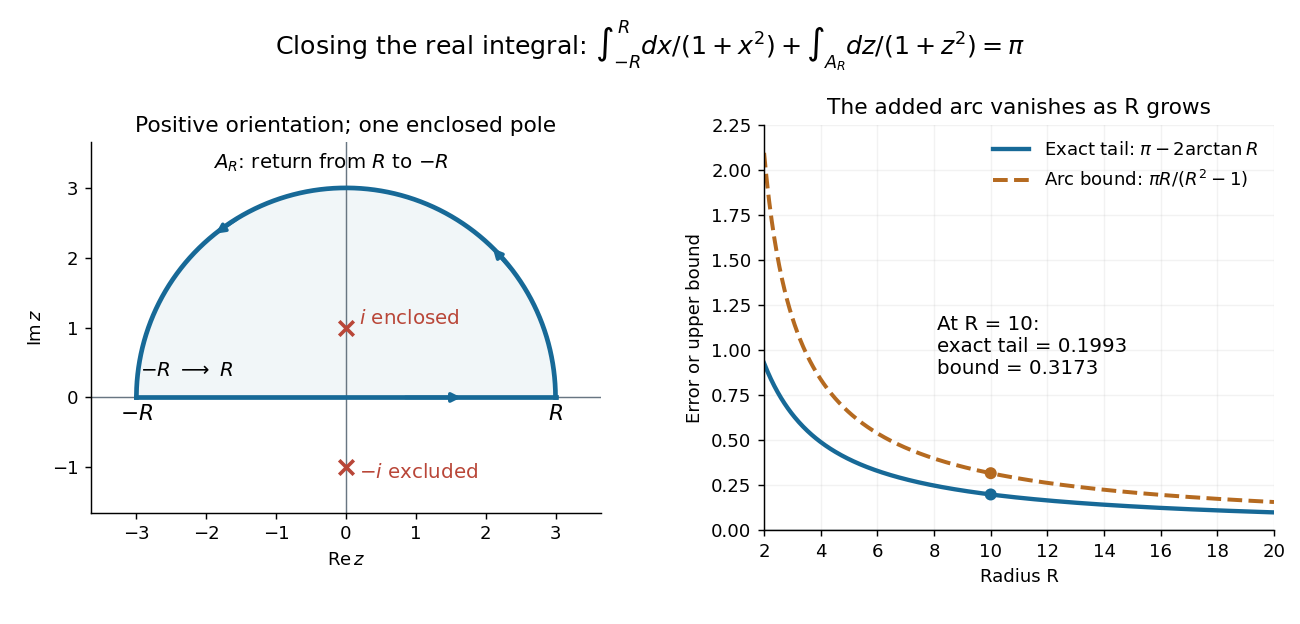


Finally, both one-sided improper integrals converge absolutely: for , , whose tails are integrable. Thus the symmetric limit computes the ordinary improper integral, not merely a Cauchy principal value, andClosing below instead would enclose the simple pole . With the same left-to-right traversal of the real line, that contour is clockwise, so its contour integral is again. This provides a useful sign check: the opposite residue is accompanied by the opposite direction around the enclosed region.
The same strategy extends to many other rational functions: choose a contour, identify its enclosed isolated singularities, compute their residues, and bound the added pieces. The choice of contour and the bound are as much part of the calculation as the residues. [ref]
For , integrate over an upper semicircle with a small clockwise indentation excluding zero. The large arc vanishes; the small arc tends to times the residue , namely . The contour encloses no poles, so the remaining real-axis principal value is . Taking real parts gives the displayed ordinary integral, whose cancellation at zero removes its apparent singularity. Evenness of the cosine extends the formula to arbitrary real , with zero frequencies obtained by a limit. The individual integrals of cannot be subtracted as separately convergent improper integrals.
The cotangent kernel has a simple pole of residue one at every integer. If a meromorphic is regular at the integers, these residues sample its integer values. Integrating around squares of half-side and applying the residue theorem converts a finite sum of samples into residues at the other poles. When the contour integral tends to zero and has only finitely many other poles, the limiting sum is the negative sum of those off-integer residues of . A uniform cotangent bound and sufficiently rapid decay of justify the vanishing contour term. At an integer where itself has a pole, use the full Laurent series to find the combined residue instead of substituting a divergent sample; the Basel problem calculation with illustrates this exception.
For real , choose a branch of the complex logarithm whose argument interval contains strictly, and integrate over an annular sector of angle . The one enclosed simple pole is , with residue . The circular arcs tend to zero, with bounds and .
Writing for the title integral and , the two radial segments and the residue theorem giveDivide by and equate real and imaginary parts. This gives and the title formula. When , the sector extends below the negative real axis; the principal complex logarithm therefore cannot be used throughout that sector. A cut along a ray just below the positive axis avoids this issue for every .
For monic with distinct nonreal zeros and , close the contour in the upper half-plane. The rational factor is on the large semicircle, whose exponential damping makes the arc integral . The two one-sided real integrals also converge by integration by parts, since the rational factor tends to zero and its derivative is . Thus the displayed formula is an ordinary improper integral, not merely a principal value.
For , integrate around a rectangle of imaginary height . Its single pole at has residue , the top-edge integral is times the bottom-edge integral, and both vertical sides vanish at large real width. The residue theorem gives . Substitution gives the equivalent integral .
For , substitution gives poles at zero and the two roots of . The inside-pole residues sum to , soThe double pole at zero is essential; omitting it gives the wrong sign and value.
Set and . In an indented upper semicircle use the principal complex logarithm and . The negative real boundary contributes , the positive boundary contributes , and both circular arcs vanish. The pole at has residue . Thus ; comparing real and imaginary parts yields the displayed integrals.
Suppose a contour follows the real axis, closes in the upper half-plane, and avoids each simple real pole by a small semicircle above it. Each indentation is clockwise and tends toIf the large arc vanishes and there are no enclosed poles away from the real axis, the Cauchy principal value is therefore
By symmetry assume and integrate around an upper semicircle indented clockwise above zero. The residue at zero is . The expansion bounds the large arc by , including when . The upper-half-plane indentation rule therefore gives . Its imaginary part is even and ordinarily integrable, yielding the displayed value. At zero the sine-product integrand tends to ; at infinity it is bounded by . The principal value is needed for the auxiliary complex integral, not for the real sine-product integral.
Articles by others on the same topic
There are currently no matching articles.