In a dilute gas, Bose-Einstein condensation makes a single one-particle state hold a substantial fraction of the bosons. This is a population effect: cooling reduces the number that the excited energy eigenstates can accommodate at thermal equilibrium. The surplus accumulates in a Bose-Einstein condensate. For an ideal gas the occupied mode is the trap ground state; interactions can deform that mode, as described by the Gross–Pitaevskii equation. Dilute does not mean classical: a small number density can still give overlapping thermal de Broglie wavelengths at sufficiently low temperature.
The appeal is that changing the trap changes a calculable Quantum Hamiltonian, while absorption imaging makes its population distribution visible. The Bose condensation in a three-dimensional harmonic trap below turns density of states into a prediction for a critical temperature and condensate fraction. These are separate questions from measuring matter-wave coherence or superfluidity.
Eric A. Cornell and Carl E. Wieman's joint lecture emphasizes the competition between useful elastic collisions, which restore thermal equilibrium during evaporative cooling, and collisions that remove or heat the trapped sample. A long trap lifetime alone is insufficient: reequilibration must keep up with evaporation.[ref]
Nobel Lecture: Bose-Einstein condensation in a dilute gas, the first 70 years and some recent experiments by Eric A. Cornell and Carl Wieman. pp. 878–879 and 890, collisional requirements

Consider noninteracting bosons in one internal quantum state, at thermal equilibrium in the three-dimensional harmonic oscillator potentialHere is the mass, the positive are angular frequencies, and is their geometric mean. Measure the one-particle energy and chemical potential from the ground-state energy. The quantum harmonic oscillator levels then have with nonnegative integer and reduced Planck constant .
When , counting lattice points can be approximated by the volume of a tetrahedron in the positive octant of :This is a density of states, with units of inverse energy. The factor is the unit tetrahedron volume; differentiating produces the factor . Treat the single ground state separately: its macroscopic population would be lost by replacing every level with a smooth density of states.
For , integrate the Bose-Einstein distribution over excited energy eigenstates. As approaches zero from below, their maximum population isHere is the Boltzmann constant and the Riemann zeta function. A short proof uses and . The nonnegative terms permit exchanging summation and integration by Tonelli's theorem, giving . Near zero the integrand is proportional to , so its integral converges. That finite excited-state capacity is the mechanism of Bose-Einstein condensation.
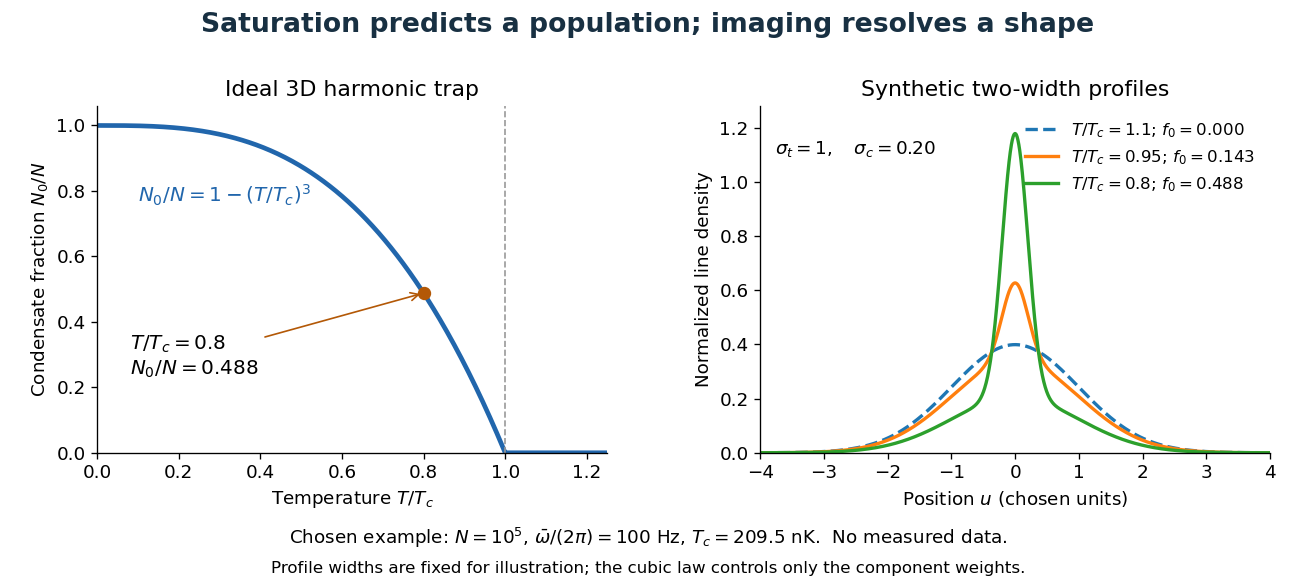
Set . Particle conservation gives, to this continuum accuracy,Above , the macroscopic condensate fraction is zero and the chemical potential adjusts below zero. This cubic power belongs to a three-dimensional harmonic trap; it is not the homogeneous three-dimensional ideal gas exponent. For , and , the model gives . At , , or approximately condensed bosons. These are chosen parameters and calculated values.
Finite gives a smooth crossover rather than a sharp phase transition. The exact ideal gas sum over excited quantum harmonic oscillator levels differs from the continuum integral, especially when is not large relative to every . A sharp trapped-gas limit takes , with fixed and fixed frequency ratios. Interactions also alter the critical temperature, condensate fraction and release profile; a dilute gas can have appreciable interaction energy compared with the trap level spacing. The cubic law is a useful baseline, not a fit guaranteed for either 1995 experiment.
The condensate fraction is the population of a macroscopically occupied one-particle state divided by the total particle number . For an interacting system, use a macroscopic eigenvalue of the one-particle density matrix, rather than assume that the relevant mode is an undeformed single-particle trap ground state. The condensate fraction is not generally the fraction measured as superfluid by a flow or rotation response.
A broad component plus a narrow central component can have one local maximum while still displaying two distinct width scales. This is what “bimodal” means in this imaging context; it does not require two separated peaks. To isolate the population effect, construct an original normalized line profileBoth terms are normal distributions; their integrals are one, so the component areas are and . With , the narrow component has central height , while the broad component contributes . A tall central feature therefore need not contain most of the particles. Holding these widths fixed deliberately isolates changing weights; it does not model how temperature, interactions or camera resolution determine actual widths.

For absorption imaging in the weak-probe regime with negligible saturation, the optical depth is , where is the reference light intensity without atoms, the transmitted light intensity, an effective absorption cross section, and the column density. Integrating over both image coordinates gives the particle number; a central pixel height alone does not. Finite resolution can obscure a narrow component, and saturation invalidates this simple logarithmic calibration.
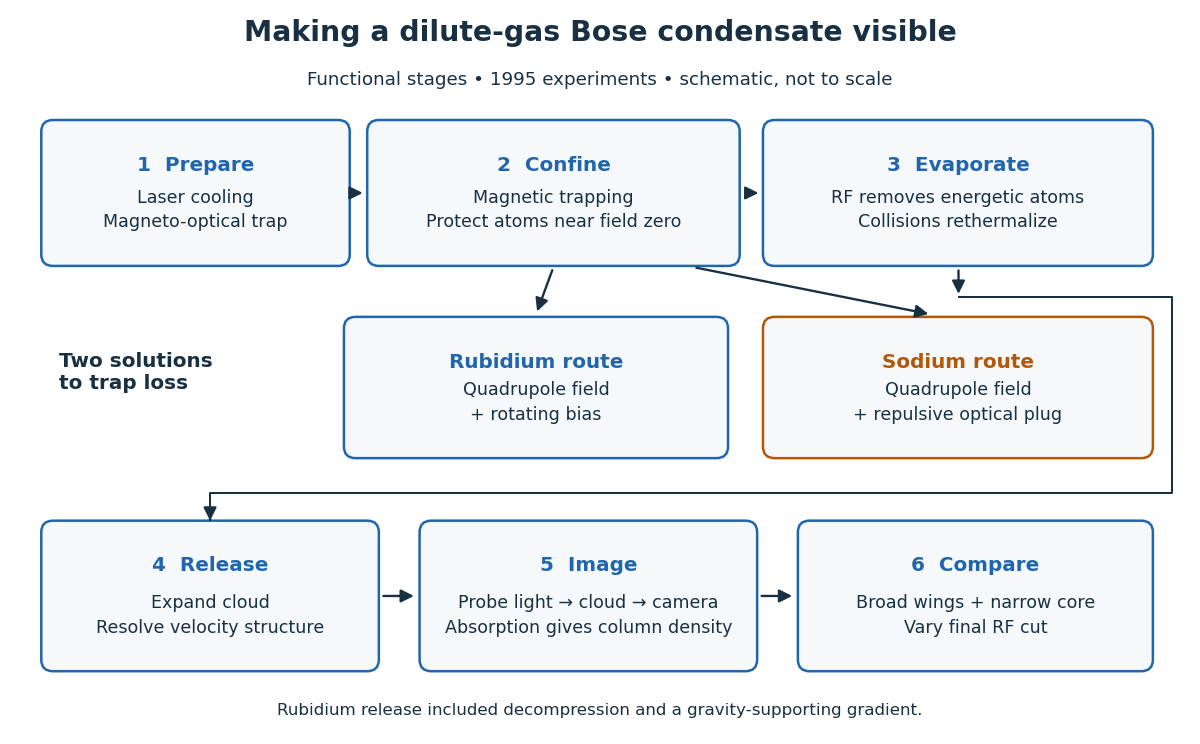
The rubidium experiment used laser cooling, a magneto-optical trap and magnetic trapping of neutral atoms with a rotating bias field. Radio frequency transitions removed energetic atoms; elastic collisions restored thermal equilibrium. Before absorption imaging, the trap was decompressed, then nearly released with a gradient supporting against gravity. Varying the final evaporation cut revealed a narrow anisotropic core within an isotropic thermal cloud. The broad component supplied a simultaneous comparison through the same optics. Resolution and size calibration limited inference; interactions broadened the core relative to an ideal gas.[ref]
The 1995 sodium experiment combined laser cooling with a magnetic quadrupole trap and a repulsive optical plug protecting its field zero. Radio frequency evaporation preceded release and absorption imaging after time of flight. Lowering the evaporation cut produced broad thermal wings and a narrow core. Moving the plug changed the core's expansion orientation while the thermal distribution remained spherical: a control connecting the feature to confinement. Overlap of the two trapped pockets and residual switch-off acceleration limited quantitative shape comparisons; repulsive interactions affected expansion.[ref]
Bose-Einstein Condensation in a Gas of Sodium Atoms by K. B. Davis and others. pp. 3969–3972, Figs. 1–4
Bose-Einstein condensation concerns occupation of a one-particle state. Matter-wave coherence concerns field correlations between positions or times. Superfluidity concerns a flow response, including suppression of dissipation under appropriate conditions. A density peak diagnoses neither a relative quantum phase between two separately prepared clouds nor a critical flow speed. These observables require different experiments.
For example, in a single-mode fixed-number Fock state, but . Writing for that occupied mode givesThus vanishing mean field does not imply vanishing first-order matter-wave coherence. For two independent fixed-number modes, : there is no ensemble mean interference term establishing a fixed relative quantum phase. Interpreting fringes in an individual detection record requires considering correlations and the measurement; assigning a pre-existing definite relative quantum phase is unnecessary.
Wolfgang Ketterle's lecture describes a separate coherence test: two condensates expanded into one another and produced fringes. Selectively removing one condensate made the fringes disappear on alternating preparation cycles, testing against diffraction from the confinement. This compared two-cloud and one-cloud signals; it did not measure dissipationless flow.[ref]
Nobel lecture: When atoms behave as waves: Bose-Einstein condensation and the atom laser by Wolfgang Ketterle. pp. 1143–1145, Fig. 15, condensate-elimination control
Articles by others on the same topic
There are currently no matching articles.