The Einstein model of a solid represents the vibrations of chemical atoms by independent one-dimensional quantum harmonic oscillators, all with the same positive angular frequency . Equivalently, each chemical atom has three independent oscillator directions. The common angular frequency is a simplifying model assumption, not a claim about every vibration of a real solid. Hold the volume, and fixed. Define the characteristic temperature and the dimensionless ratio . The vibrational internal energy isThe first term is the zero-point energy . It is constant at fixed , so it contributes no heat capacity at constant volume. The temperature-dependent term givesThis is the vibrational heat capacity at constant volume of the model, with no expansion or other contributions included. [ref]
https://ocw.mit.edu/courses/3-012-fundamentals-of-materials-science-fall-2005/d3fa883afa8df7cf7aa0432fcaadde8f_lec22t.pdf. MIT 3.012, Lecture 22, pages 9–13: Einstein-solid partition function, energy and heat capacity
For a worked comparison, choose the model parameter . The normalized heat capacity at constant volume depends only on :
| Temperature in | ||
|---|---|---|
At , one mole of chemical atoms therefore has vibrational heat capacity at constant volume , using the unrounded model value. Even at twice the characteristic temperature, the model remains about below the Dulong-Petit law limit. These are calculations for the ideal Einstein solid, not material measurements.
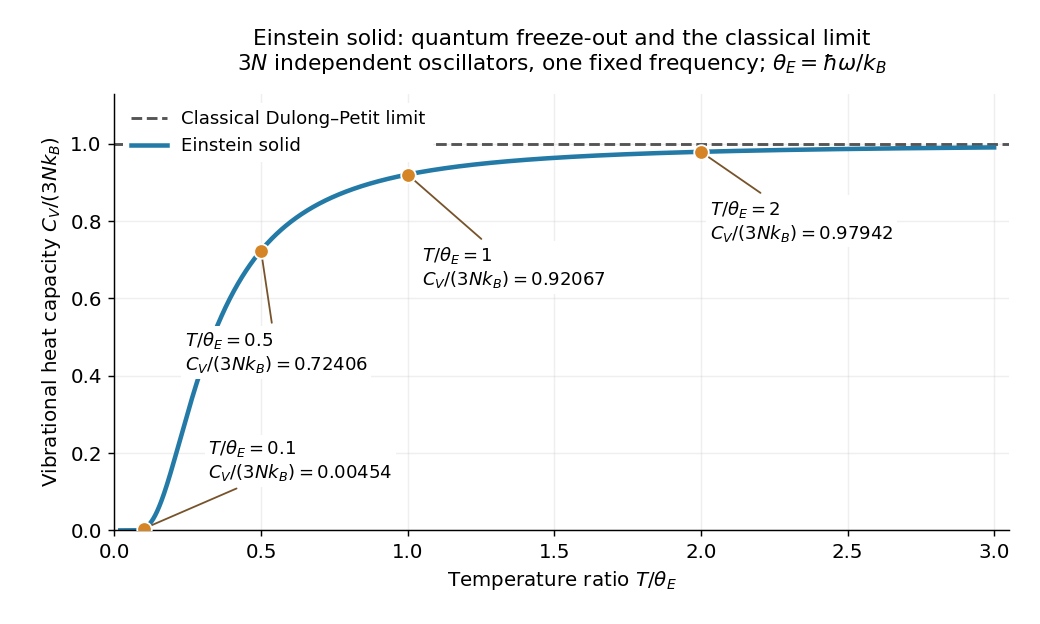
A short derivation uses the thermal partition function of a quantum harmonic oscillator. The energy eigenvalues and their Boltzmann factors form a geometric series, giving the one-oscillator canonical partition function . The mean occupation is , hence the displayed after summing over independent quantum harmonic oscillators. Taking its derivative with gives the displayed heat capacity at constant volume. [ref]
https://davidtong.org/pdfs/teaching/statistical-physics/omg1.pdf. David Tong, Statistical Physics, Example Sheet 1 (January 2012), problem 5: oscillator energy, the Einstein model and its limits
The two limits explain the shape. At high temperature, a Taylor series in small givesAt low temperature, , soThe zero-point energy remains even when the thermal response is tiny: freeze-out means that changing temperature scarcely changes the occupations, not that the chemical atoms have zero energy. This is the useful lesson of the Einstein model of a solid: the classical counting rule reappears when many levels are accessible, while discrete excitation spacings explain its failure upon cooling.
The exponential low-temperature decay is also the model's limitation. Real three-dimensional crystalline solids have acoustic phonon branches with arbitrarily small angular frequencies in the bulk limit. The Debye model includes these collective normal modes and predicts a low-temperature vibrational contribution , which the single-frequency Einstein solid cannot reproduce. This qualification concerns the vibrational contribution; additional excitations can change a material's total heat capacity. [ref]
https://davidtong.org/teaching/statistical-physics/statmechhtml/S3#S3.SS3. David Tong, Statistical Physics, section 3.3: acoustic phonons and the Debye low-temperature law
Einstein introduced the quantum treatment of solid vibrations in his 1907 paper Die Plancksche Theorie der Strahlung und die Theorie der spezifischen Wärme. Its historical importance is that quantum excitation energies explained why the classical Dulong-Petit law could fail; the modern quantum harmonic oscillator formulation above includes the zero-point energy explicitly. [ref]
https://onlinelibrary.wiley.com/doi/10.1002/andp.19063270110. A. Einstein, Annalen der Physik 327, 180–190 (1907), original-paper publication metadata
Articles by others on the same topic

An Einstein solid is a model in statistical mechanics that describes a system of non-interacting oscillators, which can be used to understand the thermodynamic properties of solids. This model was proposed by Albert Einstein in 1907 as a way to explain the specific heat of solids, particularly at low temperatures. In the Einstein solid model, the following assumptions are made: 1. **Atoms as Oscillators:** Each atom in the solid is treated as an independent quantum harmonic oscillator.


One important quantum mechanics experiment, which using quantum effects explain the dependency of specific heat capacity on temperature, an effect which is not present in the Dulong-Petit law.
This is the solid-state analogue to the black-body radiation problem. It is also therefore a quantum mechanics-specific phenomenon.