An exoplanet atmospheric observatory characterizes planetary spectra through transit, eclipse, phase-curve, high-dispersion, or direct-imaging observations.
An atmospheric retrieval fits a parametrized radiative transfer model to an exoplanet transmission spectrum or exoplanet emission spectrum. Temperature, abundances, clouds and reference radius/pressure can trade off against one another. Posterior precision within one model is not proof that its structural assumptions are unique.
The Spitzer Space Telescope provided infrared observations of exoplanet secondary eclipses and exoplanet thermal phase curves. Its original mission included infrared spectroscopy; its warm mission retained the 3.6 and 4.5 micrometre imaging bands.
The Hubble Space Telescope provides ultraviolet, visible, and near-infrared transit and eclipse spectroscopy and established many early detections of atoms, aerosols, and atmospheric escape.
The James Webb Space Telescope combines a 6.5-metre aperture with stable near- and mid-infrared spectroscopy. Its instruments measure transit, eclipse, and phase-curve spectra across multiple molecular bands.
The NIRISS single-object slitless spectroscopy mode measures time-series spectra from to . It supports exoplanet transmission spectra and eclipse observations, as described in the instrument guide.
NIRSpec provides multiple spectroscopic modes within –. Its time-series modes can measure exoplanet transmission spectra and exoplanet secondary eclipses; individual settings have narrower coverage. See NASA's instrument overview.
MIRI's low-resolution spectroscopy includes a slitless time-series mode for exoplanet observations. Its useful coverage includes the – region, with longer-wavelength limits dependent on calibration and sensitivity. See the instrument guide.
Ariel is an ESA mission designed to survey the visible and infrared atmospheres of about one thousand planets through transit and eclipse spectroscopy.
The Extremely Large Telescope combines a 39-metre-class aperture, adaptive optics, direct imaging, and high-dispersion spectroscopy to characterize giant and terrestrial exoplanets.
CRIRES is a high-resolution infrared spectrograph. Its upgraded form supports molecular spectroscopy of exoplanet atmospheres and measurements based on the Doppler effect. See ESO's instrument overview.
Exoplanet direct imaging spatially separates planetary light from host-star light. It is most sensitive to young, hot, self-luminous giant planets on wide orbits around nearby stars.
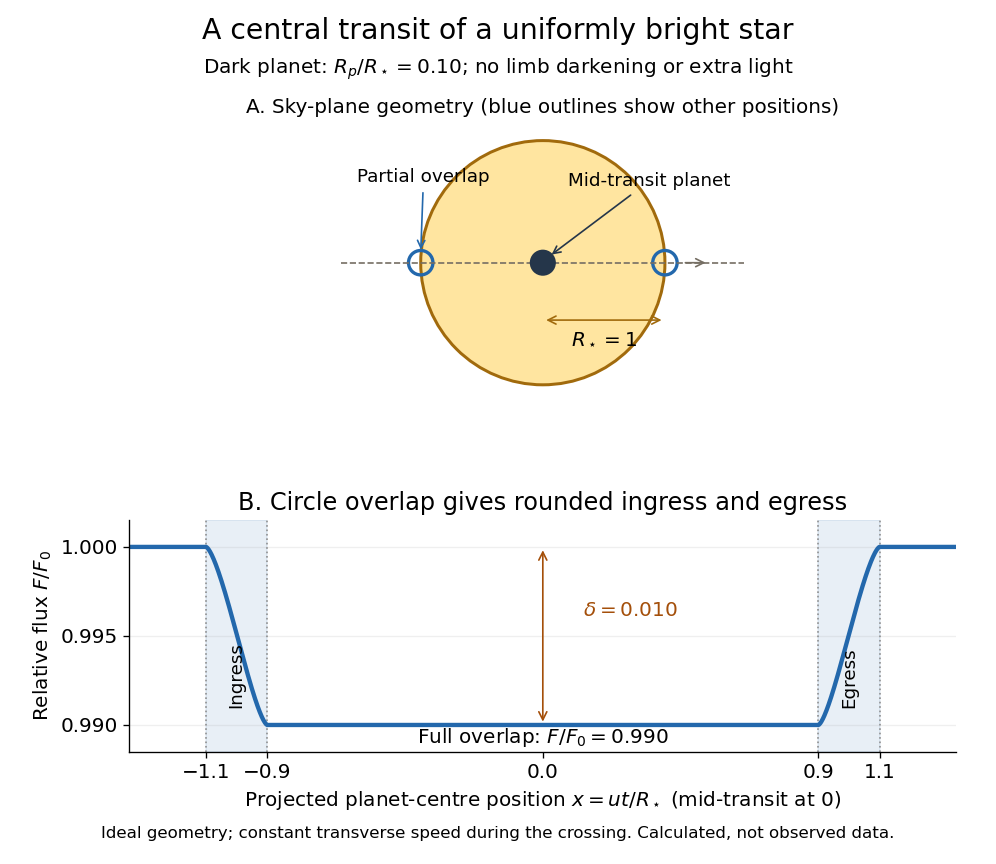
Exoplanet transit photometry measures the decrease in a star's observed radiative flux during an exoplanet transit. Define as the unobscured star's observed radiative flux and as the value at time . For a dark, opaque exoplanet crossing a uniformly bright circular stellar disc, a fully superimposed planetary disc blocks exactly the fractionHere and are the planet and star radii. This exoplanet transit depth determines a radius ratio, ; an absolute planet radius requires an independently estimated stellar radius. For , : a one-percent dip, with . Halving the radius ratio to reduces the exoplanet transit depth to , a quarter as much.
For the central exoplanet transit illustrated below, the transit impact parameter is . Write and let be the projected centre-to-centre separation in units of . The light curve is , where is the overlap area of circles of radii and . There is no overlap when ; the planetary disc is fully inside when , giving . Between those limits, the overlap area grows or shrinks continuously. Thus even a uniform star has curved ingress and egress, with a flat bottom only during full overlap. The illustration uses approximately constant transverse velocity over the short crossing, so with mid-transit at . Analytic models also handle limb darkening. [ref]
https://arxiv.org/abs/astro-ph/0210099. Mandel and Agol (2002)
.
The simple exoplanet transit depth formula assumes constant stellar brightness, no limb darkening or starspots, negligible light from the exoplanet, and no transit dilution by other light. It describes full overlap in a non-grazing exoplanet transit, requiring for a full-overlap interval. A grazing exoplanet transit never hides the whole planetary disc against the star, and limb darkening weights different blocked areas differently. Repeating dips are valuable evidence, but eclipsing binary stars and starspots can imitate parts of the signal, so confirmation and joint modelling matter.
The fractional decrease in observed radiative flux during an exoplanet transit, relative to the out-of-transit baseline. For a uniform star, a dark planet, full disc overlap, and no transit dilution, the exoplanet transit depth is . For a nonuniform star it depends on the blocked specific intensity as well as the radius ratio.
Constant extra light makes an exoplanet transit appear shallower. If the host star supplies out-of-transit observed radiative flux and an unresolved source supplies , let . Then . For , a true exoplanet transit depth of appears as ; ignoring transit dilution gives a radius ratio instead of , under the same uniform-disc assumptions.
A starspot is a relatively cool, dark region on a star's surface associated with a magnetic field. Starspots change the light curve as the star rotates. A planet crossing a starspot blocks less light than it would from an unspotted region, producing a local upward anomaly during an exoplanet transit; unocculted starspots can instead deepen the normalized exoplanet transit depth. They can also distort spectral lines and imitate a Doppler spectroscopy signal.
A departure of transit arrival times from a constant-period ephemeris can reveal gravitational interactions with other bodies. Dynamical fits may constrain an exoplanet mass independently of transit depth, providing a mass to combine with radius for exoplanet interior models.
For two nearly circular Kepler orbits near a first-order period ratio, the slow resonant argument circulates on the displayed superperiod when longitude of periapsis precession is negligible. If , then . Within resonant-argument libration, this circulation formula is replaced by an amplitude-dependent libration period.
A first-order resonant orbital perturbation changes the semi-major axis and therefore the mean motion. Integrating the sinusoidal mean-motion variation over the near-resonant transit-timing superperiod gives a mean-longitude amplitude proportional to . Converting phase to transit time gives the displayed amplitude ratio. It assumes small perturbations, circulating resonant argument, effectively fixed free orbital eccentricity, and dominance of this enhanced term over direct phase and forced-eccentricity contributions. The formal divergence as signals failure of this expansion, not infinitely large transit times.
In leading mean-conjunction geometry a common observer phase for two resonant arguments requires and modulo . With , the exact modular criterion isNecessity follows by subtracting the two congruences after multiplication; sufficiency follows from the integer linear combinations of and , whose set is . For exterior centres and interior centres at orders one to three, only satisfies it. This is phase compatibility, not a guarantee of an observed exoplanet transit: timing, observer orientation, resonant-argument libration widths and true-versus-mean longitude must also be considered.
For an edge-on orbit crossing the centre of a uniformly bright stellar disk at distance , projected speed is and chord time is . A steady cross-sectional-area current therefore places area in front of the star, givingThis requires a geometrically narrow, optically thin wire with negligible overlap. A noncentral chord, limb darkening, finite angular extent and large optical depth change the estimate; it cannot predict dimming greater than one.
An exoplanet passes in front of its host star as seen by an observer and blocks part of the stellar flux. Exoplanet transit photometry infers geometry and radii from the resulting light curve. A true alignment involves the true anomaly, not generally the mean anomaly.
The minimum projected planet-star separation during an exoplanet transit, divided by the stellar radius. It determines the stellar chord length and hence the transit duration of a small planet.
For a small planet on a nearly circular Kepler orbit, a stellar chord at normalized transit impact parameter has length . Dividing by transverse orbital speed gives the duration. A central transit has the longest duration within this approximation. Eliminating with Kepler's third law yields for known mean stellar mass density. Finite planet radius, appreciable orbital eccentricity, and corrections change the bound.
For an opaque or detectably extinguishing spherical debris cloud of radius much larger than the stellar radius, a central exoplanet transit lasts approximately . Combining this with the Hill radius gives the displayed mass estimate. For cloud impact distance , replace by : the central formula then gives a lower mass estimate unless the chord geometry is known.
Doppler spectroscopy detects an exoplanet through the host star's changing Doppler shift. Both bodies orbit their shared astronomical barycenter: the star undergoes stellar reflex motion even when the exoplanet itself is unseen. Its velocity along the line of sight shifts its spectral lines; at speeds small compared with the speed of light, , with positive for recession. Repeated measurements can fit a Kepler orbit, rather than merely detect one shifted spectrum. Starspots and other changes in stellar spectral lines must be distinguished from actual orbital motion.
For one companion in an isolated two-body problem, the stellar radial-velocity semi-amplitude isHere is the gravitational constant, the orbital period, the orbital eccentricity, and the star and exoplanet masses. The orbital inclination is measured relative to the sky plane: is face-on and is an edge-on orbit. The exact binary mass function measured from the fitted orbit isWith known and , this is usually reported as . Taking gives the minimum companion mass; a smaller orbital inclination allows a larger mass. A detected exoplanet transit constrains close to for a compact planet orbiting well outside the star's surface, substantially resolving this ambiguity. Combining Doppler spectroscopy and exoplanet transit photometry then supplies a mass and radius for exoplanet interior studies.
For a computed circular example, let and choose a relative orbital speed : this is the speed of the planet relative to the star, not its speed about the astronomical barycenter. Conservation of momentum givesThe barycentric velocities point in opposite directions, so their speeds add to . Here and : at , at , and zero at . The star still orbits in the face-on case, but its orbital velocity has no line-of-sight component. The plotted circular signal is for a chosen phase origin and constant system velocity .
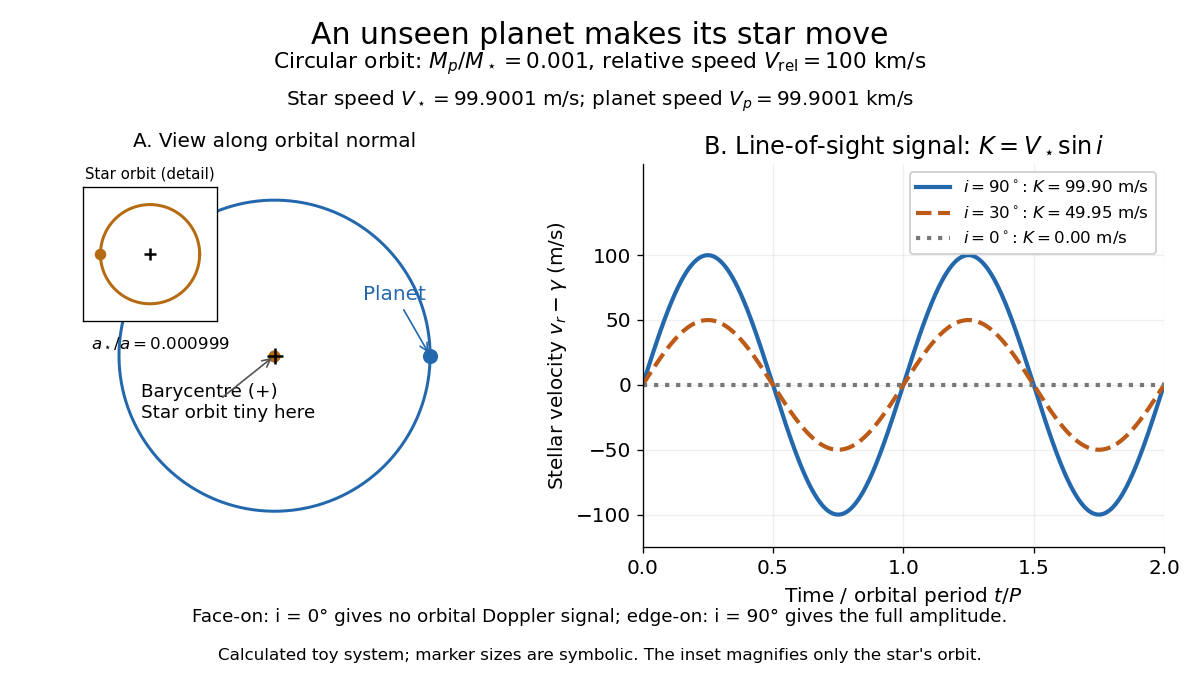


The motion of a star around the astronomical barycenter caused by an orbiting companion. In an isolated two-body problem with relative semi-major axis , the stellar semi-major axis is . Doppler spectroscopy measures its line-of-sight velocity and astrometry measures its projected position on the sky.
Half the peak-to-peak line-of-sight orbital velocity range of a star in a single-companion Kepler orbit. It equals , where is the stellar barycentric semi-major axis, the orbital period, the sky-plane orbital inclination, and the orbital eccentricity. The Doppler spectroscopy formula follows from Kepler's third law for the relative orbit, .
Articles by others on the same topic
There are currently no matching articles.