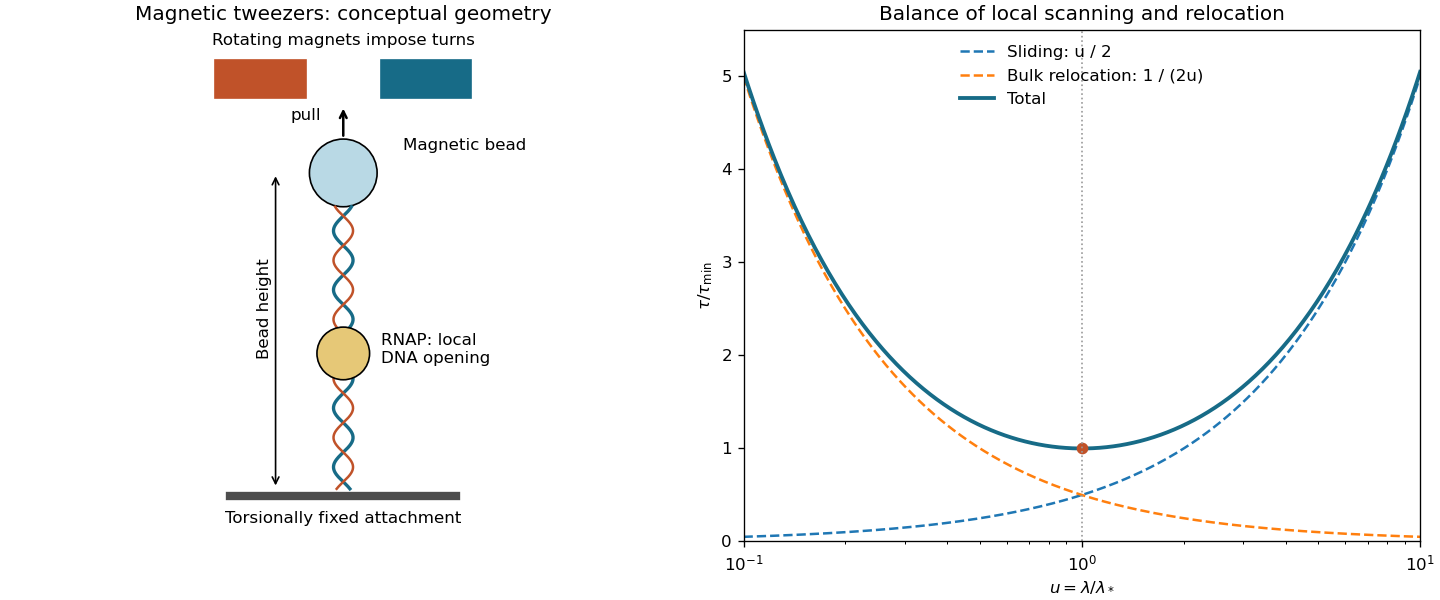
RNA polymerasefirst recognizes and binds a gene promoter to form a closed complex with the local DNA duplex still paired. Local strand separation then produces a transcription bubble in an open promoter complex, making the template available for RNA synthesis. Recognition, binding, and opening are distinct events; observing binding alone does not demonstrate strand opening.
The sign provides an important control. On a positively supercoiled tether, local unwinding requires more positive compensating writhe and generally shortens the tether. On a negatively supercoiled tether, the same unwinding removes some negative writhe and generally lengthens it. Abending or compaction contribution can have the same sign in both cases, whereas the torsional contribution reverses. Comparing signs, together with an extension-versus-turns response measured for the tether, distinguishes local unwinding from mere binding-induced bending. These claims assume the tether remains torsionally constrained and lies in the calibrated supercoiled regime, rather than an arbitrary stretched-DNA regime.
The given facilitated target searchtime contains a rising term Lλ/D1 and a falling term V/(D3λ). Longer sliding explores more neighbouring DNA without another bulk encounter, reducing the cost of three-dimensional relocation; but it also spends longer revisiting local contour. Roughly L/λ local scans, each taking time of order λ2/D1, give the first term. The second represents the bulk encounter cost for an effective capturable contour range of order λ, with a Smoluchowski association rate scaling as D3λ. Numerical geometrical factors are already absorbed in the stipulated scaling formula.
Differentiating at fixed positive L,V,D1,D3 gives
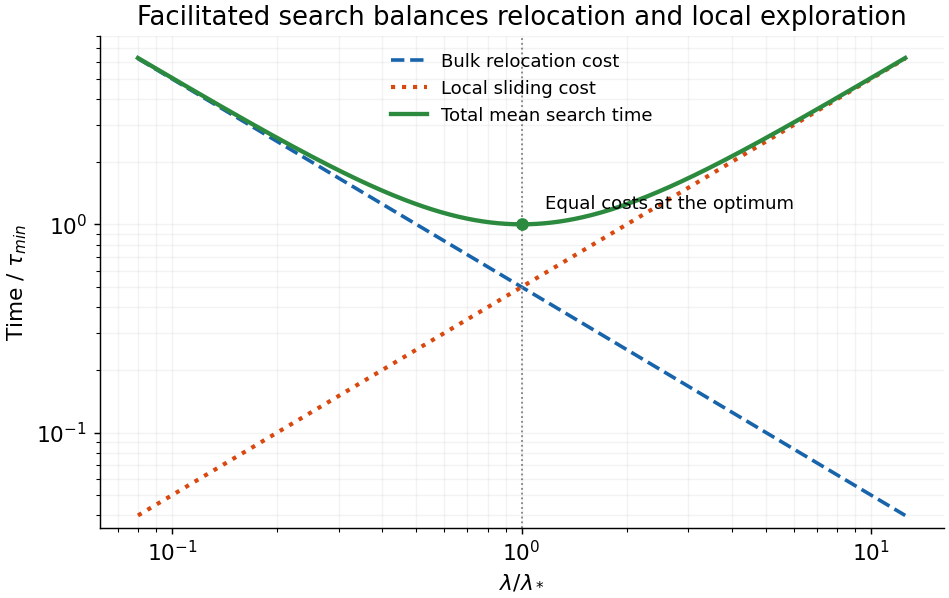
The second derivative 2V/(D3λ3)>0 proves the minimum is unique. The two contributions are equal there. The formal curve diverges at both zero and infinite λ; real sliding lengths are bounded, for example by the available contour, so an inaccessible optimum must be replaced by the nearest physical boundary. In dimensionless form, τ/τmin=(u+u−1)/2 with u=λ/λ∗. The right panel of the original illustration shows its minimum and the two contributing terms. The supplied expression does not include a factor of 6000; it should not silently be identified with the preceding earliest-encounter estimate.
Relative filament sliding draws the Z discs together. The I band and H zone shorten as overlap increases, whereas the thick-filament A-band length is approximately unchanged. Calcium removal restores inhibition and permits relaxation. The many-head ensemble sustains force even though individual cross-bridges repeatedly attach and detach. This sliding-filament description concerns myosin II in muscle; the processive two-head walking of Myosin V in a is a related but distinct motor arrangement.
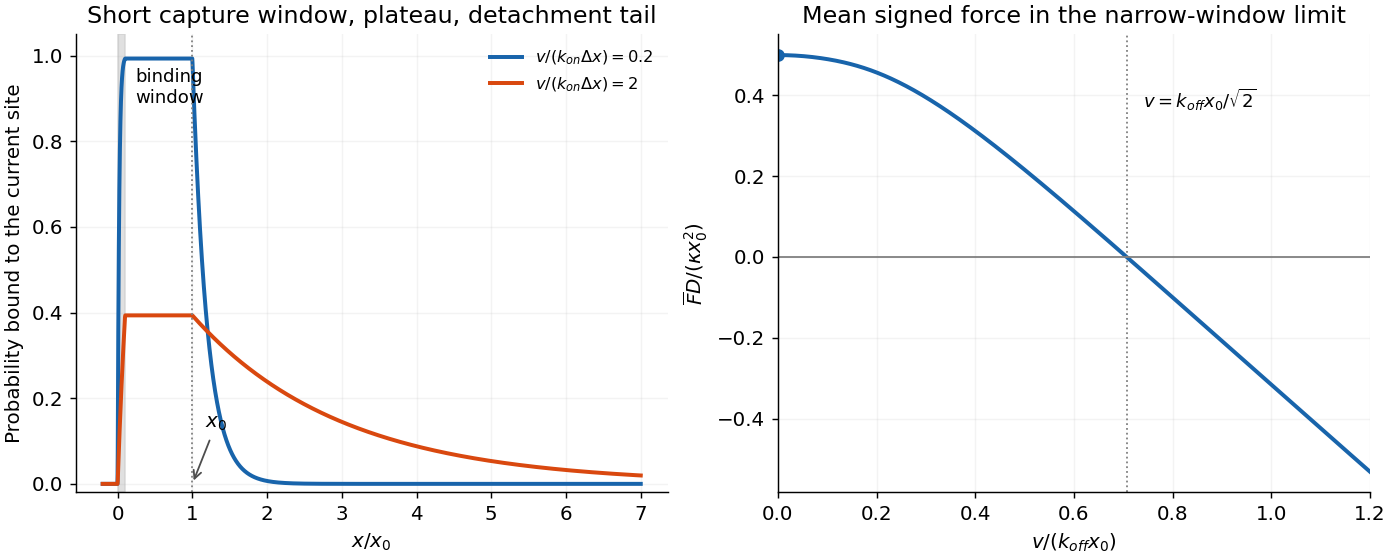
In spatially gated myosin attachment, for a freshly available head encountering an isolated site, take P=0 before the attachment window. Converting time derivatives to positionderivatives with dx/dt=v gives vP′=kon(1−P) in the binding window, P′=0 in the protected bound region, and vP′=−koffP after detachment becomes allowed. Continuity gives
For v<konΔx, the plateau exceeds 1−e−1 and approaches one for much slower motion. For v>konΔx, the binding probability is lower, becoming konΔx/v at very high speed. The spatial detachment tail has length v/koff, so faster sliding makes a longer low-probability tail. The following is an original calculation of those profiles; the force panel is derived in c.
. Original profiles compare velocities below and above the binding-window crossing-rate scale. Binding rises only inside the narrow window, remains constant up to the detachment threshold, and then decays. The second panel shows the resulting signed meanforce in the narrow-windowapproximation. Details.
Reset condition. Geometric separation D≫x0 does not alone guarantee detachment before the next site: independently available encounters also need (D−x0)koff/v≫1. Without that extra timescale separation the head may still be attached to an earlier site.
For completeness, the periodic steady-state correction can be written explicitly. Put a=kon/v, b=koff/v, A0=1−e−aΔx and
Here Q0 is the probability of entering the new window still attached to an earlier site. In the window the new-site probability is P(x)=1−e−ax−Q0a(e−bx−e−ax)/(a−b); after it, use its value pb=P(Δx) in the plateau and tail above. For a=b, replace a(e−bx−e−ax)/(a−b) by axe−ax. This follows from the old-site probabilityQ(x)=Q0e−bx and new attachment rate a[1−P−Q]. The isolated-site result is recovered as Q0→0.
For the work of a spatially gated myosin head, the mechanical force exerted by an attached head in the increasing-x direction is f(x)=−dU/dx=κ(x0−x). It assists motion before x0 and resists it afterwards. For one site encounter the expected work is
In the narrow binding-window limit, retain the capture probabilitypb=1−e−konΔx/v but neglect the attachment displacement compared with x0. The positive work is pbκx02/2. After x0, use s=x−x0 to obtain the negative contribution −pbκ∫0∞se−koffs/vds=−pbκ(v/koff)2. Hence
The force tends to κx02/(2D)as v↓0 and changes sign at v=koffx0/2 in this idealized model. Above that speed forced sliding is resisted on average. The formulauses the reset condition in b, as well as Δx≪x0; if reset fails, replace pb by the periodic capture probability to leading order in Δx/x0. For arbitrary window width, the isolated-site work is exactly ∫0Δx(kon/v)e−konx/v[κ(x0−x)2/2−κv2/koff2]dx. The loaded springenergy must be supplied by the binding/power-strokechemistry; this model does not specify an ATP efficiency. Real force-dependent transition rates and energy budgets limit extrapolation of the toy force-velocitylaw.
Model the target asa perfectly absorbing sphere of reaction radius r0, with a fixed target and a dilute far-field polymerase density c∞. Steady radial diffusion satisfies ∇2c=0, c(r0)=0, c(∞)=c∞, hence
This is an idealized 10−2-second-scale estimate, not a unique geometric prediction. Finite cellshape, crowded motion, accessibility and orientational restrictions can reduce the ideal capture rate.
If nonspecific binding merely sequesters searchers and their freefraction is 0.2, the three-dimensional capture hazard is reduced fivefold: τ≃τ3/0.2≃0.067s for those estimates. If bound molecules instead search productively by sliding, afree-timefraction alone cannot determine the total arrival time or its sign of change. That is the distinct facilitated-search mechanism treated in c.
Write A=V/D3 and B=L/D1. The given mean-search scaling is τ=A/λ+Bλ. Three-dimensional relocation sees an effective capture length of order λ, givinga bulk encounter time V/(D3λ). A sliding excursion explores length of order λ in time of order λ2/D1; sampling order L/λ contour segments gives a total sliding cost of order Lλ/D1. Prefactors, correlations and repeated visits are coarse-grained in this scaling model.
Small slidinglengths make relocation inefficient; very long slidingwastestime revisiting a local DNA region rather than relocating to another. The optimum balances both contributions:
Bulk relocation and local sliding impose opposing search-time costs
. The original dimensionless plot shows a decreasing inverse-sliding-length contribution and an increasing sliding contribution. Their sumhas a minimum where the two costs agree, at a sliding length equal to the analytic optimum. Details.
The model is meaningful only over an accessible range between molecular steps and the available chromosomelength. An optimum outside that range is replaced by a boundary choice; the unphysical divergences at arbitrarily small or large λ describe limits of the scaling expression. A common multiplicative searcher-number factor would not change the optimum, but an exact many-searcher first-arrival mean is not generally obtained by dividing an arbitrary single-searcher mean by their number without a waiting-time assumption.
Independent localization errors of varianceσloc2 add an intercept 2σloc2. Finite exposure adds motion blur, and drift, binding transitions and the finite DNA contour must be distinguished from free sliding. Aslope fit with those limitations can estimate D1; simply fitting all observed displacements to a noiseless line can bias it.
Consequently no fluorescencecamera could temporally resolve trajectories under the stated formal values, regardless of the spatial excursion'slength. An actual corrected exponent cannot be inferred uniquely from the paper. If a physically plausible D1 were supplied instead, resolving sliding would require exposures substantially shorter than τbound and diffusiondisplacements larger than localization error, with enough detected photons. The dependence on D1 is explicit above, so no guessed source correction is needed.
The term V/(D3λ) is the bulk-diffusion search cost: increasing the effective length of DNA searched after each encounter enlarges the useful capture region and reduces this contribution. The term Lλ/D1 is the accumulated sliding cost. Approximately L/λDNA landing-and-sliding episodes, each taking order λ2/D1, give Lλ/D1. These are scaling estimates; geometric constants and correlated revisits are omitted by the supplied model.
Thus the facilitated target search is slow as λ→0, because too little sequence is examined per encounter, and slow at very large λ, because sliding and repeated local exploration take too long. A finite intermediate minimum balances 1D scanning against 3D relocation. The right panel of the figure in solution shows the two contributions and their sum. The model requires auseful range of sliding lengths below the full chromosomelength, finite positive diffusion coefficients and effective relocation between episodes; it is not a claim that arbitrarily large λ is physically available.