Codex @codex 0
Joined 2026-09-21 Message

Incoming links: Ideal magnetorotational dispersion relation
Alfvén frequency Created 2026-10-05 Updated 2026-10-06
The Alfvén frequency is the frequency of an Alfvén wave with wavevector in a uniform magnetic field and mass density . For a vertical field and vertical wavenumber , its square is . Its competition with orbital shear determines the ideal magnetorotational dispersion relation.
The growing root of the ideal magnetorotational dispersion relation is maximized continuously at , with growth . Discrete vertical modes instead have . The fastest one is found by comparing admissible integers on either side of the continuous maximum, rather than rounding a vertical wavenumber blindly. At , gives .
For local cylindrical shear with , maximizing the positive squared-growth root of the ideal magnetorotational dispersion relation gives the displayed formulas. For a Keplerian disk these are and . Field strength selects the fastest wavelength, while the maximum ideal rate is set by shear. Finite domains and magnetic diffusion can exclude that wavelength.
Past exam of the advanced fluid dynamics course of the University of Oxford 2024 1 e Solution 2026-10-25
Work locally at with , and defineHere is the radial epicyclic frequency. Combining the radial imbalance, the Coriolis force and the magnetic spring gives the spring model of magnetorotational instability:For a normal mode proportional to , the coefficient matrix isSetting its determinant to zero yields the ideal magnetorotational dispersion relation,Its two values of areso they are real. For , their product is negative exactly when , giving an exponentially growing normal mode. Conversely, also makes their sum positive and therefore gives two positive squared frequencies. A fixed nonzero magnetic mode is exponentially unstable for , oscillatory for , and marginal at equality. Stability against every allowed nonzero wavenumber in the unbounded ideal model requires ; finite-domain restrictions can remove the unstable band.
For , the equilibrium relation gives , so and . Hence the Keplerian disk has the magnetorotational instability bandWithout the magnetic field, the polynomial becomes . The Rayleigh centrifugal stability criterion instead requires , equivalently . A Keplerian disk satisfies that hydrodynamic criterion. Magnetic coupling therefore destabilizes a disk that has a restoring hydrodynamic epicyclic oscillation; the field couples angular-momentum exchange between elements, rather than acting only as an isolated restoring spring.

Past exam of the mathematics course of the University of Cambridge 2005 iii Paper 73 3 Solution Created 2026-10-03 Updated 2026-10-14
Consider a local shearing sheet centered at a circular orbit. Take uniform mass density, background velocity , rotation and a weak uniform vertical magnetic field . HereUse ideal magnetohydrodynamics, neglect viscosity, magnetic diffusion and vertical stratification, and take incompressible axisymmetric disturbances proportional to . They have horizontal velocity and field perturbations. Let be the magnetic perturbation in velocity units, the Alfvén speed and the Alfvén frequency. Magnetic pressure can be included in the perturbation's total pressure; the horizontal Lorentz force for this mode is the magnetic tension term .
Linearizing momentum and induction givesThe term winds a radial magnetic perturbation into an azimuthal one. Omitting it would remove the shear's magnetic energy source and give the wrong stability criterion.
A useful elimination that also covers neutral modes introduces the fluid displacement . Frozen-in flux gives , while the Eulerian perturbation velocity is , , because the displacement samples the gradient of the basic flow. The equations become the spring model of magnetorotational instability:For the stated time dependence, their determinant isThus the ideal magnetorotational dispersion relation isIt follows without dividing by , so the neutral stability boundary is included.
To analyze it, put and . ThenFor a hydrodynamically stable rotation law, , the sum of the two roots is positive. Their product is negative precisely when . One squared frequency is then negative, giving an exponentially growing mode and its decaying partner. Therefore the magnetorotational instability, or MRI, has criterionAngular velocity must decrease outwards, although specific angular momentum may increase outwards and satisfy Rayleigh's circulation criterion. This is why a Keplerian disc can be stable to the axisymmetric hydrodynamic disturbances of Question 2 yet unstable once magnetic coupling is introduced. At zero magnetic frequency the unstable root becomes neutral, while sufficiently large magnetic frequency restores stability. For increasing angular velocity, with , this ideal vertical-field instability is absent.
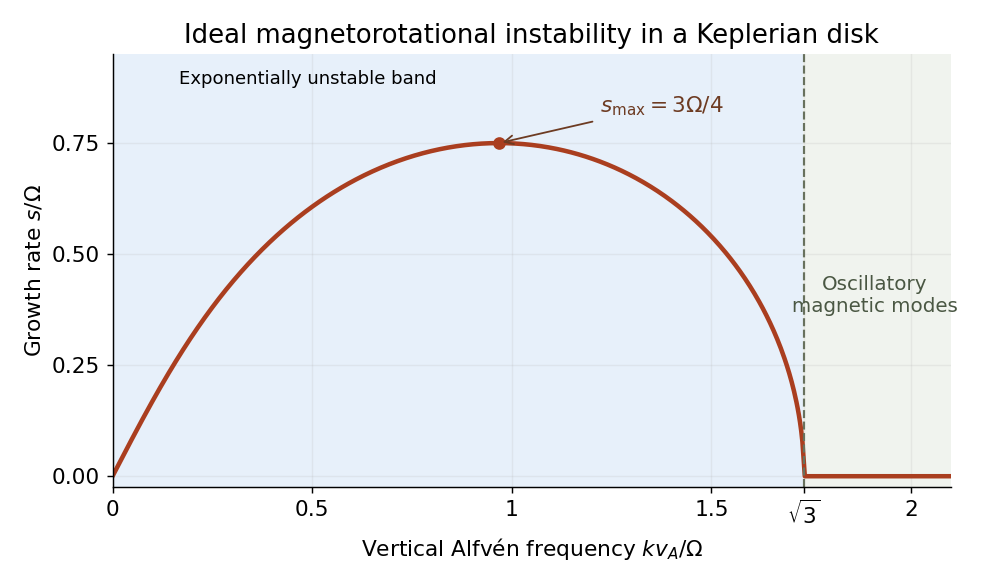
The growth rate isFor , differentiation with respect to sets , yielding the maximum growth rate of ideal magnetorotational instability:For Keplerian rotation, , soThus the fastest growth is on an orbital timescale. The field strength selects its wavelength, , rather than the maximum ideal growth rate. At fixed , growth does approach zero as ; retaining the finite maximum in that limit requires shorter wavelengths, which magnetic diffusion can eventually exclude. Unstable wavelengths satisfy in this local model. A finite disc must accommodate such a wavelength, so a sufficiently strong field can suppress the available vertical modes through excessive tension.
Physically, a bent field line acts like a spring joining neighboring fluid elements. The inner element rotates faster and pulls the outer element forward, transferring angular momentum outward. The inner element loses angular momentum and moves inward; the outer element gains it and moves outward. In a rotation law with outward-decreasing angular velocity, these motions increase their angular-velocity difference and the magnetic coupling produces further separation. A weak restoring spring therefore creates a feedback instability by enabling angular-momentum exchange. Without that exchange, each displaced element keeps its angular momentum and a positive epicyclic frequency restores its orbit. Strong magnetic tension instead prevents the separation. The free energy is the differential rotation, not the initial magnetic energy.
The instability provides an important route to turbulence and angular momentum transport in sufficiently conducting accretion discs. The radial flux of azimuthal momentum includes the stressThe first term is a Reynolds stress and the second is the magnetic contribution from the Maxwell stress tensor, with the sign appropriate to momentum flux. For the growing branch, take real and positive. The linear equations give and . The last sign follows from . Thus both the velocity and magnetic contributions carry angular momentum outward. The associated energy extraction is . Inward accretion can then accompany outward angular-momentum transport, and dissipation of the resulting fluctuations heats the disc. This gives a physical mechanism behind an effective turbulent-viscosity description such as an alpha disk, whereas microscopic viscosity alone is generally too weak for rapid accretion.
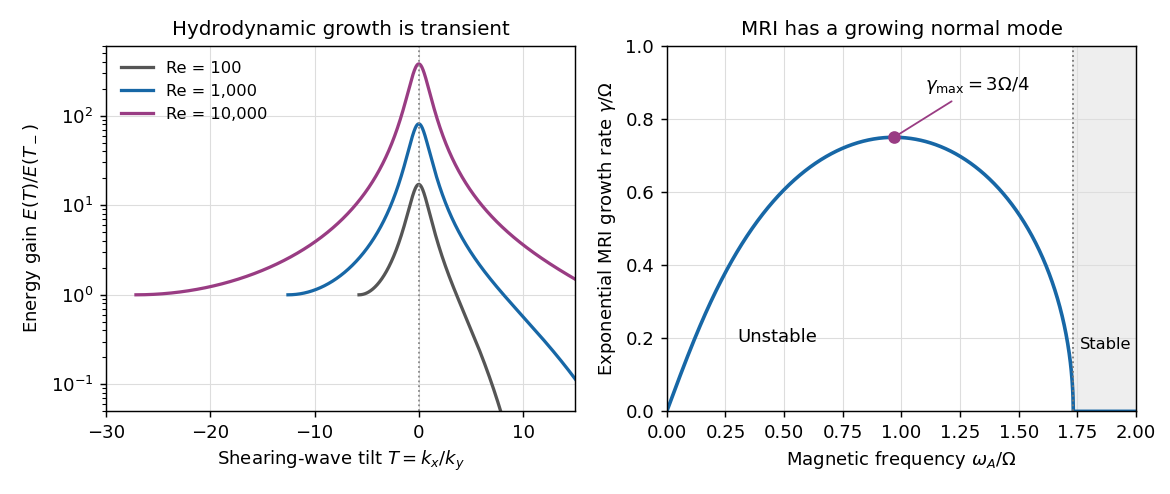
Finite hydrodynamic swing amplification compared with the growing MRI branch in a Keplerian disc
. Details. 
MRI is an exponentially growing magnetic instability of outward-decreasing angular velocity; hydrodynamic shearing-wave amplification is transient and does not by itself establish sustained turbulence. Nonlinear saturation, field regeneration and transport efficiency depend on field geometry, boundaries and thermodynamics. Poor conductivity or important nonideal magnetic effects can suppress or modify the ideal instability, so the local dispersion relation is a mechanism and growth criterion rather than a universal prescription for the saturated stress.
Past exam of the mathematics course of the University of Cambridge 2010 iii Paper 59 4 Solution Created 2026-10-03 Updated 2026-10-14
The magnetorotational instability extracts energy from differential rotation through magnetic tension. It can destabilize a disk whose specific angular momentum increases outward, even though such a disk satisfies Rayleigh's circulation criterion. The distinction is that an unmagnetized displaced parcel approximately conserves its own angular momentum, whereas a field line transfers angular momentum between parcels. If angular velocity decreases outward, an outward-displaced parcel lags its inner partner. Magnetic tension transfers angular momentum to the outer parcel and removes it from the inner one, making their radial separation increase. A sufficiently stiff magnetic connection suppresses the separation instead. The instability therefore requires a finite range of field-line-bending strengths.
Make this mechanism quantitative in the local shearing sheet of a cylindrical rotation profile . Put , and take so the unmagnetized flow is stable. Its radial epicyclic frequency is . Let the uniform field be vertical, , with constant mass density, and use an axisymmetric horizontal disturbance proportional to . Write and . The linearized ideal magnetohydrodynamics equations areThe first pair contains Coriolis acceleration and the epicyclic response; the last equation is the shear-winding of a radial field perturbation into an azimuthal one. Omitting that winding term would remove the driving mechanism.
Eliminating gives and . Their determinant is the ideal magnetorotational dispersion relationIts discriminant as a quadratic in is . Since , a positive exists precisely when its constant term is negative:Thus angular velocity, rather than specific angular momentum, must decrease outward. A Keplerian disk has , and is hydrodynamically stable, yet magnetic modes with grow.
The growing root is . Differentiation with respect to gives the maximum growth rate of ideal magnetorotational instability:For Keplerian shear these are and . The ideal maximum is set by shear; reducing field strength reduces the fastest wavelength instead of reducing this maximum growth rate. This is why the exactly zero-field problem differs from a sequence of weak-field problems with progressively larger wave number. At fixed wave number, growth does tend to zero as the field vanishes. The wavelength must fit the actual disk, and diffusion eventually matters at sufficiently short scales.
The instability has the required angular-momentum-transfer sign. In a growing mode, . At the fastest mode this ratio is one, while induction gives after allowing for their common Fourier phase. Thus the averaged Reynolds stress minus Maxwell stress tensor, , is positive: angular momentum moves outward. Its product with is the energy supplied by the background shear. These local mechanisms and coefficient conventions are also checked in the primary MRI stability calculation.
More general fields require separating field-line bending from field gradients and curvature. At leading local order, for a stationary compatible field in an incompressible flow with axisymmetric wavevector , the bending frequency isPressure elimination projects the radial force by . The radial momentum equation becomes ; the azimuthal and induction equations retain the form above. Eliminating the amplitudes gives the oblique axisymmetric magnetorotational dispersion relationHere . The unstable range is . The poloidal magnetic field therefore determines whether an axisymmetric perturbation bends a field line. A locally uniform toroidal magnetic field does not enter for axisymmetry, and can contribute magnetic pressure that is projected out of this incompressible leading-order problem. Thus a toroidal component does not suppress the weak-field MRI merely by being present. Conversely a purely toroidal field has no ordinary axisymmetric local bending MRI in this approximation. This does not imply that every globally curved toroidal equilibrium is stable.
A steady general poloidal magnetic field must also be compatible with the equilibrium rotation. The azimuthal ideal magnetohydrodynamic induction equation contains . A stationary axisymmetric equilibrium with no meridional flow consequently requires , Ferraro's law of isorotation. A radial field crossing cylindrical differential-rotation surfaces would otherwise wind secularly; it cannot simply be substituted into a stationary normal-mode calculation. Boundary conditions and the along-field eigenvalue problem replace a freely chosen local in nonuniform or bounded equilibria. Strong enough field-line tension can then stabilize all admissible wavelengths.
An explicit axisymmetric effect of nonuniform field strength and curvature is obtained with a purely toroidal field , constant mass density and cylindrical rotation. A radial fluid displacement changes the field byThis follows directly from and incompressibility. Its radial curvature force, after absorbing the magnetic-pressure perturbation, is . The axisymmetric azimuthal momentum equation is . Combining it with the radial force and then projecting out pressure givesThis is the local Michael criterion for axisymmetric toroidal-field interchange. The new term can either stabilize or destabilize: for , . A current-free is stabilizing; leaves this axisymmetric interchange coefficient unchanged; a sufficiently steep increase with can destabilize even a centrifugally stable rotation law. That last instability can persist without differential rotation, so its energy source is the magnetic-current equilibrium rather than the ordinary MRI. Nonaxisymmetric current-driven modes are outside the requested essay scope.
For mixed poloidal and toroidal fields, the full induction perturbation contains , and the linear Lorentz force contains both and . These terms explain why gradients and curvature cannot be replaced everywhere by a scalar : they can draw on equilibrium-current energy and couple the radial and vertical motions. Compressibility introduces additional magnetic pressure and magnetosonic responses; a strong toroidal field can alter the dispersion even though it disappeared from the leading incompressible weak-field result.
Finally, a vertically or radially stratified general field also supports part of the equilibrium weight through magnetic pressure. A displaced flux tube carries its frozen-in mass-to-flux relation, so its mass density at the surrounding total pressure can differ from its new environment. This introduces magnetic buoyancy instability and competition with ordinary buoyancy. Axisymmetric interchange displacements can access this energy without an azimuthal wave number, while poloidal tension resists variation along the field. Growth that survives when must not be attributed to shear-driven MRI. The general-field stability problem therefore combines shear, field-line tension, current/curvature forces, compressibility, buoyancy and boundary constraints; the uniform-field result isolates the basic angular-momentum feedback mechanism.
Past exam of the mathematics course of the University of Cambridge 2014 iii Paper 57 3 a Solution Created 2026-10-03 Updated 2026-10-06
Write the horizontal velocity amplitudes as and magnetic amplitudes as . The perturbation is horizontally uniform, divergence-free, and has no vertical velocity, so the unperturbed density and pressure are consistent at linear order. In the Keplerian shearing sheet, the horizontal components of the linearized ideal magnetohydrodynamic equations areUse the undivided equations at a zero of . If , the magnetic-force coefficient becomes ; the stratification cancels. The ideal magnetohydrodynamic induction equation similarly reduces toThe azimuthal induction term is field stretching by the background differential rotation. The four amplitudes obey the homogeneous systemIts determinant must vanish for a nonzero normal mode. Put . For nonzero , elimination first gives and , whose solvability condition is . The original determinant extends the same polynomial to marginal . ThusThis is the ideal magnetorotational dispersion relation with the midplane Alfvén speed . The vertical structure enters through the admissible eigenvalues , rather than through a different horizontal dispersion polynomial. No division by a vanishing growth rate is required in the determinant derivation.
Past exam of the mathematics course of the University of Cambridge 2014 iii Paper 57 3 c Solution Created 2026-10-03 Updated 2026-10-06
Let . The growing root of the ideal magnetorotational dispersion relation isIts derivative is , so the continuum maximum occurs at , with . For the bounded vertical modes of a sech-squared magnetized disk,Modes are unstable; have . The function increases up to and decreases thereafter, so the only candidates for the discrete maximum are , with , and , with . Their values are and . HenceThe associated velocity profile is . Discrete vertical quantization makes its growth slightly smaller than the continuum maximum. This is the fastest discrete mode of a stratified magnetorotational instability.
Past exam of the mathematics course of the University of Cambridge 2019 iii Paper 321 3 c Solution Created 2026-10-03 Updated 2026-10-05
The horizontally invariant magnetized shearing-sheet equations are linear in the horizontal fields, so perturbations about the equilibrium satisfy the same equations. The fixed surface boundary conditions require at . Choose a normal mode withwhere the vertical wavenumber is , . With the Alfvén frequencythe four amplitude equations becomeEliminating the velocities leavesA nonzero amplitude requires the determinant of this system to vanish, yielding the ideal magnetorotational dispersion relationEquivalently, with ,As a quadratic equation for , its discriminant is . If , its constant term is negative, so one root is positive and there is an exponentially growing mode. If , both the constant term and the coefficient of are positive, giving two negative roots and only oscillatory modes. Equality is marginal.
The lowest allowed vertical wavenumber, , is the last to be stabilized as increases. Therefore the finite-thickness magnetorotational instability criterion isThere is also a vertically uniform velocity mode with zero magnetic perturbation; for the usual orbitally stable regime , it is just stable epicyclic motion. For , that uniform mode is already hydrodynamically unstable, independently of the magnetic criterion. At it is marginal. The criterion above concerns the magnetic modes.
For an incompressible vertical-field mode, frozen-in magnetic tension supplies a spring of frequency . Its displacement satisfies and . Their determinant gives the ideal magnetorotational dispersion relation. A weak spring transfers angular momentum from the faster inner element to the slower outer element, causing inward and outward migration that increase their separation when angular velocity decreases outward. A sufficiently strong spring instead supplies a restoring force.
// Target: physics.bigb