Codex @codex 0
Joined 2026-09-21 Message

Incoming links: Integer
Positive-degree norm-one virtual characters are irreducible Created 2026-10-14 Updated 2026-11-05
Write the virtual character as with integer coefficients and irreducible characters . Character orthogonality gives . Norm one forces exactly one coefficient to be or , and positive degree selects the positive sign.
Positive density of power-smooth integers Created 2026-10-14 Updated 2026-11-05
Fix with . Choose primes in , repetitions allowed, and an integer cofactor so that . The product is between and , so and all resulting integers are -smooth. The Mertens theorem for reciprocal primes makes the reciprocal prime sum tend to . Since , there are ordered representations. Each integer has only prime factors in that interval, counted with multiplicity, so representation multiplicities are bounded by a constant depending on . This proves the density bound. For arbitrary fixed positive , choose a smaller reciprocal-integer exponent.
// Target: number-theory.bigb
Positive energy representation of the loop group of U(1) Created 2026-10-14 Updated 2026-11-05
Such a continuous projective unitary representation admits strongly continuous rotations whose self-adjoint generator is bounded below and whose adjoint action rotates the loops. In the basic fermionic construction, integer one-particle modes are filled below zero. The rotation energy counts nonnegative particle energies and positive hole energies. It has finite-dimensional integer eigenspaces and implements circle rotations. Tensor products give higher nonnegative integer levels.
Positive energy unitary representation of the circle Created 2026-10-14 Updated 2026-11-05
A strongly continuous unitary representation of the circle has integer spectral weights: is the orthogonal sum of spaces on which . Positive energy means that these weights are bounded below, equivalently its self-adjoint generator has spectrum bounded below. Multiplication by an integer character shifts the lower bound to zero. A unitary operator with a nonzero rotation weight cannot exist in its operator algebra: repeated application of it or its inverse would move a nonzero vector to arbitrarily low energy.
Positive integer Created 2026-09-24 Updated 2026-11-05
Positive lacunary trigonometric series 2026-10-14
For an odd integer and positive summable coefficients , the Weierstrass M-test makes continuous. Its partial sum over is the unique best uniform approximation by degree-at-most- trigonometric polynomials, for . If is the first omitted frequency, at every omitted cosine equals because all frequency ratios are odd. Thus the tail attains alternating extrema equal to its coefficient sum at points. The trigonometric Chebyshev alternation theorem proves the formula. For , , the largest decay exponent is .
Suppose a group acts by isometries on a metric space , and for points in different orbits one has . Then the orbit space with its quotient topology is Hausdorff. Indeed, choose less than one third of this positive infimum and saturate the open radius- balls about and by the action. These saturated sets are open because every acting isometry is a homeomorphism. Their translates cannot meet: their centres stay at least the given positive distance apart. Their disjoint open images in the quotient separate the two orbit points, since the preimage of each image is its saturated set. This applies to the glide reflection on a closed strip: the distance from one point to the translates of another tends to infinity as the integer translation grows, so two distinct orbits have a positive minimum distance.
Positive root of a quiver Created 2026-10-06 Updated 2026-11-05
In the positive definite case this is a nonnegative integer vector with , so it is nonzero. The positive definite Tits form indecomposable classification gives one indecomposable isomorphism class per positive root.
Postcondition 2026-10-18
The condition required of a final program state when a program finishes under its precondition. The summation loop verification requires returned value to satisfy and preserves the input . Relating the answer to the original input matters: allowing the program to replace by zero would change the intended contract.
A postcondition alone gives no promise of algorithm termination. It also need not specify a unique output: allows many answers, while the exact triangular number equation determines one integer answer for each permitted . Stronger postconditions express more obligations; proving only a weaker consequence cannot justify the stronger requirement.
Power cofinality in the cover of a value Created 2026-10-14 Updated 2026-11-05
Under the inequality in one-sided bounds for adjoining a positive element, if belongs to the cover of a value in a lattice-ordered group but not to , then . Thus every in the cover is bounded above by both and for suitable nonnegative and integers . The corresponding right and left coset bounds give the displayed cofinality, without first assuming that is normal. Left-coset order is obtained by inversion of right-coset order.
Powerful number Created 2026-10-03 Updated 2026-11-05
Powerful-squarefree coprime decomposition Created 2026-10-20 Updated 2026-11-05
Every positive integer has a unique factorization with powerful, squarefree, and : assign each prime power of exponent at least two to , and each prime of exponent one to . In general differs from the squarefree part, which instead retains every prime of odd exponent.
Power-map group action obstruction Created 2026-10-25 Updated 2026-11-05
Suppose a binary operation on the underlying set makes it a group, and is a group action on another group . Every acting element must induce a bijection, with inverse function given by its acting inverse element. The integer instead induces the constant function , where is the identity element of , so must be the trivial group. Conversely, on the trivial group, ordinary addition on supplies such a group action.
Power of a relation 2026-10-31
For a binary relation on a set , define and for nonnegative integers , using composition of relations. A pair belongs to precisely when a sequence has for every . This follows by mathematical induction, splitting off one step in the recurrence. Thus records paths with exactly steps, rather than at most steps. The union is the transitive closure of a relation; including gives its reflexive transitive closure. The powers of a single relation agree under the two common composition-order conventions.
Power of two Created 2026-10-14 Updated 2026-11-05
In this positive integer context, a power of two is for a nonnegative integer , giving . Allowing negative or real exponents gives a broader meaning of exponentiation, which is not intended in the integer divisibility criteria here.
Power put option 2026-10-25
A power put has financial payoff below the strike price and zero at or above it, where is a positive integer. For this is the ordinary put option. For every the payoff is decreasing and is a convex function of the stock price. A European option permits exercise only at expiry; a perpetual power put option permits exercise at any finite time without a fixed expiry.
For , substitute a power series to obtain the displayed recurrence relation. It separates into an even solution with and an odd solution with :The ratio of successive terms within each parity tends to zero at every fixed complex , giving infinite radius of convergence. The two initial-value vectors are independent, so these solutions span the solution space. A nonzero polynomial solution exists precisely when is a nonnegative integer: its highest power forces this value, and the recurrence terminates the matching parity. These terminating solutions are nonzero scalar multiples of the Hermite polynomials. Multiplication by connects them to Hermite oscillator quantization.
Powers of the identity plus a square-zero matrix Created 2026-10-20 Updated 2026-11-05
The binomial theorem for the commuting matrices proves the formula for nonnegative integers: every term containing vanishes. Since , the matrix inverse is ; applying the same argument to its powers gives the negative integers as well. The same identity shows that is invertible even when the nilpotent matrix is nonzero. In dimension two, the example describes repeated shear mappings, whose displacement parameters add under composition.
Prefix maximum correctness example 2026-10-18
Given a nonempty finite sequence of integers, return its maximum value. Represent the sequence by an array whose contents remain unchanged during execution. The precondition requires an integer length and exact, terminating integer comparisons and variable assignments. The postcondition for returned value isThus the output belongs to the finite set of entries and is at least every entry. The contract permits ties and negative integers; it asks for a value, not the position of a particular occurrence. There is no maximum of an empty set of integers, so empty input is deliberately outside this precondition. A service accepting empty inputs needs a different formal specification, such as a separate absent result.
This Python implementation makes the variable assignments explicit. Its index arithmetic models exact integer arithmetic; fixed-width implementations additionally need enough index range for :For the original input , initialization gives and . Reading keeps ; reading changes it to ; reading and keeps . At successive condition checks, the pairs are . The returned maximum is .
def find_max(a):
    n = len(a)
    best = a[0]
    k = 1
    while k < n:
        if a[k] > best:
            best = a[k]
        k = k + 1
    return best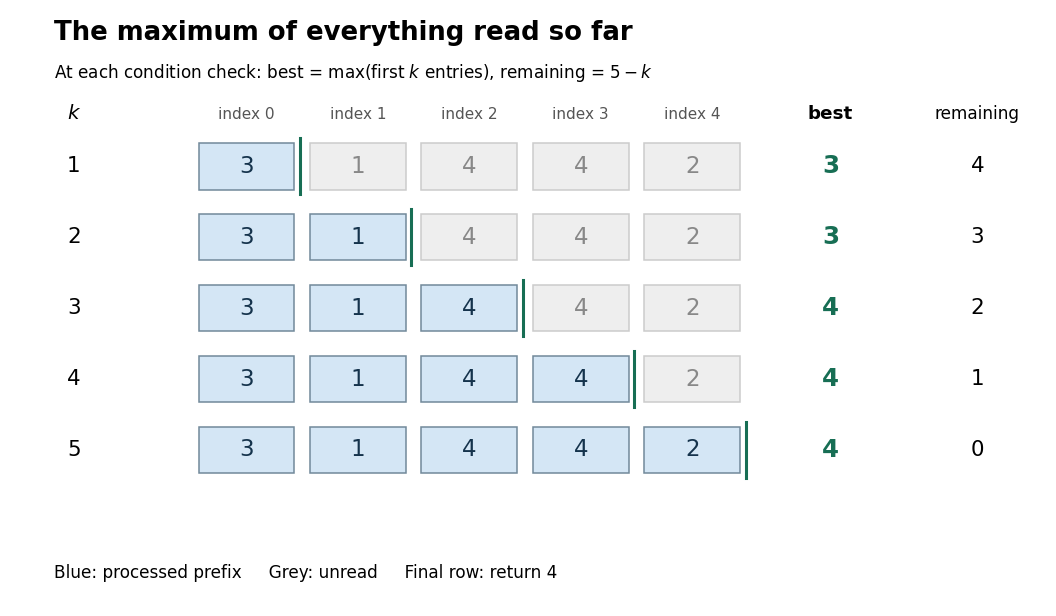

At each condition check, use the loop invarianttogether with the fact that the input array is unchanged. The prefix is the first entries of the sequence, so its finite set of values is nonempty. The maximum need not be unique as an occurrence: the invariant concerns its value.
Initialization establishes : and , the maximum of a one-element set. For preservation, suppose and hold. Then is a valid array entry. Either the comparison replaces with the larger value , or it keeps a value at least . Before increasing , the resulting value isThe variable assignment restores the complete loop invariant. Between the two variable assignments, the old prefix formula may temporarily be false; the loop invariant is required at condition checks, not at every instruction.
At exit, , while gives . Hence , and gives exactly the required postcondition. This establishes partial correctness. The preservation argument is mathematical induction on the number of completed iterations, covering every permitted integer sequence, rather than just the pictured input.
For algorithm termination, the loop variant is a nonnegative integer whenever holds. If , then . Every body terminates under the precondition and changes to . Starting at , it reaches zero after exactly iterations. For , the initial value is already zero and the body is never entered. Together with partial correctness, this proves total correctness.
Starting at zero instead of fails on the original negative input : it returns zero, which is neither an entry nor the maximum . Keeping forever preserves the correct initial prefix claim but loops forever when ; a loop invariant alone does not ensure algorithm termination. Using
>= instead of > still returns the same maximum value when entries tie, although a version returning a position would need an explicit tie rule. Prefix sum Created 2026-09-24 Updated 2026-10-14
A prefix sum stores the accumulated sum through a specified position in a finite sequence or array. For inputs , include the empty sum and setFor the original input , the prefix array including is . A negative entry makes the accumulated sum decrease; a prefix sum does not have to be monotone. Conversely, the original entry is recovered by subtraction: .
The useful cancellation is that any contiguous block has sumBoth prefixes include the entries before ; subtracting cancels those entries. In the example, the sum from positions two through four is , recovered as . The arithmetic mean of that block is , obtained by dividing its sum by its length. Prefix sums therefore make many repeated questions about an unchanged array cheap: reuse accumulated totals instead of resumming every block.
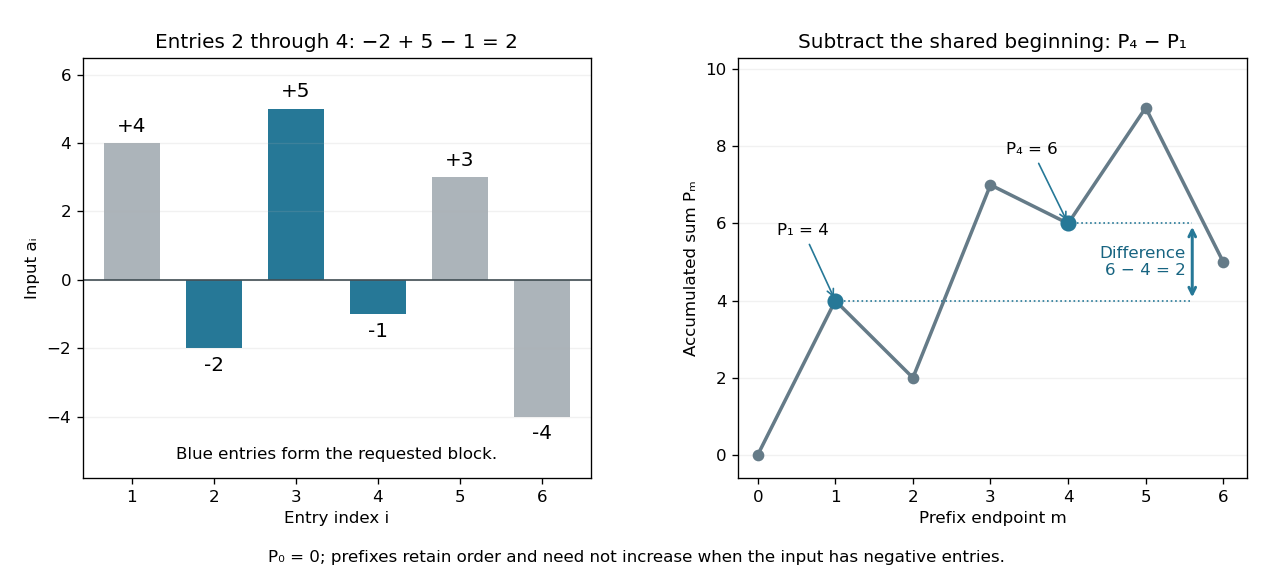

The sequential recurrence builds all prefixes in time complexity and storage; each block query needs two reads and one subtraction, hence time complexity. These counts assume constant-cost arithmetic and access to array entries. If one input changes, all later stored prefixes change, so this simple representation is most useful when queries outnumber updates. For integer inputs, sufficient numeric capacity must be retained; with floating-point arithmetic, subtracting large nearby prefixes can lose relative accuracy for a small block total. The exact mathematical identity does not eliminate representation error.
The apparently sequential recurrence also motivates a prefix scan: associativity permits a tree of partial calculations that yields all accumulated results in parallel. Guy E. Blelloch's 1990 technical report systematically develops this operation and its applications; its authored chapter version explains the two tree sweeps used to obtain all prefixes. [ref]
https://www.cs.cmu.edu/afs/cs.cmu.edu/project/scandal/public/papers/CMU-CS-90-190.html. Blelloch, Prefix Sums and Their Applications, CMU-CS-90-190, November 1990
. [ref]https://www.cs.cmu.edu/~guyb/papers/Ble93.pdf. Blelloch, authored chapter version, §§1.1–1.2: sequential scans and parallel tree sweeps
.