
Molecule Created 2026-10-13 Updated 2026-10-14
A molecule, using the International Union of Pure and Applied Chemistry (IUPAC) convention, is an electrically neutral entity containing two or more chemical atoms. Its constituents form a bound unit through chemical bonds; merely drawing a boundary around neighboring particles does not make a molecule. The neutrality requirement concerns total electric charge, not the absence of internal charge separation: water is a polar molecule with zero total electric charge.[ref]
One water molecule, , contains two hydrogen and one oxygen chemical atom. One molecular oxygen molecule, , contains two oxygen chemical atoms; a molecule need not contain different chemical elements. One carbon dioxide molecule, , contains one carbon and two oxygen chemical atoms. The molecular formula records these inventories, while molecular geometry describes their arrangement. Water and carbon dioxide are chemical compounds; molecular oxygen is a form of one chemical element.
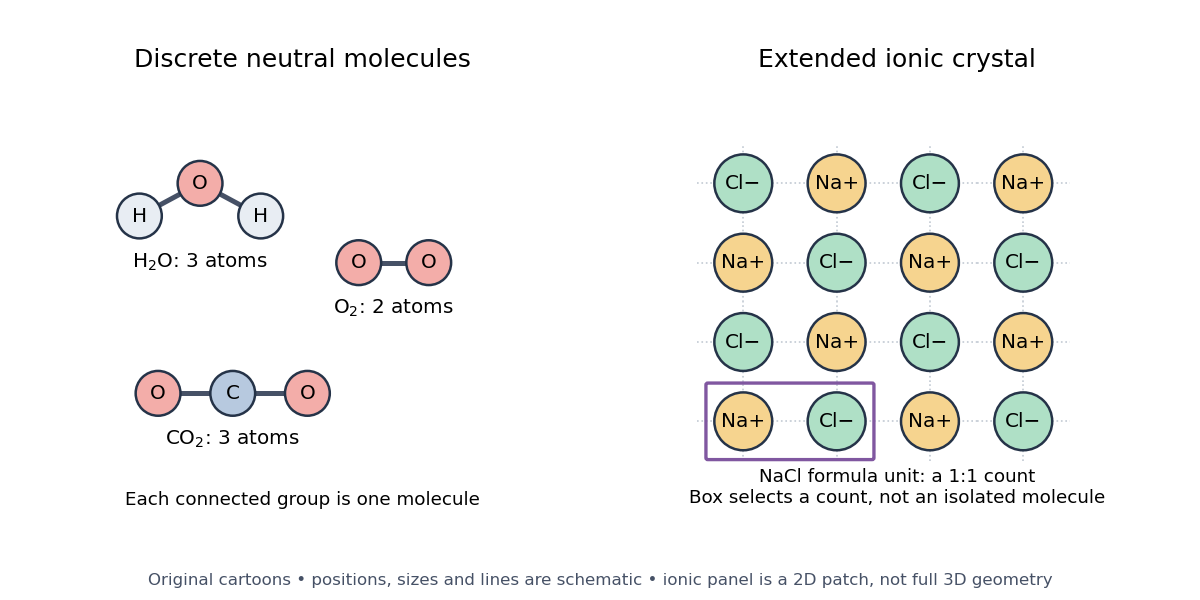

Ordinary crystalline sodium chloride, , contains an extended arrangement of sodium cations and chlorine anions . Its formula unit specifies one of each for compositional accounting, without selecting a unique isolated pair. Bulk neutrality therefore does not imply a material consists of neutral molecules. This statement concerns the ionic crystal; the physical state and conditions matter when deciding what particles a chemical formula represents.[ref]
2.6 Ionic and Molecular Compounds. Ionic Compounds: NaCl composition and the absence of discrete molecules in the ordinary crystal
A polyatomic ion is a charged bound group of chemical atoms, such as hydronium, . A molecular ion formed by removing an Electron from intact water, , retains the same atom inventory but has net electric charge . Neither satisfies the neutral-molecule definition. Distinguishing these entities makes molecular count and amount of substance and mass spectrometry interpretable: say whether the count is of chemical atoms, neutral molecules, ions, or formula units.
The useful surprise is that a molecule can be treated as one particle for motion and counting while retaining internal structure. Its molar mass connects a particle inventory to bulk mass; molecular rotation and molecular vibration reveal internal organization. The continuum approximation uses bulk fields in place of individual molecular positions and motions.