Consider the original linear system with a symmetric matrix that is also a tridiagonal matrix:Here and the Jacobi method readsStarting from , the first three vectors areEvery right-hand side uses superscript , including the middle row, even when a new first coordinate has already been computed.
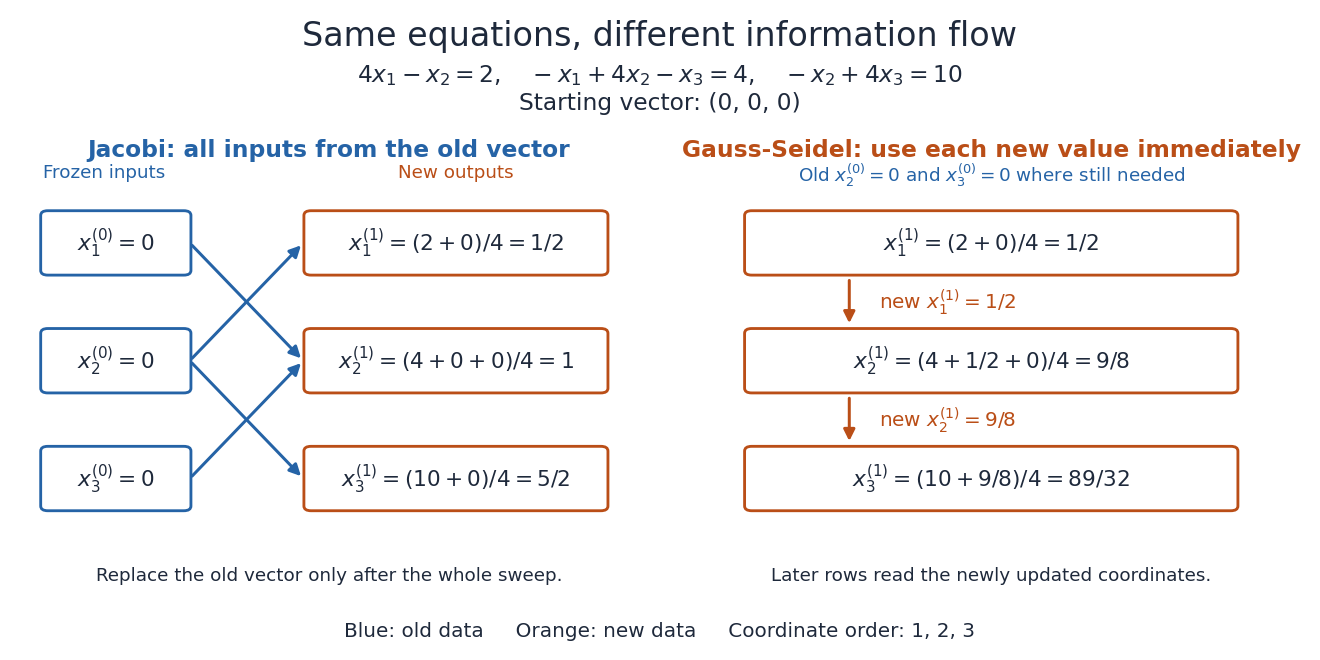
Simultaneous old-to-new component updates in the Jacobi method, compared with immediate reuse in the Gauss-Seidel method
. Details. 
For comparison, a first Gauss-Seidel method sweep in coordinate order givesThe new first coordinate enters the middle update, and the new second coordinate enters the final update. Accidentally overwriting old coordinates during a Jacobi method sweep therefore changes the mathematical method.
For the Jacobi iteration for a three-variable tridiagonal system,An orthonormal eigenbasis iswith eigenvalues , , and , respectively. These are error modes: their shapes persist under the iteration matrix, while their coefficients change. Direct multiplication verifies them, or expansion of the determinant gives . Thus and convergence holds for every starting vector.
With , the initial forward error has coefficientsFor ,The zero mode disappears after one sweep; the negative mode alternates in sign. The Euclidean norm drops by exactly per sweep from onward. The first norm drop is different because includes the zero mode. A starting error proportional to would disappear entirely in one sweep, faster than the spectral radius predicts for generic errors.
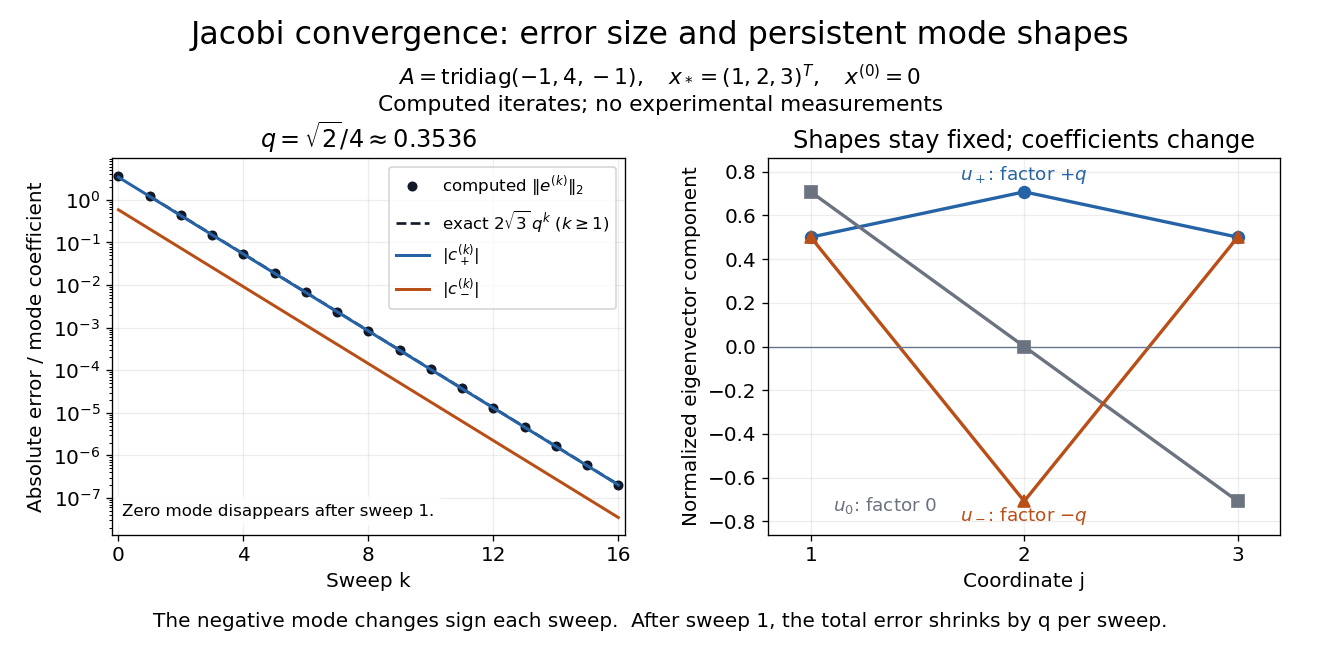
Computed Jacobi method error curves and eigenvector modes for the original three-variable tridiagonal matrix
. Details. 
The curves are computed iterates and exact formulas for this linear system. Since , the same eigenvectors have eigenvalues , , and for . They prove that is a positive-definite matrix, and give the condition number used in residual and forward error in a stationary iteration.
Articles by others on the same topic
There are currently no matching articles.