
Claude Cohen-Tannoudji Created 2026-10-18 Updated 2026-11-05
Claude Cohen-Tannoudji developed methods for controlling atomic internal states and motion with light. With Jean Dalibard, he explained how polarization gradients produce laser cooling below the simple Doppler cooling limit.
The essential link is between a spatially changing atomic light shift and state-changing optical pumping. The pumping delays let moving chemical atoms lose kinetic energy through repeated transitions between different light-shift potentials. This supplied a microscopic explanation for unexpectedly low experimental temperatures.[ref]

Portrait of Claude Cohen-Tannoudji
. Amir Bernat; existing Commons crop by Wabbuh. Creative Commons Attribution-ShareAlike 4.0 International selected from the offered multiple licenses; no need to choose GFDL or an older CC license., via Wikimedia Commons. Source.
Jean Dalibard Created 2026-10-18 Updated 2026-11-05
Jean Dalibard developed, with Claude Cohen-Tannoudji, models explaining laser cooling below the simple Doppler cooling limit. Spatially changing wave polarization makes the light shifts of atomic sublevels vary with position.
In Sisyphus cooling, moving chemical atoms climb a light-shift potential and are optically pumped into a lower-energy sublevel. Repeating that sequence removes kinetic energy. The mechanism depends on internal-state structure and optical pumping, explaining why a two-level Doppler model misses the additional cooling.[ref]

Portrait of Jean Dalibard
. © Barande Jérémy /EP. (Ecole polytechnique). CC BY-SA 2.0, via Wikimedia Commons. Source.
The two-level Doppler limit, , balances velocity-dependent scattering friction with momentum diffusion. Multilevel atoms have additional, slower internal dynamics. Counterpropagating beams with orthogonal linear polarizations create a spatially varying polarization, giving different position-dependent light shifts for ground-state magnetic sublevels. A moving atom climbs a light-shift hill, loses kinetic energy and is optically pumped into a lower-energy sublevel: this repeated Sisyphus cooling cycle dissipates motion through emitted light.
Optical pumping responds with a finite delay. Its rate, rather than only the excited-state linewidth, sets the low-velocity response scale. In the opposite-circular-polarization arrangement, motion instead produces unequal sublevel populations and unbalanced radiation pressure. Both mechanisms can cool below the two-level Doppler temperature; diffusion heating still balances the cooling, and recoil matters at the lowest temperatures.[ref]
Laser cooling below the Doppler limit by polarization gradients: simple theoretical models by Jean Dalibard and Claude Cohen-Tannoudji. 1989, pages 2023–2025, two polarization-gradient mechanisms and pumping timescale
Ground-state substructure, optical pumping and polarization gradients enable the extra cooling. Magnetic fields that disturb the required sublevel dynamics can suppress it. Optical molasses damps velocity but does not by itself provide position-restoring confinement.
For an ideal weakly driven two-level atom, opposing red-detuned beams give velocity-dependent absorption and a friction force near zero velocity. Random photon recoils also cause momentum diffusion. Their balance gives the minimum Doppler temperatureat detuning in the low-saturation model, where is the spontaneous population-decay rate, equivalently the natural full linewidth expressed as an angular frequency. This limit assumes the atom has no useful ground-state internal structure.
Real atoms possess magnetic sublevels. In a suitable multilevel transition, position-dependent polarization gives different optical couplings and different AC Stark energy shifts for those sublevels. Counterpropagating beams with orthogonal linear polarizations have nearly uniform total intensity but a periodically varying polarization. Thus spatially varying light shifts can exist even without an intensity standing wave.
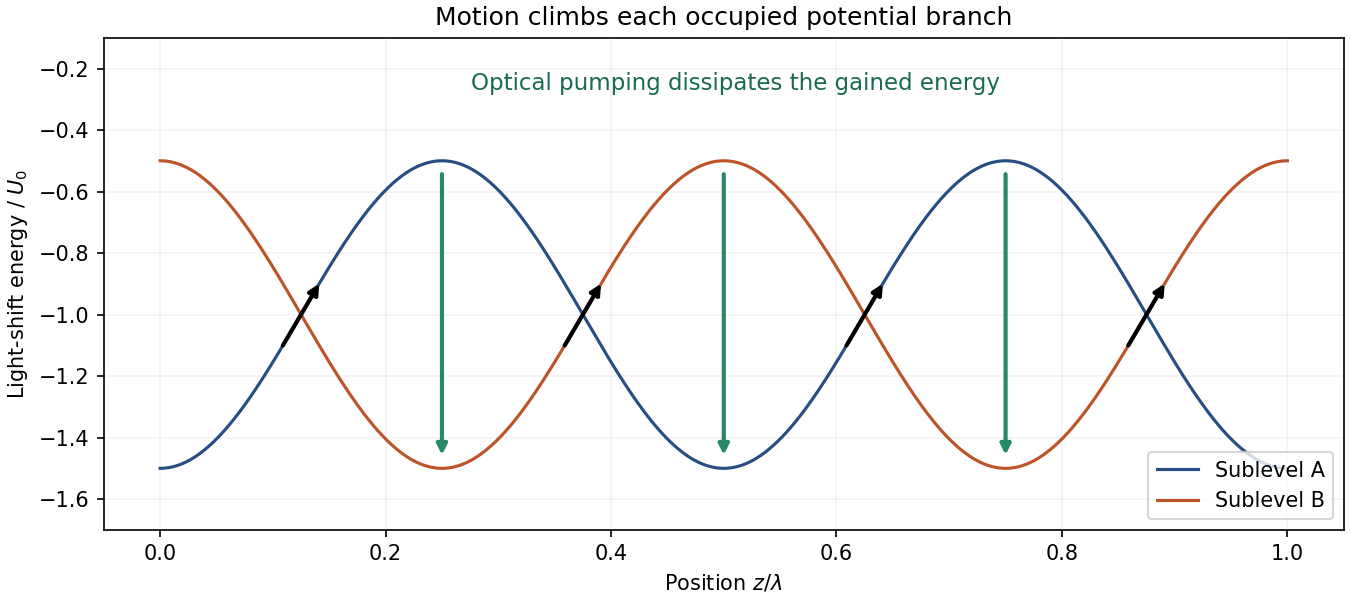
In Sisyphus cooling, an atom on one ground-state branch climbs a light-shift hill and loses kinetic energy. Near the upper part of the hill, optical pumping tends to transfer population to a lower branch. spontaneous emission makes this transfer dissipative and randomizes the emitted photon direction. The atom can then climb another hill. Finite pumping time is essential: instantaneous local equilibration would remove the delayed internal-state response that produces friction. The original multilevel analysis relates these optical-pumping cycles to the spatially displaced light shifts.[ref]

For large detuning compared with the natural linewidth, useful scales areup to angular-coupling and Rabi-frequency convention factors. Here is the optical Rabi angular frequency. The slow-atom capture range is of order . Typical energies in the Sisyphus regime track the light-shift scale rather than only , so reducing intensity can lower temperature below the Doppler limit. Capture becomes narrower, however, and recoil heating, imperfect polarization, magnetic fields and scattered light eventually matter. Define recoil energy ; this is an important scale, not a claim that every sub-Doppler method has the same universal final temperature.[ref]
Manipulating Atoms with Photons by Claude Cohen-Tannoudji. §2, Sub-Doppler cooling; §2.1, Sisyphus effect
The experimental test must establish a narrow velocity distribution independently of fluorescence brightness. William D. Phillips's account describes moving a time-of-flight probe above and below the cloud, deliberately heating the atoms to check a previously absent signal, and release-and-recapture comparisons that included gravity and finite beam geometry. These tests separated very cold atoms from an insensitive detector or a faulty thermometer.[ref]
Nobel Lecture: Laser cooling and trapping of neutral atoms by William D. Phillips. pp. 731–732, Figs. 15–16; pp. 733–734, multilevel interpretation
In a modern implementation, field cancellation and polarization checks test the mechanism, while independent expansion thermometry checks the inferred temperature. sub-Doppler cooling exploits internal-state dynamics omitted from the two-level Doppler model; it does not contradict that model within its assumptions. Polarization-gradient cooling Created 2026-10-14 Updated 2026-10-18
Polarization-gradient cooling uses spatial variation in electromagnetic polarization together with optical pumping between internal quantum states to cool moving chemical atoms.
Jean Dalibard and Claude Cohen-Tannoudji distinguish cooling by changing elliptical polarization from cooling by rotating linear polarization. The hill picture below concerns the former.[ref]
Sisyphus cooling 2026-10-18
Finite optical pumping time lets an atom climb a light-shift hill before transfer into a lower magnetic sublevel. Spontaneous emission dissipates the gained potential energy; climbing alone is conservative.[ref]
To make the geometry and signs explicit, take an original choice of phase origin for equal opposing waves:The real electric field is ; is wavelength. The fractions are squared projections onto the defined circular basis vectors, divided by total intensity. Their sum is one: interference changes electromagnetic polarization despite constant total intensity. At the field is respectively ; halfway between these positions it is linearly polarized. Specifying the vectors avoids an observer-dependent verbal handedness convention.
For an illustrative angular momentum transition, use the squared Clebsch-Gordan coefficients and for the strong and weak circular couplings from each lower magnetic sublevel. Interchanging circular components interchanges these strengths. The weighted sums are and . Rescaling their common negative shift givesBoth potential energies are negative relative to the unilluminated level. Each hill has height , and opposite hills are displaced by . An atom starting at the minimum at loses of kinetic energy if it reaches on that branch. A pump transfer there lowers its potential energy by , leaving it at a minimum. The next uphill segment ends at , where the favoured transfer is reversed. Actual transfers are stochastic and need not occur exactly at these extrema.
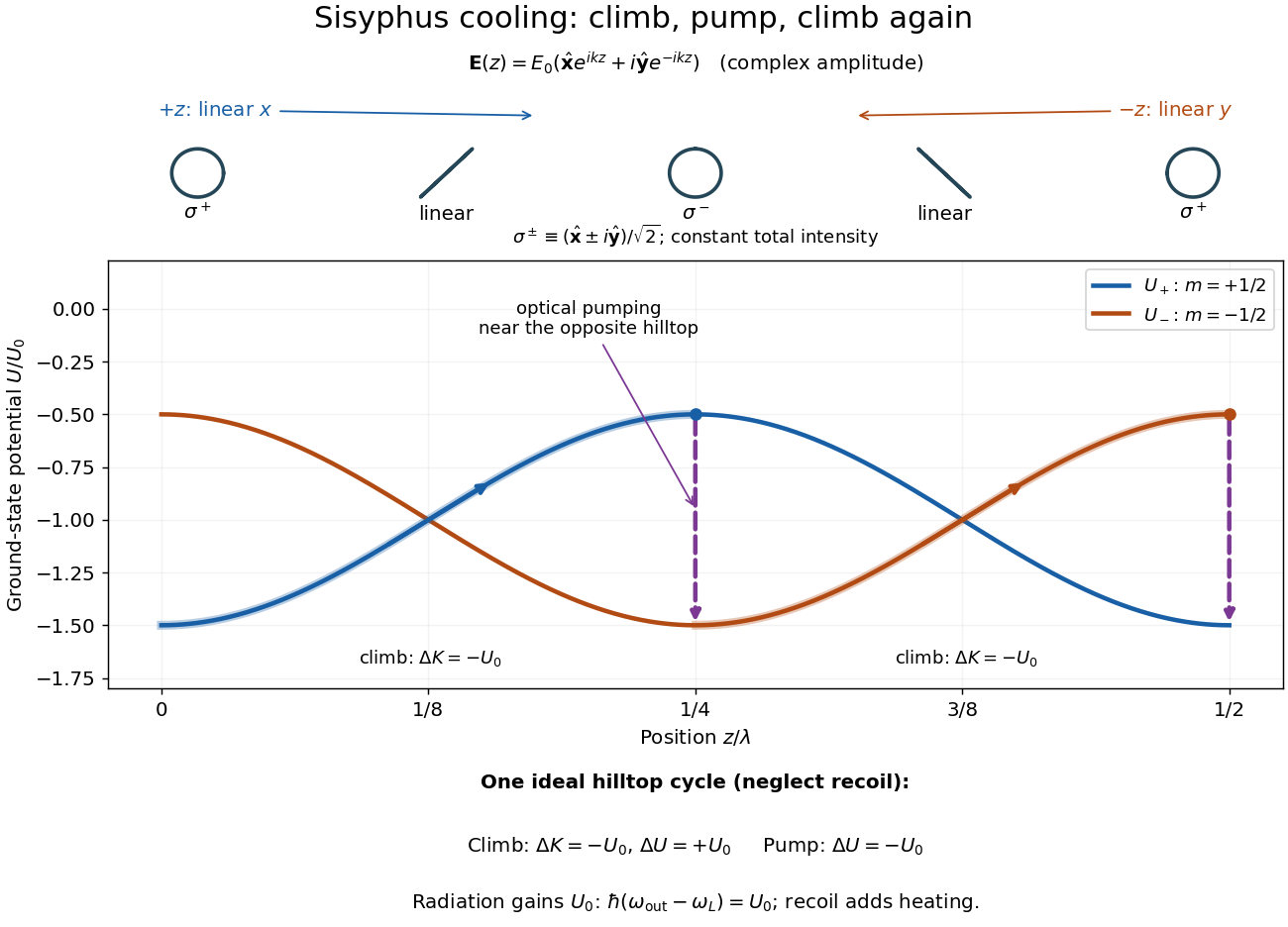

For one completed climb and pump, conservation of energy gives , while the ground-state potential energy returns to its starting value. Neglecting recoil and treating the scattered photon as the sole outgoing radiation change, . A potential drop is an internal-state reset, not an automatic equal upward kick in kinetic energy. Random emission nevertheless adds momentum fluctuations and recoil energy, so useful cooling requires the dissipated energy to compete with that heating.
The recoil energy sets a different scale from . Conventional Sisyphus cooling reaches the recoil regime when reducing the hill height also weakens cooling; it is not a claim of arbitrarily small temperature at vanishing intensity. Subrecoil techniques need further physics.[ref]