For a fully ionized, nonrelativistic monatomic ideal gas, and the virial theorem becomes
Since increases with its particle-weighted mean temperature, the equilibrated self-gravitating object has negative heat capacity: adding total energy allows expansion, makes less negative, and reduces . Conversely, radiating energy permits contraction and raises the internal temperature. This refers to a sequence of gravitational equilibria, not to the positive local heat capacity of a parcel at fixed volume.
In an ordinary nondegenerate nuclear-burning star, a rise in nuclear heating tends to expand and cool the burning region, lowering its temperature-sensitive reaction rate. Reduced heating leads to contraction and reheating. This expansion feedback is the nuclear thermostat; it can fail in degenerate matter where pressure responds weakly to temperature. During contraction of a pre-main-sequence star, gravitational binding supplies the radiated luminosity and heats the interior. For a fixed-structure scaling, half the released gravitational energy increases and half escapes as radiation, until hydrogen burning can support a long-lived main sequence equilibrium.
A star spends roughly years on the main sequence, deriving most of its luminosity from the proton–proton chain. After central hydrogen depletion, shell hydrogen burning around a contracting helium core expands it into a red giant. The low-mass helium core becomes electron-degenerate before the helium flash. Subsequent core helium burning by the Triple-alpha process, with alpha capture producing oxygen, lasts of order years.
After central helium exhaustion, hydrogen and helium shells burn around a carbon-oxygen core on the Asymptotic giant branch. Strong mass loss removes the envelope, potentially making a planetary nebula, and the remnant becomes a carbon-oxygen white dwarf. It cools using stored thermal energy and does not ignite sustained carbon burning. Detailed durations depend on composition and mass loss; the nuclear endpoint of the isolated solar-mass model is a white dwarf.
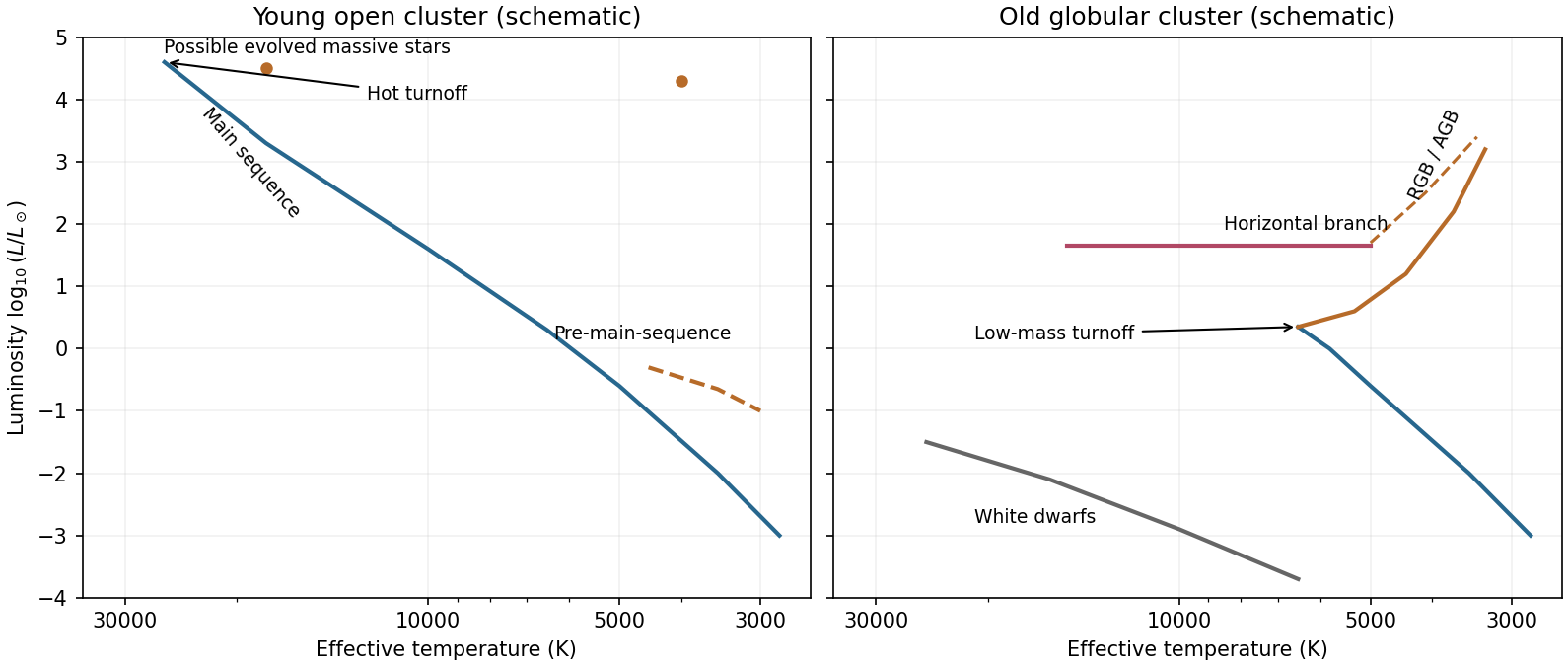
An old globular cluster has lost its original massive main-sequence members. Its main-sequence turnoff lies near a low stellar mass, typically around for an age of order years. The diagram shows a lower main sequence, a subgiant branch, a prominent red giant branch, a horizontal branch of core-helium-burning stars, an Asymptotic giant branch and a faint white dwarf cooling sequence. The preceding schematic labels these features. A few blue stragglers may lie above the old turnoff because interaction or merger rejuvenated them; they do not imply a young age for the bulk population.
For a young open cluster, the Hertzsprung-Russell diagram contains a populated main sequence reaching hot, luminous, high-mass stars, with a high-mass main-sequence turnoff determined by its age. Cool low-mass members may still lie on tracks of pre-main-sequence stars above the lower main sequence. Depending on how young the cluster is, a few evolved blue or red supergiants may already be present; an extremely young cluster need not have any. It lacks the dominant old low-mass red-giant and horizontal-branch populations of an old globular cluster.
Figure 1.
Schematic temperature-luminosity diagrams of young and old star clusters
. Temperature decreases to the right. The young cluster reaches a hot luminous turnoff and contains possible pre-main-sequence stars; the old cluster has a cool low-mass turnoff, red giant and horizontal branches, and a white-dwarf sequence. Curves are illustrative population sketches, not fitted isochrones. Details.
Assume homologous, gas-pressure-supported main sequence stars with nearly constant composition and mean molecular weight , radiative energy transport and approximately constant opacity . Hydrostatic and mass scalings give
The radiative diffusion equation gives the luminosity scaling
Therefore, under these explicit assumptions,
The radius cancels. Radiation-pressure dominance in the most massive stars changes the relation towards the Eddington luminosity scaling , so the cubic law is an idealized gas-pressure homology result rather than an exact universal massive-star law.
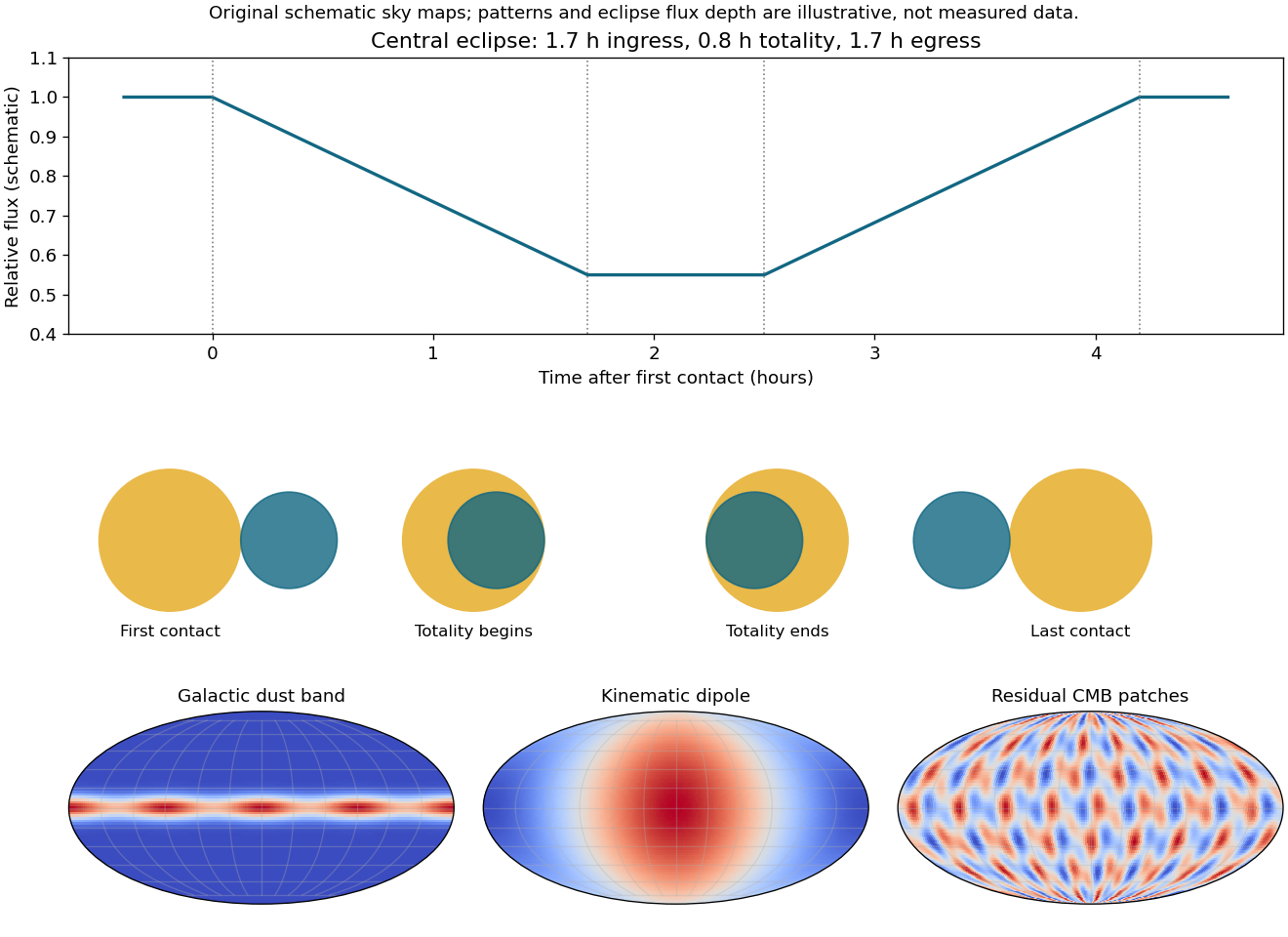
Assume a central eclipse and nearly uniform projected speed during it. Let be the smaller radius and the larger. First-to-second contact requires travel , whereas the totality interval requires . With relative speed 200 km s,
The light curve has ingress, flat minimum and egress lasting 1.7, 0.8 and 1.7 hours. At the four contacts the projected center separations are . A noncentral chord would require an impact parameter and changes the inferred radii; the data alone do not fix that geometry exactly. For comparable masses in an ordinary coeval system, a component larger than its main sequence companion suggests expansion away from the main sequence, conventionally toward a subgiant/early giant track. That is a conditional evolutionary interpretation: neither effective temperature nor a bolometric flux is supplied, so a unique position on the Hertzsprung-Russell diagram cannot be inferred from these radii alone. Binary interactions and the assumed central chord also matter; these numbers do not establish an ordinary single-star evolutionary model.
Figure 1.
Central-eclipse contact geometry and schematic microwave sky components
. Details.
An isochrone is the locus of stars of a common age and composition over a range of initial masses. A real cluster diagram approximates it, with scatter from binaries, measurement errors, composition spread and differential reddening. Region A is the hydrogen-core-burning main sequence. Region B contains evolved subgiant/red-giant stars, typically with hydrogen-shell burning around an increasingly helium-rich core. Region C is the horizontal branch, occupied by core-helium-burning stars; RR Lyrae lie in its instability strip.
Point D is the main-sequence turnoff: core hydrogen exhaustion drives structural readjustment toward shell burning and expansion. Point E is the tip of the red-giant branch, where a low-mass star ignites helium in its degenerate core, the helium flash, and subsequently moves toward horizontal-branch conditions. The two labeled events are different evolutionary transitions, not merely changes in apparent color from dust.
A white dwarf is a compact stellar remnant supported primarily by electron degeneracy pressure, radiating stored thermal energy rather than sustained main-sequence fusion. At zero-temperature leading order, filling electron momentum states gives and . Fully ionized hydrogen mass fraction , with other nuclei approximately one electron per two nucleons, implies . Therefore
This is an polytrope. Solving hydrostatic structure with a zero-pressure surface gives ; the numerical factor uses and of that Lane-Emden solution. Thus . For , , is about km. A uniform-density scaling gives the same mass dependence but a different order-one coefficient and should be identified as such.
Independently, , or about km. Agreement is good at this level; relativistic degeneracy becomes relevant for accurate modeling near one solar mass and eventually invalidates an unlimited nonrelativistic mass-radius law.
A luminosity does not determine a stellar mass without a mass-luminosity calibration. Using the usual approximate main-sequence law gives . With , the numerical results are
The angular radius follows directly from . Taking changes these estimates by only a few percent, but the calibration must be stated. Hubble's 2.4 m aperture has visible-light diffraction scale arcsec at 500 nm, hundreds of times larger. The separation is therefore unresolved even before the severe star/planet contrast is considered.
The numbered features in the original colour-magnitude diagram have the following interpretation.
Continuous star formation explains the coexistence of newly formed massive main-sequence stars with evolved low-mass remnants; interpreting a single sharp turnoff as the age of a coeval cluster would be inappropriate here.
Core-helium-burning stars populate the horizontal branch and red clump; hot subdwarf B stars provide examples with a helium-burning core of roughly half a solar mass and a very small remaining hydrogen envelope. Their high luminosity relative to mass, hot spectra and locations away from an ordinary hydrogen-burning main sequence are observational evidence for such evolved configurations.
A plausible history starts with a hydrogen-burning star. After central hydrogen exhaustion, hydrogen-shell burning builds a compact helium core and the envelope expands on the red giant branch. Sufficient core temperature ignites helium, often by a helium flash for a low-mass degenerate core. Strong mass loss or binary interaction can strip most of the hydrogen envelope, exposing a hot helium-burning remnant; retaining a substantial envelope instead gives an ordinary horizontal-branch or red-clump star.
The simple radiative Kramers scaling estimates a luminosity contrast but does not uniquely identify one evolutionary state or predict a real subdwarf luminosity precisely. A similarly low-mass helium white dwarf would be a cooling, degenerate object rather than the sustained high-temperature helium-burning configuration assumed here.
For gas-pressure-supported stellar homology with opacity and stellar energy-generation rate , radiative diffusion in a star gives . Integrating the heating rate instead gives . Equality in stellar thermal equilibrium yields the displayed radius law and . This fixes the dimensionless profiles and coefficients, and neglects radiation pressure; it is a model comparison rather than a universal law for all main sequence stars. At fixed mass and metal mass fraction, homogeneous hydrogen burning gives the homogeneous fuel-depletion luminosity feedback through .
Red supergiant 2026-10-25
A cool, highly luminous evolved massive star with an extended envelope, generally later than its initial hot main sequence stage. Its eventual core-collapse outcome depends on the core, winds, mixing and binary history, not on its red colour alone.
Stellar age Created 2026-10-06 Updated 2026-11-05
The stellar age is the elapsed time since a star formed. A constant number formation rate on a finite interval gives a uniform distribution of present ages if every formed object remains counted, including stellar remnants. An age distribution inferred only from surviving main sequence stars generally differs because their lifetimes depend on mass.
Stellar evolution Created 2026-09-24 Updated 2026-11-05
Stellar evolution is the change of a star's composition, structure and observable properties over time. Nuclear fusion changes the core's composition and available fuel; gravity, energy transport and mass loss then alter the stellar radius, luminosity and effective temperature. The initial mass strongly influences the sequence, but composition, rotation and binary mass transfer also matter.
The evolution of a solar-mass star connects the main sequence to giant phases and eventually a white dwarf. More massive stars can reach stellar core collapse. An evolutionary track in the Hertzsprung-Russell diagram makes these changes visible, while comparisons with coeval stellar populations test the predicted lifetimes. Two stars with similar present appearance can have different prior histories, especially after binary interaction.
Stellar rejuvenation Created 2026-10-05 Updated 2026-11-05
Stellar rejuvenation occurs when mixing brings fresh hydrogen into the core of a mass-gaining or merged main sequence star, making its remaining nuclear lifetime resemble that of a younger star. The amount of rejuvenation depends on the accretor's internal mixing and prior composition.
Subgiant 2026-10-05
A subgiant has begun evolving away from the main sequence after central hydrogen exhaustion, increasing its radius before the extended red giant stage.