There are two one-loop Feynman diagrams: the two orders of the labelled photons around a top quark fermion loop, with one Yukawa interaction insertion for the outgoing Higgs boson. They are added, rather than identified by a Feynman-diagram symmetry factor. Each has the same color charge trace .
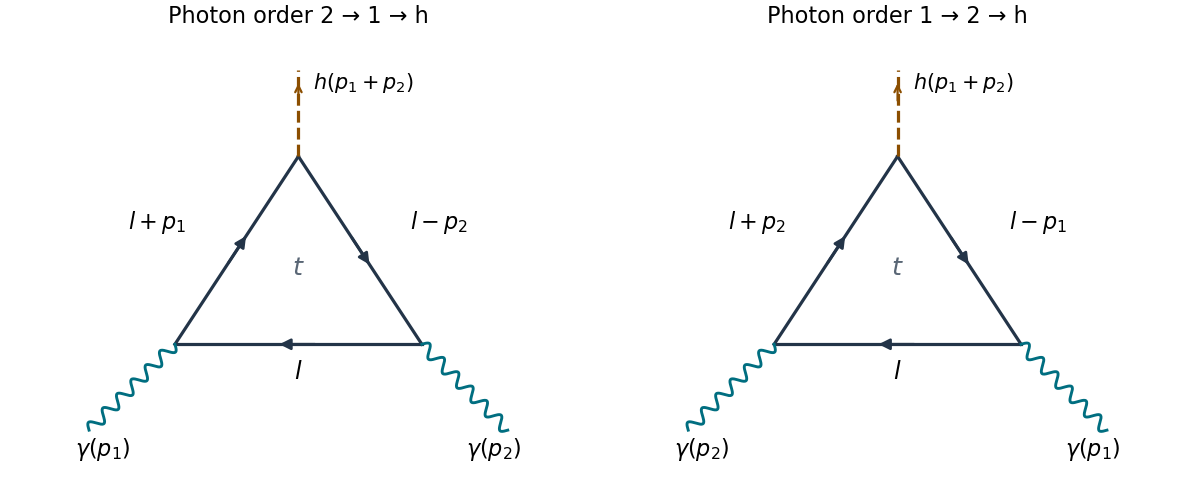
The two photon orders and consistent directed loop momenta
. Original Feynman diagrams. Solid arrows show fermion flow and the labelled internal four-momenta. Wavy external lines are incoming photons; the dashed external line is the outgoing Higgs boson. The two panels use independent dummy loop momenta. Details.
In the first routing, traverse the fermion loop from the insertion to the insertion with momentum , then to the Higgs boson insertion with momentum , then back to the insertion with momentum . Conservation at the Higgs boson insertion gives . The second routing exchanges and : its three internal momenta are , and . Reversing the orientation is another way to represent this second ordering. Two vector insertions give no Furry theorem cancellation.
Use Minkowski metric and the convention . Put , , andThe Feynman i-epsilon prescription is understood in subsequent denominators. Contracting the spinor indices around the fermion loop gives the traceHere is Feynman slash notation. The closed fermion loop sign is , the three interaction vertices contribute , and the three Dirac propagators contribute . Their product, including the color charge trace, is . Thus one ordering hasMultiplying by the incoming polarization vectors and adding the exchanged Feynman diagram givesThe displayed four-dimensional Feynman integral is formal until regularized; subsequent manipulations use dimensional regularization, which permits the required loop momentum shifts.
Set , so and . The physical polarization vectors obey . Write when they agree after contraction with these polarization vectors; terms proportional to or may then be discarded.
The gamma matrix trace identities kill the terms with an odd number of gamma matrices. The remaining three two-momentum terms and the term with three factors of areIn the coefficient the terms linear in cancel, leaving . Among the other terms, the surviving mixed products of and also cancel. ConsequentlyIn the second Feynman diagram, exchange the external labels and change the dummy loop momentum . Its projected numerator and denominator become identical to those of the first Feynman diagram. HenceWith the common factor extracted, the primitive integer coefficients areEquivalently, extracting only gives and prefactor . A common rescaling of all three coefficients changes the prefactor inversely. The physical scattering amplitude is ; the projected integrand is not an identity for an arbitrary uncontracted off-shell tensor.
Continue the loop momentum to dimensions, keeping and the external physical polarization vectors four dimensional. Introduce Feynman parameters , , denoting this integration triangle by . Completing the square givesOdd terms in integrate to zero. Lorentz invariance of dimensional regularization gives . The general projected numerator therefore becomes, under the Feynman integral,Only the term can give an ultraviolet divergence. Define, with the conventional scale factor implicit,The gamma function formula givesThus the pole of the numerator integral, including , isThe coefficients satisfy this condition. A nonzero local divergence would have to be removed by a counterterm. The Ward identity forbids a local term, and the first electromagnetic gauge-invariant coupling with one Higgs boson and two photons has the form , of engineering dimension five. It is not an independent counterterm of the Standard Model, a renormalizable quantum field theory. The top quark contribution is separately electromagnetic gauge-invariant; no additional W boson loop Feynman diagram is needed to cancel this pole.
The finite remainder must still be retained. For ,Putting before evaluating the divergent Feynman integral would incorrectly set this finite contribution to zero.
Use the Feynman parameters and defined in Solution. With , the finite term just found is . Combining it with the remaining coefficient givesThe other coefficient is . Thus, writing for the Feynman integral without the overall prefactor,For , the two coefficients must have the corresponding ratio. The mismatch is simply , independent of . Therefore the required relation iswhich is satisfied. In the primitive normalization the result isand the full top quark scattering amplitude, in our stated convention, isIndeed : replacing either polarization vector by its photon momentum makes the scattering amplitude vanish. This is the Ward identity, expressing electromagnetic gauge invariance. The result also is symmetric under exchange of the two photons. The finite term in Solution is essential for this Ward identity.
As an independent low-energy check, for the Feynman parameter integral isThe coefficient is consequently at leading order. It has the inverse-mass dimension required for an effective coupling. If , this coefficient stays finite in the large- limit at fixed ; that limit increases the Yukawa coupling, so it is not a fixed-coupling heavy-field decoupling limit.
Articles by others on the same topic
There are currently no matching articles.