An Alfvén wave is a transverse disturbance restored by magnetic tension. In a uniform conducting fluid with background , a small transverse displacement bends the magnetic field lines. Magnetic flux freezing gives , and the linear transverse Lorentz force density is . Thus the Linear Alfvén wave equations reduce toFor this shear polarization, at linear order. The disturbance transports energy along the background magnetic field; a single traveling wave has equal perturbation magnetic energy and kinetic energy, with for propagation along . These properties distinguish it from compressive magnetosonic waves.
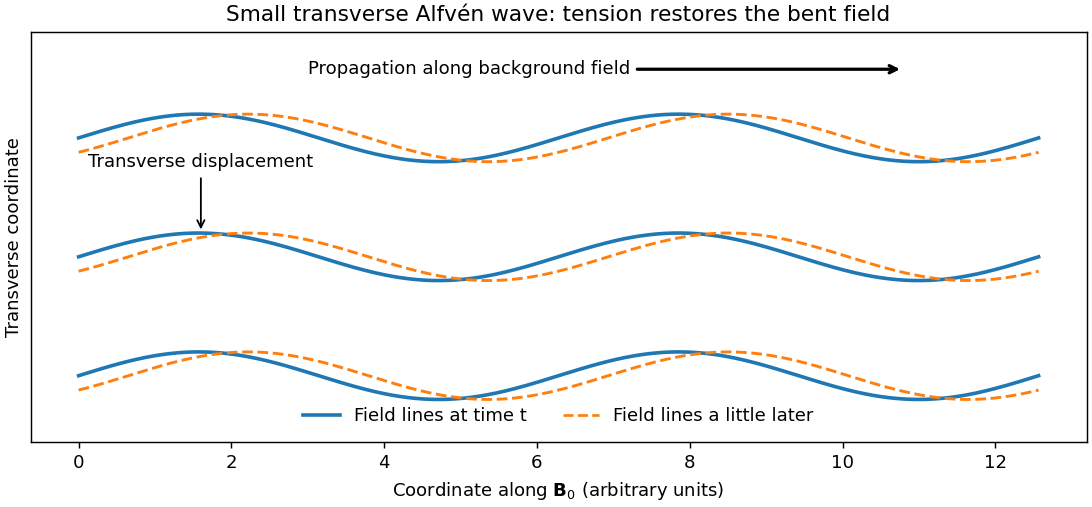

The ideal magnetohydrodynamics approximation requires strong electrical coupling and wavelengths large compared with microscopic scales. Finite electrical resistivity and viscosity dissipate the wave's energy. In stellar winds and other astrophysical plasmas, Alfvén waves carry disturbances and can contribute to heating when dissipated. The Lundquist liquid-metal Alfvén wave experiment provides a laboratory counterpart: a conducting liquid in a strong applied magnetic field transmits a transverse magnetic disturbance, making the field's mechanical restoring action measurable.
A geometrically thin accretion disk around a central mass has nearly Keplerian orbits, with . Its vertical hydrostatic equilibrium gives . The specific angular momentum decreases inward, so accreting matter must transfer angular momentum to other matter. A viscous stress couples neighboring annuli rotating at different angular velocities.
Writing for effective kinematic viscosity and for surface mass density, the outward viscous torque in an accretion disk isSteady mass conservation defines . If the inner radius has negligible applied torque, angular momentum conservation gives , henceWell outside that boundary, and the inward drift time is of order , much longer than an orbital period in a thin disk with modest effective stress. Dissipation of orbital energy heats the disk. If that heat escapes locally from two faces, the radiative flux from either face isIntegration over both faces gives in this Newtonian zero-torque model. Material can lose angular momentum while the disk's outer parts spread outward: outward transport does not imply that most of its mass moves outward. In real ionized disks, magnetorotational instability and magnetic stresses often provide the effective transport; molecular viscosity alone is generally insufficient.
In a radiative shock, a narrow dissipative jump first converts upstream kinetic energy into internal energy. The immediate strong adiabatic compression is , and the immediate temperature is the result of part 1(c). Downstream gas then radiates, loses specific enthalpy and compresses further. Its shock cooling length is of order , with the immediate downstream speed used only as an estimate because the gas slows as it cools.
For the idealization of equal far-upstream and cooled downstream temperatures, unchanged composition and negligible magnetic stress, write . Conserved mass and normal momentum flux across the whole layer giveWith , the nontrivial isothermal shock root isIt can greatly exceed the adiabatic strong-shock compression. An upstream adiabatic sound speed instead defines , so the same result is ; the two Mach numbers must not be confused. The radiated energy flux is when the two endpoint specific enthalpies agree. The gas's specific entropy rises at the initial jump and falls during cooling, while the escaping radiation carries entropy away. A transverse frozen-in magnetic field, or an imposed temperature floor, can limit the compression. Strongly cooling shocks can therefore collect thin dense shells without violating total conservation of energy.
Articles by others on the same topic
There are currently no matching articles.