The Rayleigh-Taylor instability extracts gravitational potential energy when a heavy fluid is supported above a lighter one. A small downward excursion of heavy material and upward excursion of light material can grow instead of experiencing restoring buoyancy. The Kelvin-Helmholtz instability instead extracts kinetic energy from a velocity difference across an interface or shear layer. The interface displacement and its induced flow reinforce one another by tapping the background shear; a reversed density ordering is not required.
A useful common model has two inviscid, incompressible, semi-infinite fluids separated at , with lower density/velocity , upper density/velocity , downward gravity , and surface tension . For a disturbance proportional to , with , the two-fluid interfacial gravity-shear dispersion relation isA negative right side gives exponential growth. With no shear or surface tension and , the growth rate of the Rayleigh-Taylor instability is , where is the Atwood number. With equal densities and no restoring force, the growth rate of the Kelvin-Helmholtz instability is . Heavy-over-light stratification drives Rayleigh-Taylor growth; velocity shear drives Kelvin-Helmholtz growth. A heavy lower fluid supplies gravitational stabilization, and surface tension stabilizes sufficiently short waves in this ideal interface model.
Finite shear-layer thickness, viscosity, compressibility and magnetic tension can change the growth rates and unstable wavelength range. In particular, unlimited growth with increasing is a limitation of the zero-thickness, zero-surface-tension idealization. Density-interface overturning and jet-boundary mixing are appropriate physical applications of the two mechanisms, but the nonlinear mixed state is not determined by the linear growth rate alone.
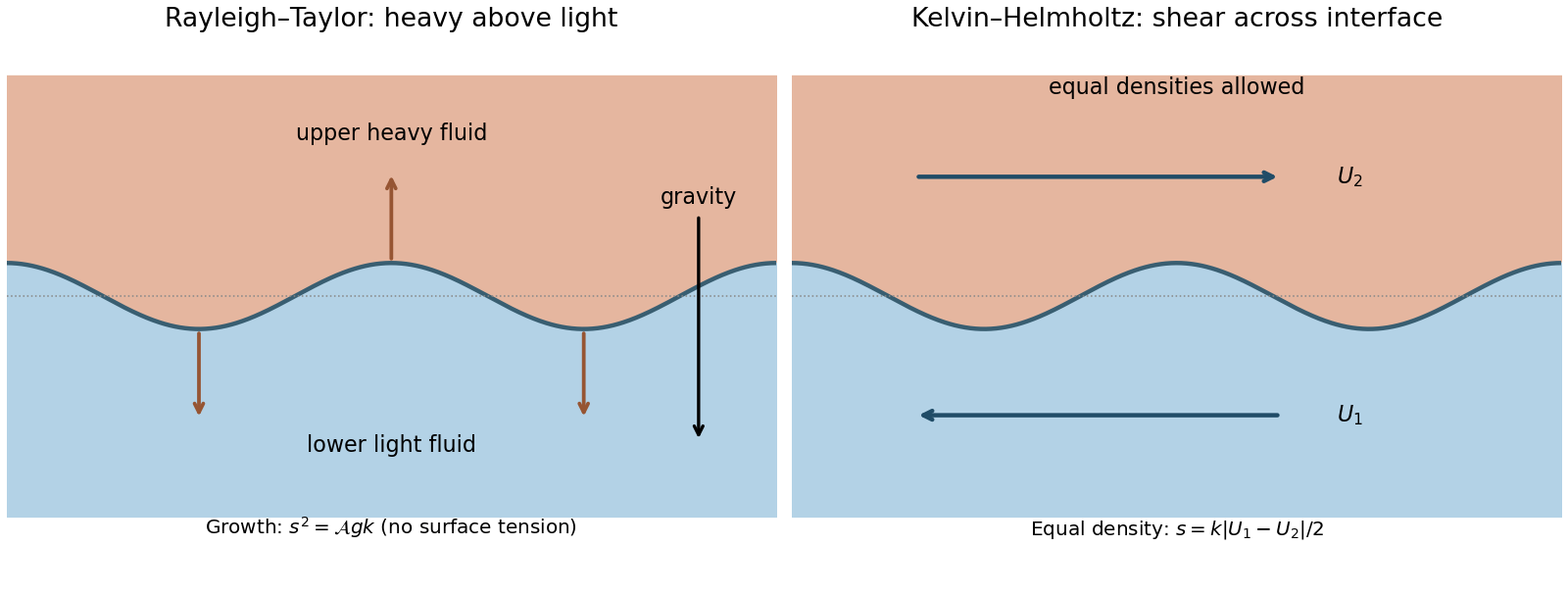
Original schematics of Rayleigh-Taylor instability and Kelvin-Helmholtz instability
. Details. 
A finite-amplitude compression can steepen because different parts of the wave travel at different characteristic speeds. For a right-moving simple wave in a perfect gas, one may write in terms of the local velocity perturbation . Faster compressive characteristics catch slower ones. When the smooth inviscid description would become multivalued, a physical compression shock replaces it. A rarefaction normally spreads rather than forming an entropy-violating expansion shock.[ref]
Lecture notes: Astrophysical fluid dynamics by Gordon I. Ogilvie. §§6.1.3–6.2, simple-wave reduction and characteristic crossing
Across a locally planar shock, use velocities relative to its moving front. The Rankine-Hugoniot conditions for a perfect gas conserve mass, momentum and total energy flux:where is the specific enthalpy. For upstream normal Mach number ,Thus a normal compression shock increases pressure, density and temperature, reduces the normal velocity, and changes a supersonic upstream flow to subsonic downstream flow in the shock frame. In the strong-shock limit, compression approaches , which is four for a monatomic gas. A shock conserves total energy but generates entropy; an adiabatic shock is not an isentropic compression. For a calorically perfect gas, stagnation temperature is conserved while stagnation pressure falls.[ref]
Normal Shock Wave Equations by NASA Glenn Research Center. normal-shock property ratios, total-temperature conservation and total-pressure loss
Real dissipative processes resolve the narrow front; the jump conditions do not require its detailed internal profile. In a continuum-gas experiment a shock tube can produce a moving shock by releasing a pressure discontinuity. pressure probes separated along the tube measure arrival speed and the pressure jump; distinguishing the shock from the following contact surface is essential. A contact surface can have a density/entropy jump with continuous pressure and normal velocity, whereas a shock carries nonzero mass flux through its front.
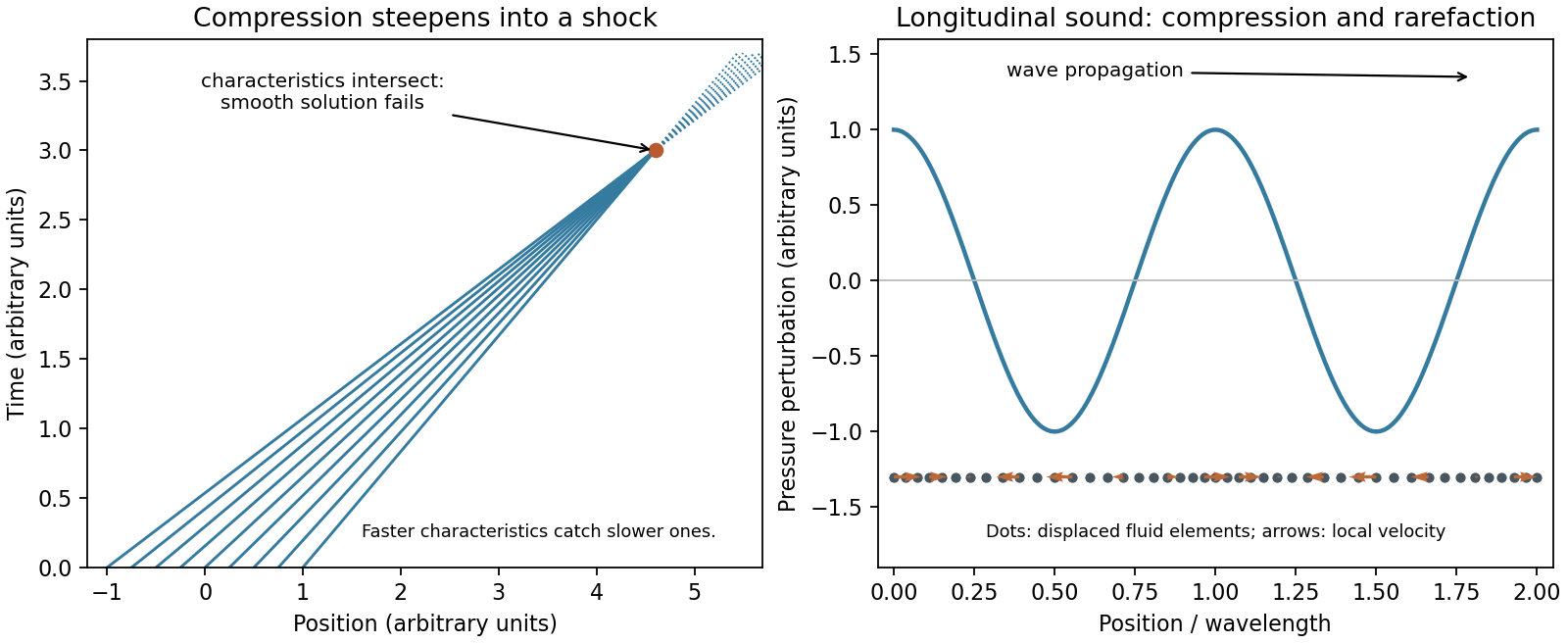
Original characteristic-crossing and longitudinal acoustic wave diagrams
. Details. 
A small pressure disturbance propagates because compression raises the pressure, the pressure gradient accelerates nearby fluid, and the induced convergence compresses the next region. For a uniform fluid at rest, linearizing mass and momentum conservation and using the adiabatic pressure-density response givesEliminating and gives . A plane wave has and longitudinal velocity parallel to . In a perfect gas,The adiabatic response is appropriate when heat cannot diffuse appreciably out of each compressed region during a period; an isothermal response would give a different derivative. In a moving uniform medium, the acoustic characteristics travel at along the flow, rather than at in the laboratory.
For a progressive wave, ; pressure, density and longitudinal velocity are in phase. The acoustic energy density is the sum of kinetic and compression energies,Sound transports energy while fluid elements execute small oscillations about their mean positions. The ideal uniform-fluid acoustic mode is nondispersive. Spherical spreading reduces pressure amplitude as when total power is conserved; viscosity and heat conduction attenuate waves, while sufficiently large compressions can steepen into shocks. In a stratified astrophysical gas the uniform result is local: wavelengths short compared with background scale heights justify it, whereas long waves can couple to buoyancy and acoustic-cutoff behavior.
Articles by others on the same topic
There are currently no matching articles.