A shock wave forms when a compressive flow steepens or when gas must be decelerated or turned faster than upstream acoustic waves can communicate the change. Astrophysical examples include a supernova remnant sweeping up surrounding gas, a fast stellar wind colliding with ambient material, and supersonic accretion onto an obstacle or onto a dense gas layer. A large Mach number by itself is not sufficient: a uniform supersonic stream need not contain a shock wave.
Choose the shock frame, and denote upstream and downstream normal velocities by . Integrating the local conservation laws over a thin control volume spanning a steady normal shock wave gives equal fluxes on both sides. Mass conservation gives constant mass flux per unit area,Pressure and advected momentum together give the normal momentum flux,For a thin non-radiating layer, with negligible gravitational-potential change across it, conservation of energy gives equal fluxes . A perfect gas has specific enthalpy , soThese are the Rankine-Hugoniot conditions for a perfect gas. Dissipation inside the thin layer produces an entropy increase and selects the physical compressive branch. Efficient radiative cooling would change the energy relation and may instead lead to an isothermal shock.
Take . Let . Mass conservation gives , and normal momentum conservation givesInsert this into the energy condition from part (a):Rearranging and factoring,The root is the unshocked state. The compressive Strong-shock Rankine-Hugoniot conditions instead giveCorrespondingly, and . These relations require and negligible upstream thermal pressure.
Let denote the total flow speeds, keeping the normal components distinct from them. The original diagram measures from the initial wall direction to the shock wave itself. The outgoing velocity is turned by , so it makes angle with the shock.
Resolve each velocity tangent and normal to the oblique shock. Tangential momentum conservation, with nonzero mass flux and no tangential surface force, makes the tangential velocity continuous:The normal flow obeys the strong normal shock wave result from part (b):Divide the second relation by the first to obtainThe approximation is controlled by the upstream normal Mach number , not just by . This distinction matters on the small-angle weak branch in part (d). The angle convention is also important: formulas using the angle to the shock normal instead would interchange sine and cosine.
Rewrite the relation from part (c) asThe angle-addition identities reduce this toFor , the right side lies strictly between zero and one. There are two physically admissible strong oblique-shock angle branches:Both lie between and . They merge when , proving the maximum deflection through a strong perfect-gas shock,For small positive , the formal strong-shock-limit asymptotics areThe weak branch is normally observed for an unconfined supersonic stream turning through a modest compression corner. It has a smaller normal component of upstream velocity, hence a smaller downstream pressure increase; for small turns the downstream flow remains supersonic. The nearly normal strong branch can be selected by suitable downstream pressure conditions, so it is not mathematically forbidden.
The two limits must be ordered honestly. At finite , the weak oblique shock approaches the Mach angle as , rather than zero. The displayed weak-branch asymptotic applies when the large- limit is taken first, or in the overlapping range , where remains valid.
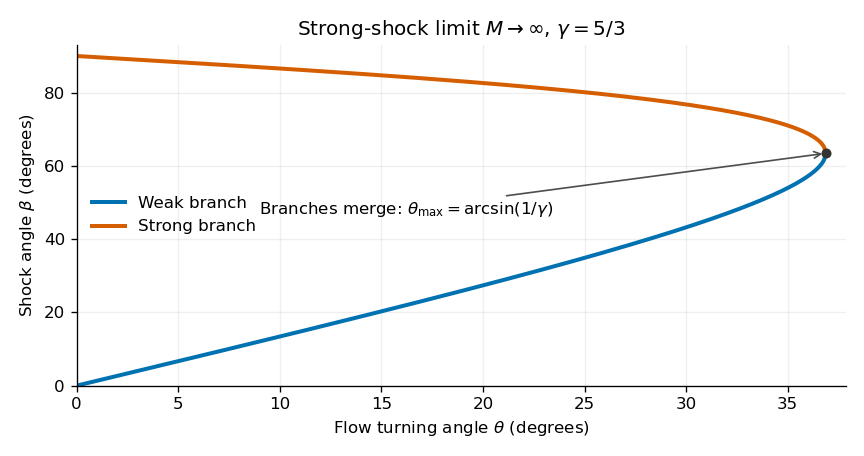
Calculated weak and strong shock-angle branches in the infinite-Mach-number limit, for a monatomic gas
. Details. 
For , , so there is no real solution for an attached straight oblique shock satisfying the assumed geometry. The shock detaches and becomes curved, with a locally strong, nearly normal portion and a subsonic region allowing the flow to adjust to the wall. The precise detached structure depends on the global geometry and downstream conditions; the attached-shock formula cannot be continued to these turns.
Articles by others on the same topic
There are currently no matching articles.