The Rankine-Hugoniot conditions follow by integrating conservation laws across a thin moving layer, then letting its macroscopic thickness tend to zero. For example, normal momentum conservation in one dimension has the conservative formFor a shock wave moving at speed , integrate over a control interval whose endpoints move with the discontinuity. The Reynolds transport theorem giveswhere denotes the difference of limiting states. Mass conservation similarly gives . If is the normal velocity in the shock frame, combining the two relations yieldsThe same construction applied to conservation of energy, for a non-radiating normal shock wave with nonzero mass flux, gives , where is the specific enthalpy. An equation of state closes these relations, and the physical compression branch has increasing entropy.
Finite dynamic viscosity replaces the ideal discontinuity by a thin smooth transition. A viscous stress contributes a derivative to the momentum flux inside the layer and converts directed kinetic energy into internal energy. If its gradients vanish in the uniform far states, the same limiting Rankine-Hugoniot conditions still hold there. Balancing nonlinear transport with viscous diffusion gives a thickness of order in the viscous Burgers equation, where is the kinematic viscosity.
The pressure-free equation has the scalar conservation law formA smooth travelling ansatz obeys , so it cannot continuously connect two distinct constant states. The inviscid shock wave must be interpreted as a discontinuous weak solution. Its Rankine-Hugoniot condition isFor ,The result is independent of which state is called upstream. For a physical compressive entropy shock of the Inviscid Burgers equation, the left and right states satisfy and therefore : characteristic curves run into the shock wave from both sides. The ordering instead produces a rarefaction wave.
For and positive , set , so the Cole-Hopf transformation is . Substitution into the viscous Burgers equation givesHence the most general equation implied by this substitution isThe time normalization in the Cole-Hopf transformation accounts for the arbitrary function : multiplying by a nonzero function of time leaves and therefore unchanged. Replacing by sets . With this conventional normalization,the heat equation.
For each , the function obeys . By the superposition principle for this linear partial differential equation,is a solution, positive for all real . Here has units so both exponents are dimensionless. The positivity ensures that its logarithm and the resulting velocity are regular.
Let . Differentiating the logarithm givesFor definiteness order . Then dominates as , while dominates as . The limiting states areWithout this ordering convention, and . Thus the states correspond to after matching each label to its dominant exponential; the propagation speed does not depend on the naming of the two states.
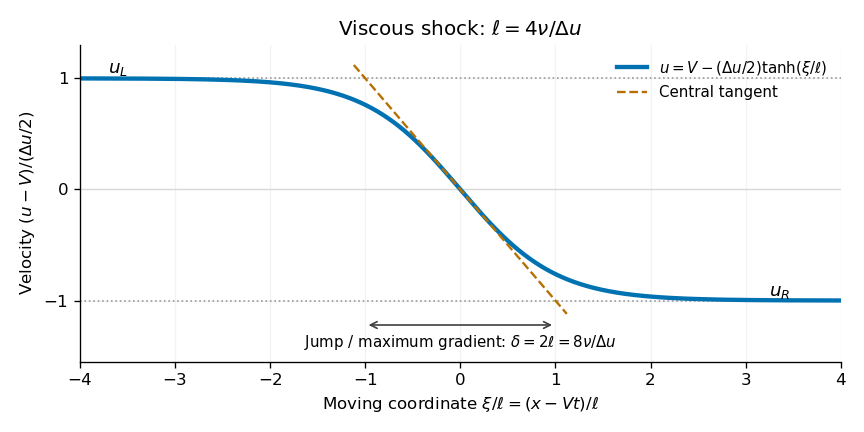
Their exponent difference isConsequently, the Viscous Burgers travelling shock moves atSet and . Factoring out the mean exponential gives the hyperbolic tangent profileA precise measure of the width must be stated. The natural length in the hyperbolic tangent argument isThus the layer has thickness of order . A different common convention, jump divided by maximum gradient, gives ; the far-tail exponential e-folding length is . These differ only by their stated definitions, rather than by different solutions.
Two distinct limits require . The source permits arbitrary real constants, but in the degenerate case the solution is uniform, , and there is no shock wave or finite shock width.

Articles by others on the same topic
There are currently no matching articles.