The Lamb shift is a radiative displacement of atomic energy levels beyond the values from the Dirac equation in a Coulomb potential. In hydrogen, the and levels are degenerate for a point Coulomb potential in the Dirac equation, yet the level lies higher by roughly a gigahertz. This is distinct from the fine structure splitting between different levels and from nuclear-spin hyperfine structure.
Electron self-energy in the quantized electromagnetic field is the dominant contribution to the familiar hydrogen splitting; vacuum polarization contributes too. Renormalization separates the physical electron mass from its divergent free-electron self-energy. A useful leading-log scale for a hydrogenic level isnot an exact numerical formula. The enhanced sensitivity of S states follows from their nonzero wavefunction at the nucleus; leading short-distance corrections act like contact perturbations. A precision prediction also includes finite nuclear size and recoil, and must consistently separate those effects from the radiative contribution.[ref]
Theory of the Lamb shift in hydrogen and light hydrogen-like ions by Vladimir Yerokhin and others. §III A, equations (7)–(8), one-loop self-energy and vacuum-polarization scale; introduction, separation of radiative, recoil and nuclear effects
The original Lamb-Retherford experiment used a beam of hydrogen atoms, electron-impact excitation into metastable , and microwave-induced transfer into short-lived states. Those atoms decayed before reaching the detector. Metastable atoms surviving to a metal target ejected electrons, so a drop in the measured current signalled a resonance. Varying the microwave excitation and magnetic field established the displacement from the Dirac equation expectation. Microwave quenching converted a small energy difference into a measurable loss of a long-lived population, avoiding optical Doppler widths that obscure the splitting.[ref]
Fine Structure of the Hydrogen Atom by a Microwave Method by Willis Eugene Lamb Jr. and Robert Curtis Retherford. 1947, pp. 241–243, metastable beam, target-current readout and microwave resonance
A Paul trap uses a time-dependent electric quadrupole field to provide dynamic confinement, avoiding the impossibility of trapping a charge in a stable three-dimensional static electrostatic minimum. Its dynamics follows a Mathieu equation: stable drive parameters produce slow Paul trap secular motion with superposed fast Paul trap micromotion. If denotes the peak oscillating field, the effective energy for small Paul trap micromotion isThe radiofrequency pseudopotential of a Paul trap is an averaged mechanical energy, not a static electrostatic potential. Doppler cooling and, where needed, resolved sideband cooling reduce Paul trap secular motion; the Lamb-Dicke regime suppresses higher motional sidebands.[ref]
Nobel Lecture: Superposition, entanglement, and raising Schrödinger’s cat by David J. Wineland. Sections III–IV, confinement, internal-state control and quantized ion motion
Two long-lived internal states encode a qubit, for example hyperfine states, while an optical metastable transition provides another option. Optical pumping initializes it. Resonant or Raman transition pulses make coherent single-qubit rotations, and state-dependent fluorescence distinguishes a bright state from a dark shelved state. Shared quantized normal modes let one ion's internal state influence another, providing entangling gates in the proposal of J. I. Cirac and P. Zoller; the motional bus must be returned to its intended state rather than left carrying unwanted information.[ref]
Quantum Computations with Cold Trapped Ions by J. I. Cirac and P. Zoller. 1995, pp. 4091–4093, shared motion and conditional gates
A concrete early experiment demonstrated a controlled-NOT gate between the internal hyperfine and motional degrees of freedom of a single trapped ion. This was an internal–motion two-qubit gate, not yet a gate between two separate ions.[ref]
Demonstration of a Fundamental Quantum Logic Gate by Christopher Monroe and others. 1995, pp. 4714–4717, encoding and gate demonstration
Challenges include electric-field-noise heating of the motional bus, excess Paul trap micromotion from stray fields, magnetic and laser phase noise, off-resonant spontaneous scattering, imperfect preparation and readout, and unwanted excitation of spectator modes. Scaling to many ions adds mode crowding, individual-addressing crosstalk and transport requirements. Cooling and quantum error correction must remove entropy without erasing stored qubits. Long storage coherence is necessary but not sufficient: gates and measurements must also be accurate and reproducible. The original gate experiment explicitly identified laser, field, trap-drive and motional decoherence limitations.[ref]
Demonstration of a Fundamental Quantum Logic Gate by Christopher Monroe and others. p. 4716, decoherence sources and limits to extended computations
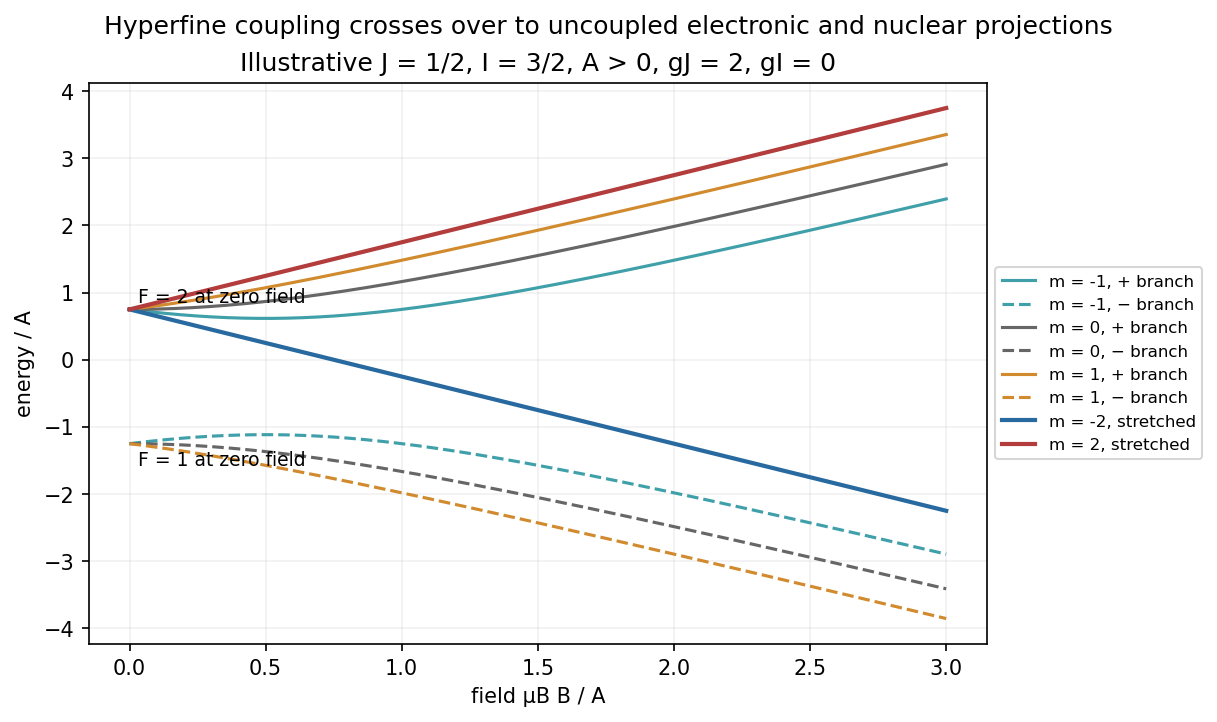
For a nucleus of spin and electronic , the magnetic-dipole hyperfine interaction is , using dimensionless angular-momentum operators. The electric-quadrupole hyperfine contribution vanishes for . In zero field, labels the levels:Their signed separation is . For , the larger- multiplet lies higher; negative reverses this order. If there is no such hyperfine splitting.
Let the field define and writeHere is the signed nuclear Zeeman coefficient expressed in Bohr-magneton units, including its nuclear-to-Bohr-magneton factor; it is not an unconverted nuclear factor. Total projection is conserved, while need not be. In the basis , , the two-state block isFor , define . Diagonalization gives the Breit-Rabi formula,For either sign of , the block itself remains valid; its ordered eigenvalues are .
For a stretched hyperfine Zeeman state at projection there is only one state each. Their energies are exactlyAssigning two branches to each stretched projection would double-count states.
In weak fields the shift is , with for ; an state has no first-order Zeeman shift. At strong hyperfine-decoupling fields the eigenstates approach product states withThis is the hyperfine regime of the Paschen-Back effect, still assuming the field is weak enough not to invalidate the electronic manifold. States of the same mix and avoid crossing when their off-diagonal coupling is nonzero; different- levels can cross.

Articles by others on the same topic
There are currently no matching articles.