An organelle maintains a reproducible molecular and functional organization while continuously replacing its components. Identity is therefore a regulated steady state, rather than a permanent collection of molecules. A useful explanation must connect selective delivery and retrieval to local biochemical reactions, physical boundaries and inheritance.
For a membrane-bounded organelle, the lipid bilayer separates its contents from the cytosol, preserves membrane-protein topology and permits lumenal conditions to differ from the surroundings. A lysosome, for example, requires an acidic lumen and retained hydrolases as well as a membrane. Its vacuolar proton ATPase establishes acidity, while counterion conductance and regulated transport prevent unbounded charge accumulation. An endoplasmic reticulum lumen instead supports protein folding and calcium storage. These environments determine which reactions occur and help stabilize the appropriate resident proteins. A boundary alone is insufficient: an empty vesicle can have the same basic bilayer architecture without the same biological identity.
Membrane composition creates selective recruitment sites. Local phosphoinositide synthesis and dephosphorylation produce membrane domains recognized by particular lipid-binding proteins. Phosphatidylinositol 3-phosphate is associated with early endosomal domains, whereas phosphatidylinositol 4-phosphate contributes to Golgi organization. These distributions reflect localized enzymes and regulated turnover, not an immutable lipid barcode. Other properties—including sterol abundance, bilayer thickness and curvature—can favour some membrane proteins over others. Membrane contact sites and lipid transfer proteins redistribute selected lipids while preserving the separation of the two compartments.
Rab GTPases provide a second layer of recognition. Membrane recruitment and nucleotide exchange generate an active Rab domain; effectors then promote vesicle tethering, motor recruitment and sorting. A Rab and its effectors can reinforce one another's localization. GTP hydrolysis and extraction provide opposing reactions that prevent uncontrolled spread. SNARE proteins, together with tethering factors and the appropriate lipid environment, subsequently favour fusion of compatible membranes. Specificity is combinatorial: neither a Rab nor a SNARE should be treated as a unique address sufficient by itself.
Membrane trafficking would progressively mix organelles without selective retrieval. COPII exports selected cargo from the endoplasmic reticulum, while COPI-dependent and other retrieval pathways return escaped residents and trafficking machinery. Resident proteins can be retained through interactions or retrieved using recognizable sorting information. The Golgi similarly balances forward cargo movement with recycling of processing enzymes. Endosomes sort some receptors back to the surface through recycling carriers while directing other material toward degradation. Such exchange preserves an organelle's characteristic composition without requiring every incoming molecule to remain there.
Identity can also change in an organized sequence. In endosome maturation, a compartment can lose Rab5 and acquire Rab7 while retaining internalized material. Live imaging of this Rab conversion argues that an early identity is actively replaced, rather than the same early compartment retaining an unchanging molecular label forever.[ref]
Rab Conversion as a Mechanism of Progression from Early to Late Endosomes by Jochen Rink and others. Live-cell Rab-marker conversion during cargo progression
A cell maintains distinct early and late populations even though individual compartments pass between them. Thus stable system-level organization and changing individual organelles are compatible.Some compartments use additional rules. Mitochondria and chloroplasts combine organelle protein import, genome expression, membrane growth and division; their identity cannot be reduced to vesicle fusion specificity. Peroxisomes import matrix proteins and receive membrane constituents through their own biogenesis pathways. Organelle positioning, fission and inheritance keep these functions distributed through growth and division, while damage recognition and turnover remove defective components.
Experimentally, one should distinguish causation from marker correlation. Acute inhibition of a localized lipid enzyme or Rab regulator can be followed by live imaging, cargo transport, lumenal pH measurements and rescue with a functional allele. A convincing identity change alters function and multiple independent features, rather than merely displacing a fluorescent marker. The central principle is selective flux plus local self-organization, balanced by retrieval and turnover.
First establish that proteins cross the organelle boundary; then define its resident proteome and determine which residents arrive by import. A protein detected near an organelle may be a surface binder, contaminant, transient visitor or locally synthesized product. These possibilities require different controls.
Start with an operational definition of the new organelle: its location, boundary, ultrastructure and reproducible biochemical enrichment. Fluorescence microscopy with independent markers and electron microscopy can determine whether it is membrane-bounded and whether it contacts or engulfs other compartments. A condensate without a membrane can recruit proteins by partitioning; that should not be mistaken for translocation through a membrane. Purification by density-gradient centrifugation or affinity isolation should include markers for likely contaminants and measurements of organelle integrity. An enriched fraction is a starting material, not evidence of import by itself.
Choose candidate proteins from fractionation, imaging or sequence predictions and make minimally perturbing labeled versions. Follow newly synthesized protein using a pulse-chase experiment and independently verify its position relative to the organelle boundary. Loss of a cytosolic precursor followed by accumulation of an internal mature form is suggestive, but proteolytic processing alone does not demonstrate translocation. Tags can obscure targeting signals or change folding, so compare different tag positions and validate endogenous localization where possible.
The key biochemical test is an organelle import assay coupled to a protease protection assay. Incubate isolated intact organelles with a labeled precursor, then remove externally accessible protein with protease. Imported lumenal or matrix protein should be protected in intact organelles but become sensitive after detergent disruption. Surface-bound controls must remain accessible; an independent internal marker tests organelle sealing. Include organelle-free incubations to identify protease-resistant aggregates, and verify that detergent does not simply inactivate the protease. Carbonate extraction or membrane fractionation can distinguish an integral membrane product from a soluble internal one. For membrane proteins, map protected fragments and terminal accessibility rather than demanding protection of the entire chain.
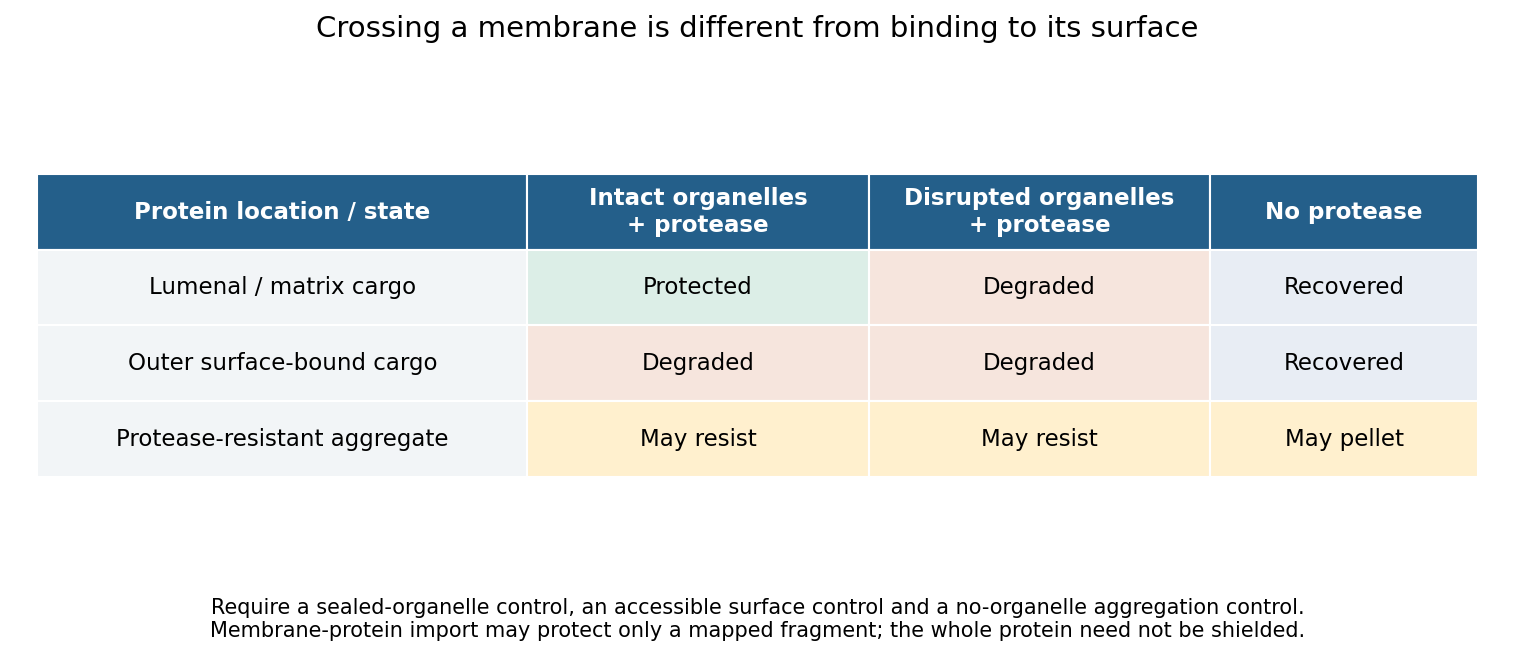
Original control logic separating protein import from surface binding and protease-resistant contamination
. Details. 
Perturbation then tests the mechanism. Compare incubation time and temperature; deplete and restore relevant energy sources; dissipate a membrane potential only after confirming that this treatment preserves membrane integrity; and compete with an excess of unlabeled substrate. Energy requirements must be discovered rather than assumed. Mitochondrial matrix entry, ER translocation and peroxisomal import use different machinery. In particular, stable folding is not a universal barrier: primary peroxisome experiments demonstrated import of stably folded substrates.[ref]
Import of stably folded proteins into peroxisomes by P. A. Walton and others. Import tests challenging a universal unfolding requirement
Mutating a candidate targeting signal should reduce import, while appending that signal to a suitable reporter can test sufficiency. Disrupting a candidate receptor or translocation component, followed by rescue with the wild-type protein, tests necessity. Because a blocked pathway may destroy the organelle indirectly, pair import measurements with morphology, membrane integrity and the import of unrelated controls. An import-defective allele that leaves the compartment otherwise functional is more informative than complete organelle loss. A negative isolated-organelle result does not exclude import if purification removed a required factor; compare with an intact-cell assay. Conversely, protection shows internalization but does not alone distinguish direct protein translocation from delivery inside a vesicle or engulfed compartment. Route-specific perturbations and topology measurements must resolve that distinction.
For the protein complement, combine quantitative spatial proteomics with complementary methods. Measure protein abundance across an entire fractionation gradient and identify proteins with reproducible localization profiles, rather than accepting every protein in a single pellet. Compare intact-organelle protease treatment with disrupted controls, and compare wild type with an import-defective condition. Analyze both soluble and membrane fractions. Liquid chromatography-mass spectrometry identifies peptides, but poorly soluble, scarce or unusual proteins may escape detection, so fractionation and acquisition strategies should be varied.
An internally localized TurboID or other proximity labeling enzyme can reveal proteins accessible in the relevant compartment in living cells. A cytosolic control, a catalytically inactive labeling construct and matched expression levels help identify background. Proximity labeling establishes accessibility and neighborhood, not translocation or stable residency by itself; labeling radius, reagent access and perturbation by the enzyme must be considered.[ref]
Finally distinguish resident, imported and all imported. A resident may have been synthesized by an organelle genome; an imported protein may only transit through the compartment. Time-resolved labeling, precursor processing, localization and dependence on a defined import pathway can classify these cases. Report coverage across growth conditions, detection limits and a confidence tier for each candidate. No single proteomic experiment proves absolute completeness, but convergent topology, kinetic and genetic evidence can produce a well-supported import catalogue.
Articles by others on the same topic
There are currently no matching articles.