The reactive occupied orbital of ethoxide is an oxygen lone pair; the acyl electrophile accepts into its carbonyl orbital. Draw the ethoxide lone pair as a directional oxygen-centred lobe directed toward an electrophile. In a lithium-ion-pair picture the low unoccupied acceptor on lithium is an empty, diffuse Li-centred orbital, with 2s/2p character depending on coordination. It should not be confused with an occupied Li–O covalent bonding pair.
For methyl acetate, the occupied frontier donor is principally an oxygen nonbonding orbital, mixed with the ester orbital system. Its low-lying reactive acceptor is , with opposite phases on carbon and oxygen and a relatively large accepting lobe on the carbonyl carbon. The corresponding sketch must show a node between the carbonyl atoms. These are chemically useful frontier-orbital descriptions; lithium alkoxide aggregation and ethanol solvation make a unique isolated-molecule orbital energy diagram an oversimplification.
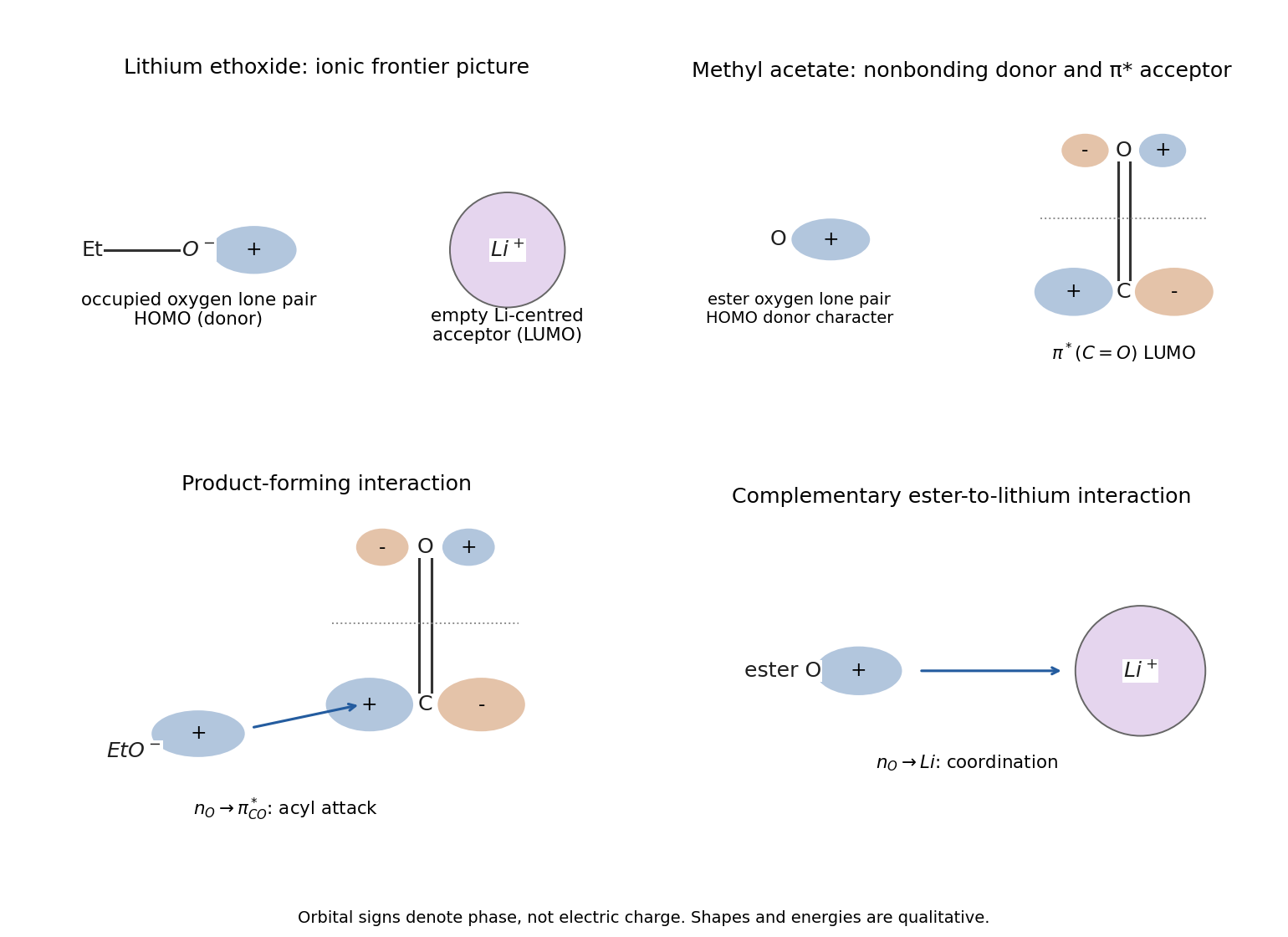
Original frontier-orbital sketches and the two complementary donor–acceptor contacts in the ester–lithium ethoxide encounter
. Details. The product-forming pairing is . Orient an occupied ethoxide oxygen lobe toward the large carbon lobe of the carbonyl acceptor with matching phase. An oblique approach permits constructive overlap while the pi bond weakens; this is the usual Bürgi-Dunitz trajectory to acyl carbon. The high-energy occupied orbital on the anion makes ethoxide the stronger electron-pair donor than the neutral ester oxygen.
The reverse frontier pairing, , gives oxygen-to-lithium coordination. It is a plausible stabilizing contact and can coexist with the first interaction, rather than constituting an alternative way to replace the ester alkoxy group. In the elementary frontier picture, the anionic donor-to-carbonyl interaction is the important pairing for the new covalent bond and is favoured by its donor strength and appropriate accepting coefficient at carbon. The Li contact can polarize the carbonyl and organize the reacting pair. Precise energy-gap rankings require a specified solvated lithium species; the sketches alone do not justify pretending that lithium coordination cannot occur.
The mechanism is nucleophilic addition followed by elimination of methoxide. An ethoxide oxygen lone pair attacks the carbonyl carbon, while the C=O pi pair moves to oxygen:The tetrahedral intermediate collapses when its anionic oxygen reforms the carbonyl and the C–OMe bond breaks with its electron pair going to the methoxy oxygen:lithium is a coordinating counterion; it does not supply an electron pair to the acyl carbon. proton exchange with ethanol connects the methoxide produced to the ethoxide catalyst pool and gives methanol, so the net solvent-mediated exchange is methyl acetate plus ethanol to ethyl acetate plus methanol. The reversibility of the elementary acyl steps is important: changing an alkoxy group is not automatically an irreversible reaction.
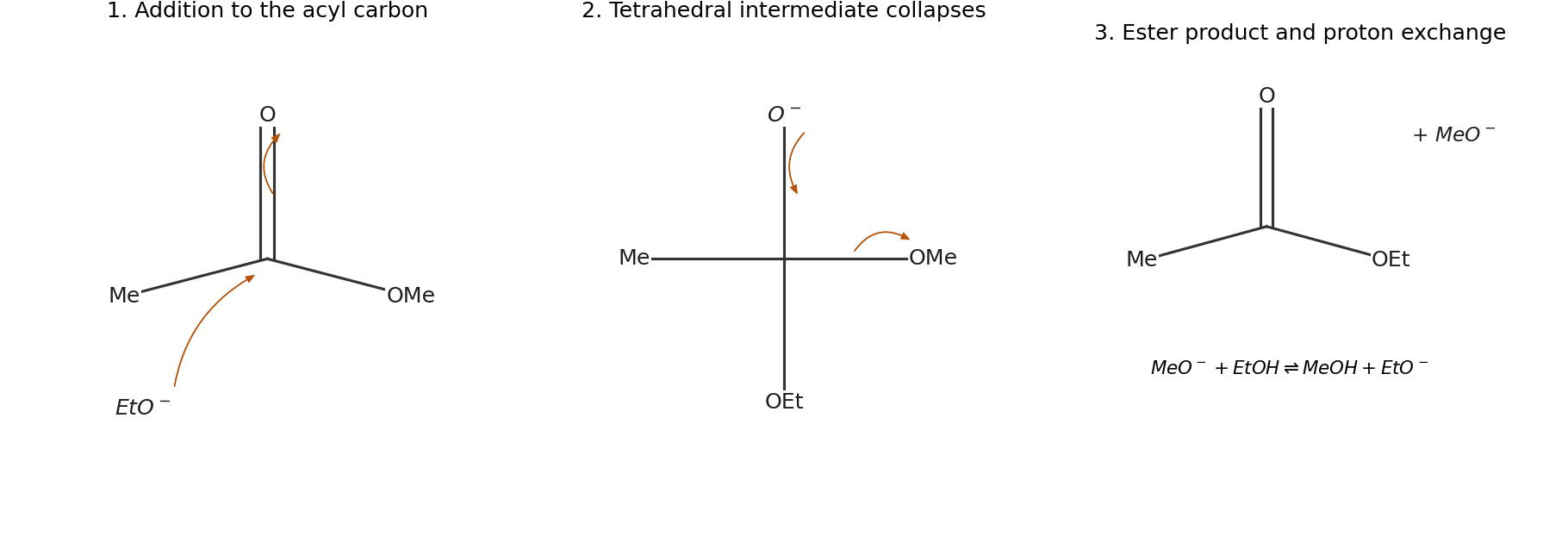


ethanol undergoes proton transfer with the methoxide produced. The oxygen lone pair of methoxide attacks the hydroxyl proton of ethanol, while the ethanol O–H bond pair returns to its oxygen:The alcohol acidities are similar, so this is an equilibrium, not an overwhelmingly one-way deprotonation determined solely by intrinsic acidity. The large ethanol reservoir and initially small methanol concentration nevertheless matter. This exchange means that lithium ethoxide need not be consumed stoichiometrically in the net transesterification. Neutral ethanol can also participate in proton shuttling; it is not acting as a reducing reagent or as a substrate for elimination under these conditions.
Excess ethanol drives a reversible ester exchange mainly through the actual mixture composition, not through a large new bond-energy advantage. The net reaction exchanges one ester and one alcohol for a closely related ester and alcohol. It preserves the main bond types and has no obvious large exothermicity. Solvation and ion pairing can contribute to its enthalpy, but there is no basis here for asserting a large negative standard reaction enthalpy.
There are two molecules on each side, so an increase in particle count is not the entropy explanation. Instead useWith ethanol as the solvent and little methanol initially, the reaction quotient is small; product formation and mixing lower the Gibbs free energy until the exchange equilibrium is reached. ethanol can be treated approximately as having fixed activity near its pure-solvent value, rather than assigned an arbitrarily enormous activity, while methanol remains dilute. This composition-dependent chemical-potential contribution is the appropriate entropic/mixing argument. It explains forward conversion under these conditions without claiming that must be positive, or that complete conversion follows without an equilibrium constant or removal of methanol.
Articles by others on the same topic
There are currently no matching articles.