The reactive occupied orbital of ethoxide is an oxygen lone pair; the acyl electrophile accepts into its carbonyl orbital. Draw the ethoxide lone pair as a directional oxygen-centred lobe directed toward an electrophile. In a lithium-ion-pair picture the low unoccupied acceptor on lithium is an empty, diffuse Li-centred orbital, with 2s/2p character depending on coordination. It should not be confused with an occupied Li–O covalent bonding pair.
For methyl acetate, the occupied frontier donor is principally an oxygen nonbonding orbital, mixed with the ester orbital system. Its low-lying reactive acceptor is , with opposite phases on carbon and oxygen and a relatively large accepting lobe on the carbonyl carbon. The corresponding sketch must show a node between the carbonyl atoms. These are chemically useful frontier-orbital descriptions; lithium alkoxide aggregation and ethanol solvation make a unique isolated-molecule orbital energy diagram an oversimplification.
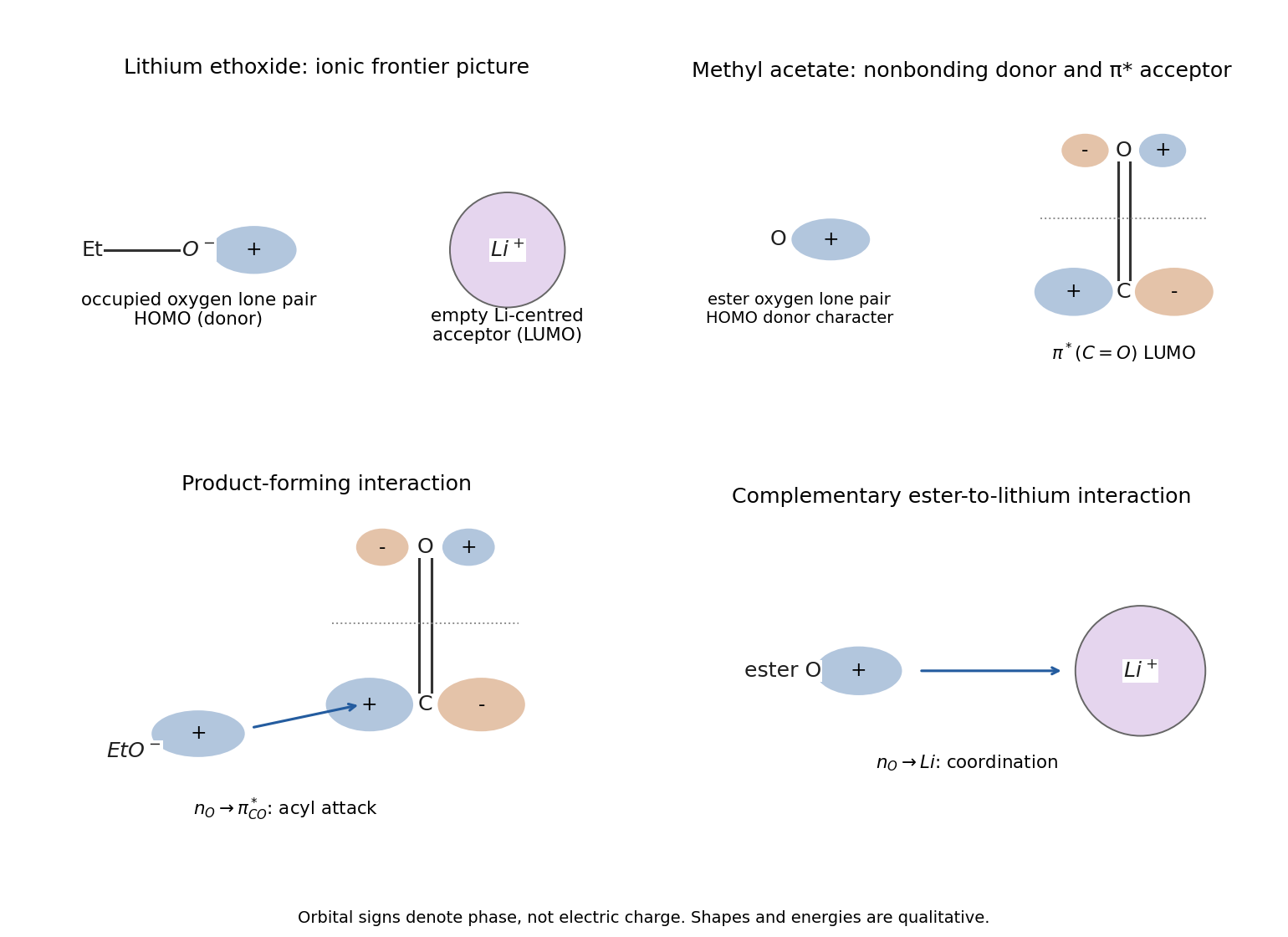
Original frontier-orbital sketches and the two complementary donor–acceptor contacts in the ester–lithium ethoxide encounter
. Details. The product-forming pairing is . Orient an occupied ethoxide oxygen lobe toward the large carbon lobe of the carbonyl acceptor with matching phase. An oblique approach permits constructive overlap while the pi bond weakens; this is the usual Bürgi-Dunitz trajectory to acyl carbon. The high-energy occupied orbital on the anion makes ethoxide the stronger electron-pair donor than the neutral ester oxygen.
The reverse frontier pairing, , gives oxygen-to-lithium coordination. It is a plausible stabilizing contact and can coexist with the first interaction, rather than constituting an alternative way to replace the ester alkoxy group. In the elementary frontier picture, the anionic donor-to-carbonyl interaction is the important pairing for the new covalent bond and is favoured by its donor strength and appropriate accepting coefficient at carbon. The Li contact can polarize the carbonyl and organize the reacting pair. Precise energy-gap rankings require a specified solvated lithium species; the sketches alone do not justify pretending that lithium coordination cannot occur.
The mechanism is nucleophilic addition followed by elimination of methoxide. An ethoxide oxygen lone pair attacks the carbonyl carbon, while the C=O pi pair moves to oxygen:The tetrahedral intermediate collapses when its anionic oxygen reforms the carbonyl and the C–OMe bond breaks with its electron pair going to the methoxy oxygen:lithium is a coordinating counterion; it does not supply an electron pair to the acyl carbon. proton exchange with ethanol connects the methoxide produced to the ethoxide catalyst pool and gives methanol, so the net solvent-mediated exchange is methyl acetate plus ethanol to ethyl acetate plus methanol. The reversibility of the elementary acyl steps is important: changing an alkoxy group is not automatically an irreversible reaction.
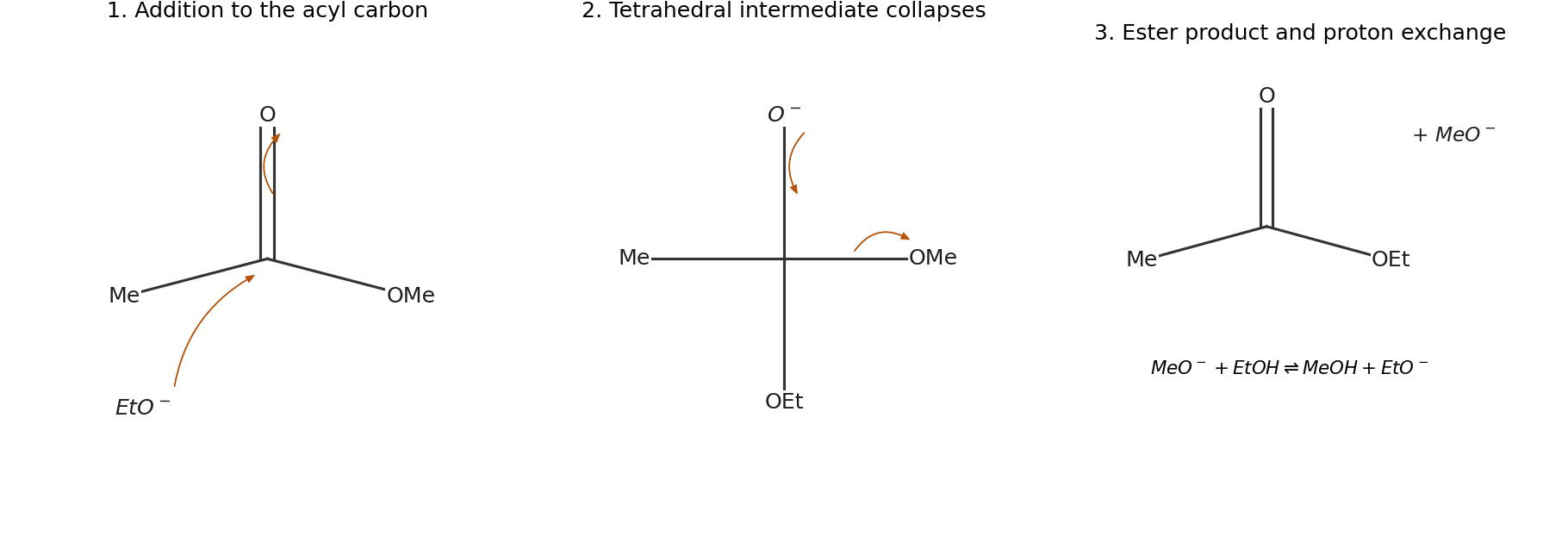


ethanol undergoes proton transfer with the methoxide produced. The oxygen lone pair of methoxide attacks the hydroxyl proton of ethanol, while the ethanol O–H bond pair returns to its oxygen:The alcohol acidities are similar, so this is an equilibrium, not an overwhelmingly one-way deprotonation determined solely by intrinsic acidity. The large ethanol reservoir and initially small methanol concentration nevertheless matter. This exchange means that lithium ethoxide need not be consumed stoichiometrically in the net transesterification. Neutral ethanol can also participate in proton shuttling; it is not acting as a reducing reagent or as a substrate for elimination under these conditions.
Excess ethanol drives a reversible ester exchange mainly through the actual mixture composition, not through a large new bond-energy advantage. The net reaction exchanges one ester and one alcohol for a closely related ester and alcohol. It preserves the main bond types and has no obvious large exothermicity. Solvation and ion pairing can contribute to its enthalpy, but there is no basis here for asserting a large negative standard reaction enthalpy.
There are two molecules on each side, so an increase in particle count is not the entropy explanation. Instead useWith ethanol as the solvent and little methanol initially, the reaction quotient is small; product formation and mixing lower the Gibbs free energy until the exchange equilibrium is reached. ethanol can be treated approximately as having fixed activity near its pure-solvent value, rather than assigned an arbitrarily enormous activity, while methanol remains dilute. This composition-dependent chemical-potential contribution is the appropriate entropic/mixing argument. It explains forward conversion under these conditions without claiming that must be positive, or that complete conversion follows without an equilibrium constant or removal of methanol.
Both dimers have two electrons in a valence sigma-bonding orbital and a formal valence bond order of one. For hydrogen the minimal-basis configuration is , with the -derived as highest occupied molecular orbital and as LUMO. The bonding combination has no internuclear node; the antibonding combination does.
For lithium, include the filled core pair of levels as well as the valence levels:The first two orbitals are predominantly core combinations whose bonding and antibonding occupations cancel in a simple bond-order count. The highest occupied molecular orbital is predominantly , denoted ; the LUMO is , predominantly the antibonding combination but modified by mixing with compatible contributions. The nearby empty -derived sigma and pi levels must also be shown. Only orbitals of matching symmetry mix, so this does not mean that every combination mixes with every combination.
On a common qualitative energy reference, hydrogen is much lower than lithium's valence , while lithium's core levels lie much deeper. The Li valence bonding–antibonding separation is smaller, consistent with its longer and weaker bond. The figure uses a compressed core region and schematic gaps, not measured orbital energies. The role of symmetry-compatible s–p orbital mixing in the first-row diatomics is illustrated in institutional molecular-orbital notes.[ref]
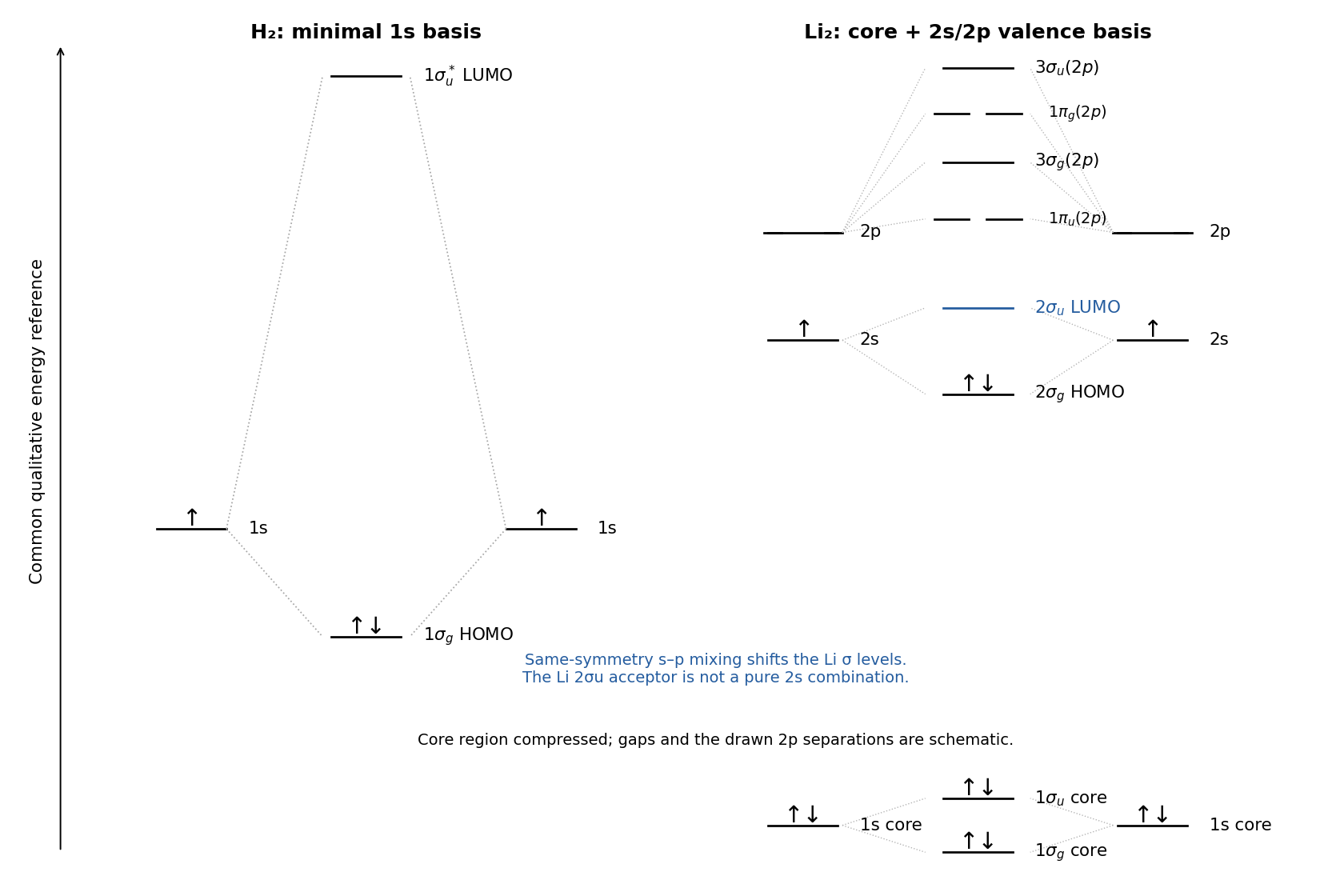
Original common-reference qualitative orbital diagrams for hydrogen and lithium dimers, including lithium 2p-derived levels and core occupancies
. Details. 
Two electrons can occupy a fully bonding orbital delocalized equally over all three hydrogen atoms. Three atomic orbitals on an equilateral triangle form one totally symmetric combination and a degenerate pair of higher orbitals. In an orthonormal equal-interaction model with diagonal energy and off-diagonal ,The lower orbital is proportional to , with constructive overlap along every edge. Its two electrons give a three-centre two-electron bond and equivalent interactions between every pair of nuclei. At the equilibrium distance, this bonding competes with nuclear Coulomb force to favour the symmetric triangular arrangement. The occupied shell is nondegenerate and closed, so there is no first-order Jahn-Teller incentive to distinguish the three edges. A straight-line or localized single-bond description would miss that equally shared bonding pattern.
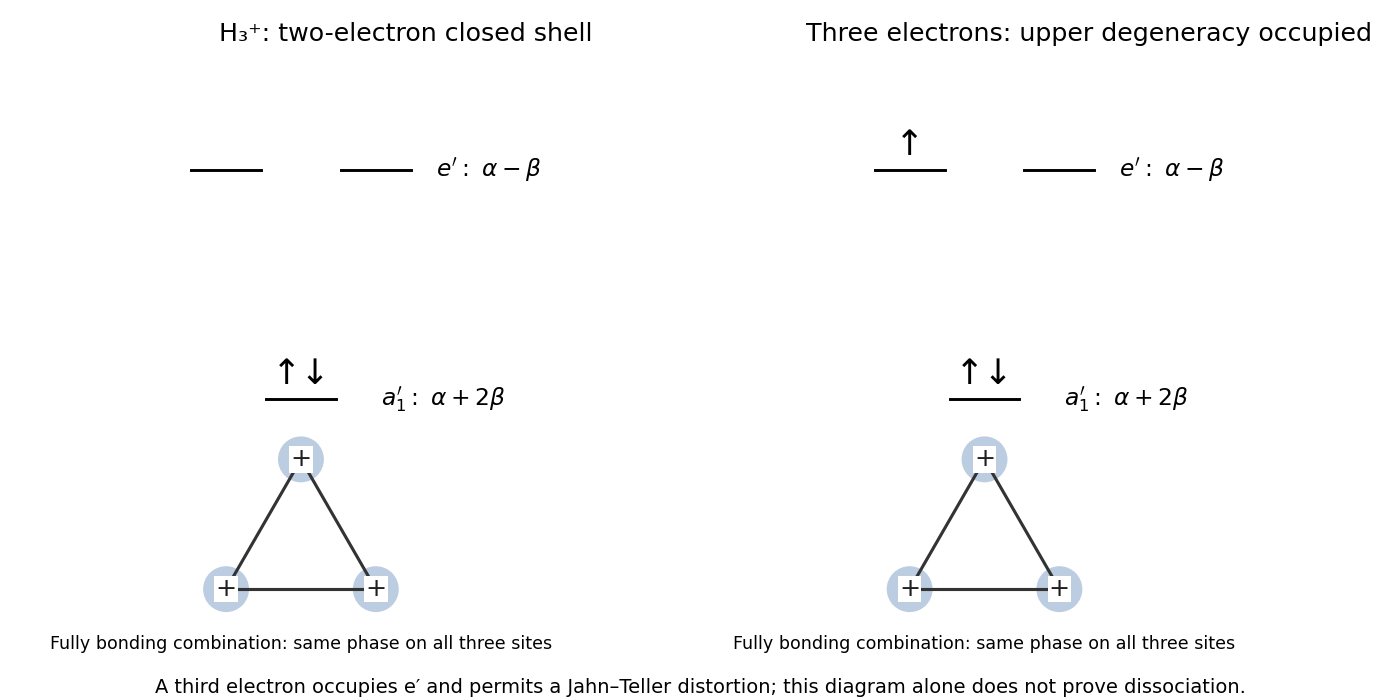
Original three-site orbital filling for the two-electron cation and the effect of a third electron on a degenerate triangular shell
. Details. 
The third electron must enter the higher, degenerate and partly antibonding orbital pair rather than the already filled fully bonding orbital. At an equilateral geometry the configuration becomes . This weakens the collective bonding and creates orbital degeneracy, so a distortion can lower the singly occupied component and localize bonding. Along the ground-state reaction coordinate, formation of a normal two-electron H–H bond with a separated hydrogen atom becomes favourable.
The result is ground-state dissociation to , not loss of a proton from the cation or formation of three isolated atoms. One should not claim that adding one electron exactly cancels two bonding electrons: a simple three-orbital count alone does not predict a zero bond order or prove dissociation. The important qualitative changes are occupancy of an antibonding/degenerate level and access to a lower-energy dimer-plus-atom arrangement. A complete dissociation statement requires the potential-energy surface, including nuclear repulsion; electronically excited neutral H states are a separate issue.
Li can retain a bound triangular framework, but an equilateral triangle with three valence electrons is Jahn-Teller unstable. The six core electrons are effectively spectators. In the simplest triangular valence model, two electrons occupy the fully bonding level and one occupies the degenerate upper pair. Making one edge different splits that pair; the single electron occupies the lower component, giving an electronic stabilization that can outweigh the cost of a small distortion. An isosceles triangle is sufficient to lift the degeneracy, so three different edge lengths are not required.
The two 2.8-Å contacts are close to, but slightly longer than, the 2.7-Å dimer bond, while the 3.5-Å edge is much weaker. Delocalization and partial antibonding occupation explain why these cannot be treated as three independent full-strength Li–Li single bonds. lithium's nearby valence functions provide additional polarization and mixing channels absent from a hydrogen -only description, allowing a more flexible multicentre electronic structure. The existence of a bound minimum, unlike ground-state H, is an energetic fact rather than a consequence of three-electron counting alone. Calculated Li surfaces show bound states, a conical intersection and Jahn-Teller coupling.[ref]
Articles by others on the same topic
There are currently no matching articles.