Source paper: released Oxford examination archive, member
2018/T/a16156w1.pdf. The actual cover identifies the Second Public Examination, Trinity Term 2019, Friday 28 June, 09:30–11:30; the archive directory predates that cover year. All three questions are covered below, including every printed Roman part.Use nonnegative amounts on the original directed edges of the flow network. A feasible flow is a function satisfying the capacity constraints and flow conservation at every internal vertex:Its flow value is net outflow at the source,Summing flow conservation shows that this is also net inflow at the sink. Subtracting incoming flow matters when the source has incoming edges.
An – cut of a flow network is a partition of a set with and . Its cut capacity is the total outward flow network edge capacity,Incoming edges do not contribute to this sum. Equivalently, one may use the antisymmetric net-flow convention, but the nonnegative arc convention above will also be used in the subsequent reductions.
Sum net outflow over all vertices in the source side . An internal directed edge occurs once positively and once negatively, so it cancels. All internal vertices have zero net outflow by flow conservation, and the sink is outside . ThereforeThe second sum is nonnegative, while every term in the first satisfies its capacity constraint. Consequently,This is direct accounting from flow conservation; it does not invoke the max-flow min-cut theorem.
A path-cycle matching is exactly an edge subset whose resulting subgraph has maximum degree at most two: every nontrivial connected component of a graph of this form is a graph path or a cycle in a graph. Thus the task is a bipartite b-matching problem with bound two at every vertex.
Find a bipartition , orient every original edge from to , and add a source and sink . Give each arc , for , flow network edge capacity two; each original arc flow network edge capacity one; and each arc , for , flow network edge capacity two. Compute an integral maximum flow and select the original edges whose flow is one. The integral max-flow theorem guarantees such an integral optimum.
By flow conservation, at most two selected edges touch each vertex, so they decompose into the required vertex-disjoint paths and cycles in a graph. Conversely, any permissible path-cycle matching gives a feasible flow: send one unit through its middle arc for each selected edge, with the outside arc amounts equal to the endpoint degrees. In both directions, the flow value equals the number of selected edges. Maximizing either quantity therefore maximizes the other.
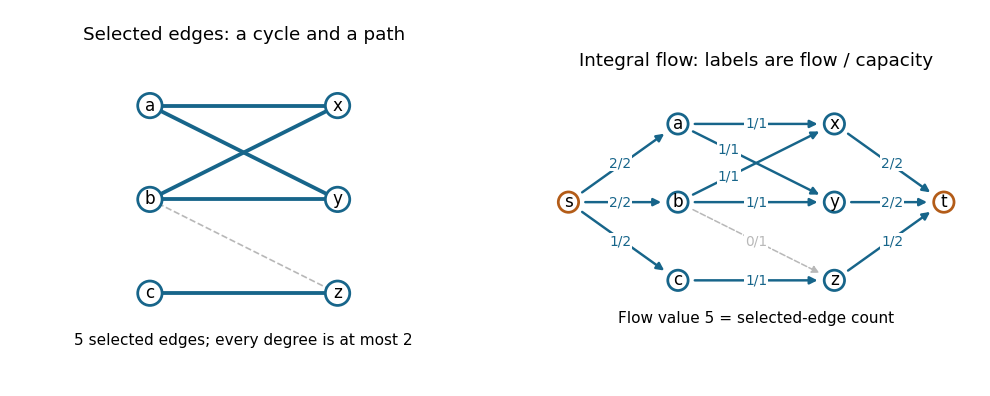

The blue edges in this example form a four-cycle in a graph and a one-edge graph path; the dashed edge is unused. Their five units of flow are optimal: the two left vertices can each contribute at most two selected edges, and has only one incident edge.
The constructed flow network has vertices and arcs. A polynomial-time algorithm for maximum flow, such as the Edmonds–Karp algorithm, followed by a traversal of the selected subgraph, gives an efficient solution.
Separate the forced integer portion from the choice of rounding direction. Put and . Define residual demandsThese are nonnegative integers, since the original row and column sums are integers. Also . Each fractional part satisfies .
Construct a flow network with a vertex for each row and column, source-to-row arcs of flow network edge capacity , row-to-column arcs of flow network edge capacity one exactly where , and column-to-sink arcs of flow network edge capacity . The amounts themselves define a fractional feasible flow of flow value . No flow can exceed , the total source flow network edge capacity. Because all constructed flow network edge capacities are integers, an integral maximum flow also has flow value and saturates every source and sink arc.
Let be its middle-arc flow, taking when that arc is absent. Then , and the required answer isAt an already integral entry no middle arc exists, so that entry stays fixed. At a nonintegral entry the two possibilities are precisely its floor and ceiling. Flow conservation gives and , preserving every original row and column sum.
This is matrix rounding with fixed margins. There are vertices and at most arcs. Exact rational arithmetic computes the floors and residual demands in polynomial time in the encoded input length; the resulting flow network edge capacities are small integers, so there is no need to scale by a potentially large common denominator.
First give the vote of every voter whose allowed set contains . Let their number be . This loses no possible strict victory: starting with any winning assignment, changing such a ballot to increases 's score and weakly decreases an opponent's score. Thus a winning assignment exists exactly when one exists with these ballots fixed.
Every remaining voter must now be assigned to an allowed opponent, and each opponent may receive at most votes. If any allowed set is empty, there is no valid election assignment. With at least two candidates, immediately makes a unique victory impossible. With only the candidate , every nonempty ballot set forces that candidate, so the answer is yes under the question's strict-comparison definition.
For the remaining case , make a flow network with a vertex for each remaining voter and each opponent. Add source-to-voter arcs of flow network edge capacity one, voter-to-opponent arcs of flow network edge capacity one for the allowed choices, and opponent-to-sink arcs of flow network edge capacity . Compute an integral maximum flow. ThenA flow saturating all voter arcs assigns each remaining voter to exactly one allowed opponent, by integrality and flow conservation. The sink-arc capacity constraints give every opponent strictly fewer than votes. Conversely, any winning assignment with the fixed votes defines just such a saturating feasible flow. The flow network has at most vertices and arcs, hence the decision takes polynomial time.
Take and . Their convex combination satisfiesThus every such convex combination remains in , so is a convex set. The assertion also holds when is empty.
An extreme point cannot be written as a nontrivial convex combination of two distinct points of : if with and , then .
A vertex of a linear polyhedron is a feasible point at which the active constraints include linearly independent row normals. Equivalently, some independent bounding hyperplanes intersect uniquely at that point. This definition does not require to be bounded or full-dimensional. For a linear polyhedron, it is also equivalent to the point uniquely maximizing a suitable linear function: sum the selected active inequalities to construct one such linear function.
Let be a vertex of a linear polyhedron and choose independent active constraints, written , with invertible. Suppose , where and . Each selected inequality has and , whileSince both weights are positive, equality in this weighted upper bound forces for every selected row. Hence , and invertibility gives . Therefore every vertex of a linear polyhedron is an extreme point.
No. For the linear polyhedron , take and . The maximum of is one, attained at . Yetso is not an extreme point, hence not a vertex of a linear polyhedron. An optimal face can contain many points; an arbitrary maximizer need not be one of its vertices of a linear polyhedron.
Only have printed nonnegativity restrictions; are unrestricted. In four-dimensional space, a vertex of a linear polyhedron needs four independent active constraints. There are exactly four available constraints, so all must be active. Solving them givesand therefore the only possible vertex of a linear polyhedron is . It is feasible, and its four active normals are independent, so it is indeed a vertex of a linear polyhedron.
One can also see uniqueness geometrically from the slack variables and . The feasible region is in affine bijection with the nonnegative orthant in :That orthant has only the origin as an extreme point, giving the same unique vertex of a linear polyhedron.
Use the standard maximum form of a linear program convention subject to and . Split the unrestricted variables as and , with all four new variables nonnegative. The resulting linear program isIf equality-constraint standard form is preferred, add a nonnegative slack variable to each inequality.
Give the two inequalities nonnegative dual variables . The dual linear program isThe paired inequalities encode equalities for the two original unrestricted variables. Equivalently, the dual linear program has , , , and . Thus its only feasible point is , of objective function value .
The point satisfies dual feasibility and supplies an upper bound of by weak duality. Directly, take one copy of the first constraint and four copies of the second:Since , the original objective function is at most . The feasible point attains . HenceThere are also nonvertex optima. In terms of the slack variables, the exact objective function identity isEquality requires , leaving the entire optimal faceNegative or on this ray are allowed. This illustrates why the single vertex of a linear polyhedron does not imply a unique optimum.
First suppose the stated nonnegative vectors exist. If , multiply by and by . Since and , this gives the contradictionThus the certificate implies .
For the converse, putA common feasible point exists exactly when , . Introducing a nonnegative vector of slack variables makes this equivalent toIf this system is infeasible, the nonnegative-equations version of Farkas' lemma supplies an unrestricted vector such thatSplit according to the original two blocks of inequalities. The three conditions become , and , exactly the desired certificate. Both directions are proved. The role of is essential: it is why the combined normal need only be nonnegative rather than zero.[ref]
Convex Optimization by Stephen Boyd and Lieven Vandenberghe. §5.8.3, printed pp. 261–262, linear-inequality alternatives and Farkas' lemma
Let and choose any column probability vector , for example the first coordinate unit vector. Because has nonnegative entries and each row sums to one, maps the probability simplexinto itself: and .
The iterates need not converge, so take their arithmetic averages,A telescoping sum givesBoth vectors on the right before subtraction have L1 norm one, so .
The probability simplex is closed and bounded in finite-dimensional Euclidean space, hence compact by the Heine-Borel theorem. It follows that a subsequence converges to some . Passing to the limit in the displayed identity, using continuity of the linear map , gives , with and .
This proves stationary distribution existence for a finite Markov chain without any Markov chain irreducibility or aperiodicity assumption. Those stronger hypotheses concern uniqueness and convergence, not the existence required here.
A parameterized decision problem is fixed-parameter tractable if there is an algorithm deciding inputs of encoded length and parameter in running time at most , where is a computable function and is a constant independent of . Arbitrarily expensive dependence on the parameter is permitted; putting in the exponent of does not by itself establish fixed-parameter tractability.
For a minimization problem with nonnegative costs, a factor-two approximation algorithm runs in polynomial time, always returns a feasible solution, and satisfies on every feasible input. A feasible solution also satisfies . If the optimum is zero, the guarantee requires an answer of zero cost.
The vertex cover decision problem takes a finite simple graph and a nonnegative integer , and asks whether there is a vertex cover of cardinality at most . The optimization problem asks for a minimum vertex cover, with cost equal to its cardinality.
For the decision problem, if there are no edges, accept; if there is an edge but , reject. Otherwise choose an edge and branch: either include and recurse on with budget , or include and recurse on with budget . Accept if either branch accepts. Every vertex cover contains at least one endpoint of , so every possible solution is retained by at least one branch. Conversely, adding the selected endpoint to a vertex cover returned by the smaller instance covers all original edges. This proves correctness by induction on the remaining budget.
The search tree has depth at most and at most leaves. Processing each node in time gives running time, establishing fixed-parameter tractability.
For optimization, greedily build a maximal matching : repeatedly select an edge and discard every edge touching either endpoint. Return the set of all endpoints of . Any edge with neither endpoint in could be added to , contradicting maximality; thus is a vertex cover. Since the edges of a matching in a graph have pairwise disjoint endpoint sets, every vertex cover must contain at least one different vertex for each of them. ThereforeThe greedy construction takes polynomial time, and can be implemented in with adjacency lists. It needs only a maximal matching, not a maximum matching.
If the basis has members, it has subsets, each specifying a possible union. Different subsets can produce the same union, so the number of distinct generated sets is at most . Consequently,Here is a set family of distinct sets. If a representation lists duplicate input sets, discard those duplicates before applying this bound. The empty union is included.
Write and . If is a basis for the original instance, replace each member by . Deletion commutes with unions, so the resulting family generates every member of and has at most members.
Conversely, take a basis for the reduced instance. Lift each of its members byIf is represented as a union of reduced basis sets, the same union of their lifts agrees with on . It contains exactly when one of the selected reduced basis sets contains , namely exactly when . By the assumed incidence equivalence in a set family, this occurs exactly when . Thus the lifted union is precisely , and the lifted basis has no more members.
Therefore deleting preserves the yes/no answer with the same parameter . The reverse construction does not require a reduced basis set to be an input set.
First discard duplicate input sets, and let . If , reject by part (i); this rejection can be encoded as the fixed no-instance , , of the set basis problem. Otherwise, represent each ground element by its incidence columnKeep one element from each class of equal columns. By repeatedly applying part (ii), this preserves the answer. The reduced number of elements satisfiesRelabel these representatives and store their reduced incidence matrix. Its membership bits, the dimensions and have encoded length bounded solely by a computable function of ; the leading incidence bound is . Thus this is a kernelization, even though it is not a polynomial kernel. Forming columns and grouping identical ones takes polynomial time in the original explicit input length. To test , compare bit lengths or truncate exponentiation at ; never construct an enormous merely to perform this preprocessing comparison.
For completeness, the bounded instance can be solved explicitly. Enumerate all ordered lists of subsets of the -element ground set, allowing empty members to pad shorter bases. There are at most such lists. For a candidate basis and each reduced input set , form the union of every candidate basis set contained in . If this union equals , a representation exists; if it does not, no union of that candidate's members can represent , because any member not contained in would add a forbidden element. Testing every therefore verifies a candidate in time polynomial in .
The preprocessing is polynomial in the original input length, and the remaining search depends only on . Hence the set basis problem is fixed-parameter tractable with respect to . Empty input families and are covered by the same empty-union convention.
Assume the standard nonempty instance convention , and set . Start with no centers. Pick any city still farther than from every selected center, add it as a center, and mark every city within distance of it as covered. Stop when all cities are covered.
Distinct chosen centers have pairwise distance greater than . Fix an optimal set of centers and assign each city to one optimal center within distance . Two cities assigned to the same center have distance at most by the triangle inequality. Thus no two chosen centers can be assigned to that same optimal center. The pigeonhole principle shows that the greedy procedure selects at most centers and has radius at most . If fewer than are selected, add arbitrary distinct cities; this cannot worsen the radius.
With the supplied radius, a straightforward implementation updates coverage in time per selected center, hence takes distance tests. The argument also handles . It is the packing bound underlying the metric k-center problem.
The optimum radius is a distance from some city to a selected city, so it belongs toSort the distinct values of , try them in increasing order, and run part (i)'s greedy procedure with each trial value . Declare a trial successful when all cities are covered using at most centers; stop a failed trial as soon as a st center would be selected. The trial must succeed by part (i), so the first successful value satisfies . Its output hasThere are candidate distances and work per trial, giving a polynomial-time algorithm with running time , plus sorting. Success at need not mean that radius itself is feasible; only the radius- guarantee is used.
A faster alternative is the farthest-first traversal. Choose any first center, then repeatedly choose a city farthest from its nearest current center until have been chosen. Let be the resulting radius. If , adjoin a city attaining that distance. At every earlier selection, the maximum distance to the then-current center set was at least , so all pairs among these cities are at distance at least . Two belong to the same optimal radius- closed ball, giving by the triangle inequality. If , the guarantee is immediate. Maintaining nearest-center distances gives distance evaluations without knowing .
Articles by others on the same topic
There are currently no matching articles.