The velocity of a fluid element is the time derivative of its position with its Lagrangian coordinates held fixed. Direct differentiation givesReplacing the Lagrangian coordinates by the current Eulerian coordinates therefore gives the velocity fieldThe distinction between following a fluid element and differentiating at fixed Eulerian coordinates is what connects the given deformation map to this velocity field.
For a planar incompressible flow, the divergence of the velocity field must vanish. HereEquivalently, the Jacobian determinant of the deformation map isso every material area is preserved. However, the out-of-plane vorticity isSince , this vorticity never vanishes. The motion is an incompressible flow but is not an irrotational flow; its local spin is clockwise.
Adopt the streamfunction convention , . Integrating the first component of the velocity field in gives . The second component then requires . Thus, omitting an arbitrary function of time,At a fixed instant, the streamlines are the connected curves . To classify this quadratic form, introduce the invertible scaled and rotated coordinatesThenFor , both coefficients are positive. Every therefore gives an ellipse, and is the stagnation point at the origin. For , the quadratic form is an indefinite quadratic form: each gives a hyperbola. The level consists of the straight separatriceswhose rays approach or leave the origin; the origin itself is a stagnation point. At the transition , , so the nonstationary streamlines are parallel straight lines and is a line of stagnation points. These are instantaneous streamlines; the time dependence means that they need not coincide with pathlines.
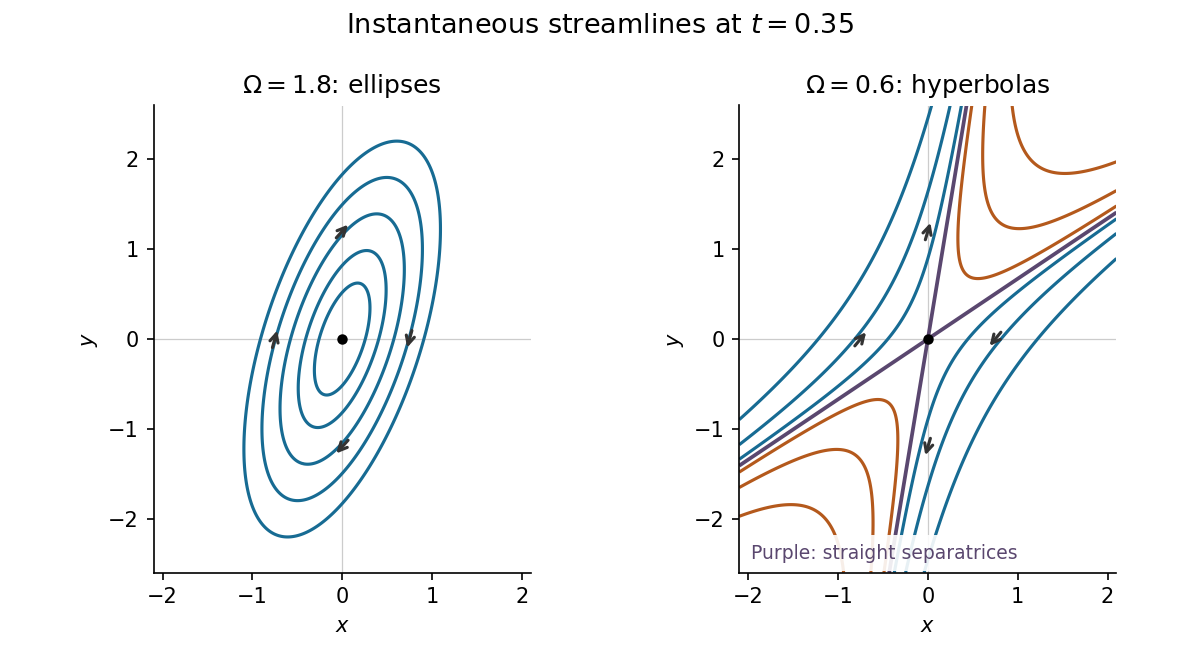
Instantaneous elliptical and hyperbolic streamlines at the same positive time
. Details. 
Use for the complex potential of a two-dimensional potential flow, so its complex velocity is . The incident uniform flow and line source haveThe coefficient of the complex logarithm is one because a line source of strength has complex potential of a two-dimensional potential flow , and here . Applying the Milne-Thomson circle theorem to the unit circle givesSince , locally consistent branches of the complex logarithm giveChanges of branch only alter the constant in a local expression; is single valued away from its singularities. The added terms represent a two-dimensional potential doublet at the origin, an image line source at , and a compensating line sink at the origin. The image line source and line sink have equal and opposite strengths, so no net volume flux enters the cylinder.
On , the Milne-Thomson circle theorem makes up to a constant. Consequently the streamfunction is constant there, establishing the no-penetration boundary condition. All line source strengths are real, and the two-dimensional potential doublet has zero circulation, so the circulation around the cylinder is zero. There is no additional line vortex term.
Let denote the force per unit length exerted by the fluid on the cylinder, and let be the constant mass density. For a counterclockwise contour around the unit circle, the Blasius force theorem givesAn efficient use of the residue theorem finds the sum of the enclosed residues by subtracting the external pole at from the sum of all finite residues. At large ,The sum of all finite residues of is therefore . At , write , with a holomorphic function near . ThenThusUsing and givesThe vanishing vertical force also follows from reflection symmetry about the real axis. This force on a unit cylinder due to a uniform flow and an external source uses the counterclockwise orientation in the Blasius force theorem to fix the sign of the horizontal force.
Since , the denominator inis positive. The positive root of isThe other root is negative, so the horizontal force points in the positive direction for , vanishes at , and points in the negative direction for . In particular, the nearby line source pulls the cylinder towards itself as , while at large the horizontal force is .
Articles by others on the same topic
There are currently no matching articles.