Original public paper: Physical PDF pages 813–815. All three questions and all three alternatives in question 2 are answered. We use natural units and Minkowski metric signature .
A variational symmetry of a Lagrangian density maps admissible field configurations to configurations with the same action, up to an allowed boundary contribution. Thus (i) the action is invariant for suitable boundary conditions, while (ii) the Lagrangian density need only change by a total divergence, rather than be pointwise invariant. For an internal symmetry of a classical field theory, the coordinates are fixed. A spacetime transformation also changes the integration measure and must be treated accordingly.
A conserved current satisfies on shell. The Noether charge then obeys , so conservation of the integrated charge additionally requires vanishing net boundary flux.
For several real field components and a constant infinitesimal parameter, write and . The product rule givesSubtract the specified divergence. The Euler-Lagrange field equations make the first term vanish, proving the Noether theorem withFor a complex scalar field, treat the field and its complex conjugate as independent variables in this calculation; this is equivalent to using its two real components. This is the Noether current for a first-derivative scalar field, summed over components.
Collect the two complex fields into . Their Lagrangian density has the radial formFor a constant Hermitian matrix , the unitary transformation preserves both the kinetic contraction and . In particular the two specified transformations have generators and , the first two Pauli matrices. Their Noether currents are instances of the unitary scalar multiplet currentExplicitly,An overall change of current sign corresponds to reversing the associated symmetry parameter; the signs here follow the two transformations as written.
The matrix commutator of their infinitesimal matrices is . The antisymmetric difference of successive transformations therefore supplies a third symmetry, after a nonzero rescaling of its parameter:Its current isThe three traceless matrices obey . Their exponentials act as SU(2) on the complex doublet. This identifies both the Lie algebra and the group acting on these fields: the central element changes and is not the identity transformation, so the doublet action is not an action of obtained by identifying with .
There is also a common global phase symmetry of a complex scalar field, , with current . Together with SU(2) this gives among complex-linear transformations. Independent constant phases of and , and field interchange, are already contained in this group.
In fact this particular scalar potential has a larger real internal symmetry. Write and ; thenThe O(4) symmetry of a complex scalar doublet includes transformations mixing with , which need not be complex-linear. Its connected part has six rotation generators, so listing alone would not exhaust the internal symmetries of the displayed isolated theory. Individual field conjugations are examples of its discrete transformations. Finally the spacetime-independent scalar coefficients and Lorentz contractions give Poincaré symmetry, and the real scalar action also permits spatial reflection and time reversal. These statements concern the action; a chosen vacuum or external boundary conditions can preserve fewer symmetries. Special parameter choices can introduce additional symmetries, but are not required here.
Chirality distinguishes the two inequivalent Weyl spinor representations of the proper Lorentz group. For a Dirac spinor, define and the chiral projectorsThey satisfy and . Proper Lorentz transformations preserve each chiral representation, whereas parity exchanges them. Helicity instead measures the projection of spin angular momentum along momentum. For a massive particle it can change under a boost that overtakes the particle, so it must not be identified with chirality. For massless positive-energy particles the left-chiral field annihilates negative-helicity particles and creates positive-helicity antiparticles.
The Standard Model is a chiral gauge theory: left- and right-chiral fields have different gauge group representations. In the convention , one generation containsThe minimal field content has no right-handed neutrino. A sterile right-handed field is a possible extension, not a required member of that minimal list. The table displays weak isospin, hypercharge and color charge assignments, not assignments of massive-particle helicity.
The weak charged current contains and its Hermitian conjugate, with coupling . Only the left-chiral lepton doublet participates, giving parity violation. Both chiralities can couple to the Z boson, but their coefficients differ:Here is that of the left-chiral component. For the electron, it is . The photon and gluon couplings of a charged massive fermion are vectorlike; this does not make the full electroweak interaction vectorlike.
A bare Dirac mass term joins the two chiral representations. Their different electroweak quantum numbers forbid that term before electroweak symmetry breaking. A Yukawa interaction, such as , is gauge invariant; the Higgs doublet expectation value then gives . Up-type quarks use the conjugate doublet. Thus chirality explains the weak charge assignments, their parity violation, and why masses arise through the Higgs mechanism. The consistency of these chiral assignments also requires Standard Model anomaly cancellation.
Gauge boson self-interactions follow from noncommuting generators, rather than a separate assumption that the force carriers should attract one another. With and , the Yang-Mills field strength isThe last term is required so that transforms covariantly under the gauge group. Let . Expanding gives a quadratic kinetic term and the cubic and quartic Yang-Mills self-interactionsThe structure constants and one gauge coupling fix both types of vertex. For an Abelian group the structure constants vanish: the renormalizable pure electromagnetic field action has no elementary three- or four-photon vertex. Photon scattering through charged-particle loops is a different statement, not a contradiction.
In Quantum chromodynamics, the non-Abelian structure produces three- and four-gluon vertices; the gluons themselves carry color charge. These vertices influence multi-jet production and the renormalization group running of the strong coupling. In the electroweak sector the fields mix with the Abelian field after electroweak symmetry breaking. The resulting charged-vector vertices include and , with couplings and , together with the related four-boson vertices. Neutral-only triple vertices such as are absent at tree level in the Standard Model.
The electroweak triple gauge coupling can be measured using . The neutrino exchange and neutral-vector exchange diagrams interfere: the gauge-related coefficients cancel the most rapidly growing longitudinal-polarization terms. Their relative strengths and angular dependence therefore test the theory more sharply than merely observing a pair of massive vector bosons. The electron-mass-suppressed Higgs contribution completes the corresponding mass-dependent cancellation. Adding arbitrary independent three- and four-vector couplings would generally destroy these relations.
At the Large Electron–Positron Collider, the L3 experiment fitted charged triple-gauge parameters using hadronic and semileptonic W-pair events, complemented by single-W and single-photon channels. These measurements agreed with the predicted self-couplings. Their interpretation uses reconstructed decay products and differential distributions, rather than direct pictures of a three-boson vertex.[ref]
Measurement of Triple-Gauge-Boson Couplings of the W Boson at LEP by L3 Collaboration. 2004, abstract: W-pair channels at 189–209 GeV, complementary channels and agreement with Standard Model self-couplings
The evidence tests several linked claims: a weak neutral current, massive charged and neutral mediators, their chiral couplings, and the non-Abelian interactions among those mediators. A theory must describe these with a common set of electroweak parameters.
The Gargamelle neutral-current experiment supplied a particularly direct early test. A neutrino beam crossed a heavy-liquid bubble chamber; charged reaction products made visible tracks, while incoming and outgoing neutrinos did not. Neutral-current candidates had a hadronic vertex without an accompanying charged lepton, or an isolated recoiling electron. The visible final state differs from a muon-neutrino charged-current event with an outgoing muon. Neutral hadrons entering from surrounding material could imitate a hadronic vertex, so background rejection was essential. The 1973 observations supported an interaction carried by a neutral weak mediator; they did not directly reconstruct an on-shell Z resonance.[ref]
Gargamelle by CERN. Experimental description: neutrino beam, heavy-liquid chamber, hadronic and electron-scattering searches
The UA1 experiment and UA2 experiment collider discoveries supplied complementary evidence in 1983. A proton–antiproton collider provided enough energy to produce the mediators. Charged W candidates used a high-transverse-momentum charged lepton and missing transverse momentum from an escaping neutrino; because its longitudinal momentum was not measured, a transverse-mass distribution was useful. Neutral Z candidates instead formed a charged-lepton pair with an invariant-mass peak. Observing both kinds of events and their masses tested the predicted mediator structure.[ref]
The Weinberg angle connects independent measurements. At tree level, a Higgs doublet givesso . Neutral-current scattering, the mediator masses and electromagnetic measurements must be consistent with one mixing angle after a common renormalization prescription and radiative corrections are included. Precise Z-resonance widths and asymmetries test the left- and right-chiral couplings; a mass peak alone would not establish those coupling assignments.
At higher collider energies, W-pair production tested the electroweak triple gauge couplings. Reconstructing hadronic jets or a charged lepton plus missing momentum identifies W decays; total rates and production/decay angles constrain the and vertices. Their non-Abelian relations are required for the characteristic interference with neutrino exchange. L3's 2004 analysis used these channels and found agreement with the Standard Model expectation.[ref]
Measurement of Triple-Gauge-Boson Couplings of the W Boson at LEP by L3 Collaboration. Abstract: measured triple-gauge parameters and W-pair, single-W and single-photon samples
Finally, the 2012 Higgs boson discovery and subsequent coupling tests address the symmetry-breaking sector, beyond the existence of gauge mediators. The initial observation was a new resonance in several decay channels; establishing all its properties requires further measurements. These are mutually supporting tests of the electroweak interaction, with distinct apparatus, observables and background controls, rather than a claim that any single event proves the entire theory.
There are four relevant tree-level Feynman diagrams: -channel photon, Z boson and Higgs boson exchange, and -channel electron-neutrino exchange. The electron and Positron are incoming, and and outgoing. The Higgs diagram is normally tiny because its electron coupling is proportional to ; it should nevertheless be included in the requested list.
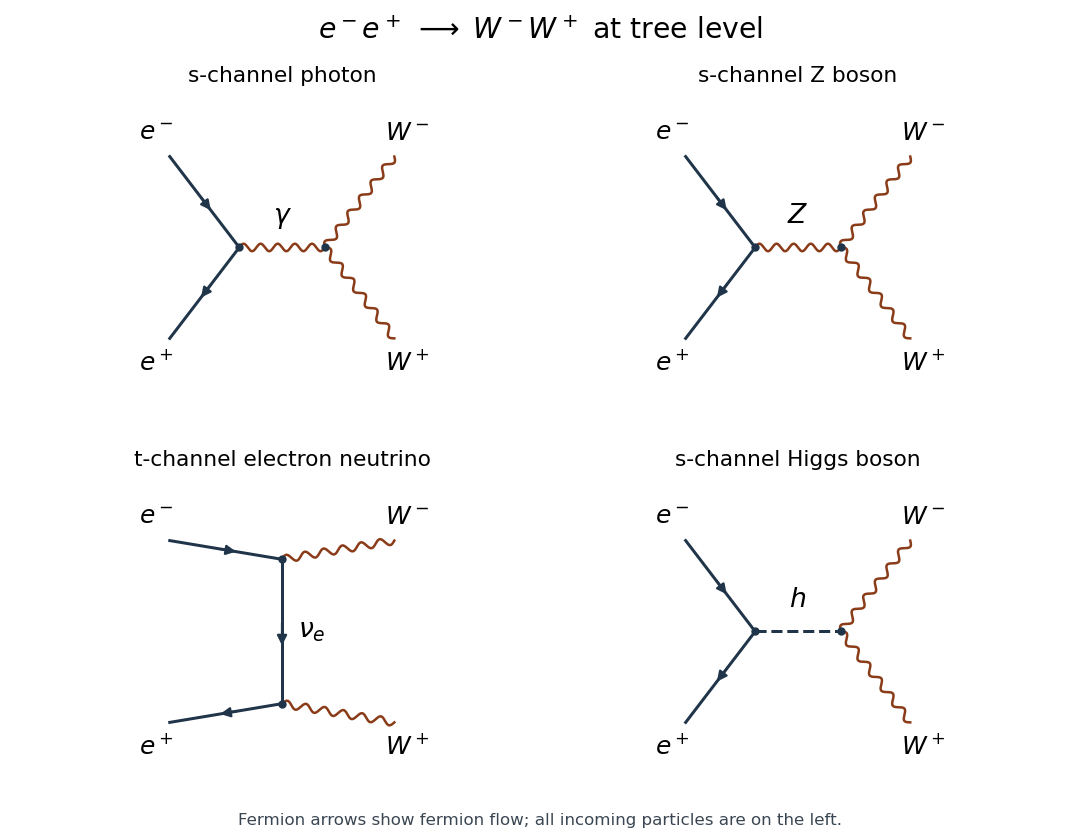

Let . The Higgs-electron coupling is , while the Higgs boson coupling to W bosons is . Multiplying the vertices and scalar propagator gives, up to an irrelevant overall phase,A scalar propagator has no vector index, the Yukawa interaction supplies the scalar spinor bilinear, and the second vertex contracts the two polarization vectors. We retain the tree propagator and neglect widths, consistently with the stated leading-order calculation.
For unpolarized incoming beams the spin average is , not a sum without normalization. The fermion spin sums and gamma-matrix trace identities giveThe terms with one gamma matrix have zero trace; the two-gamma trace gives . Both final polarization states are specified as longitudinal, so no final polarization average is appropriate.
In the centre-of-momentum frame, take and , where and . A pair of longitudinal polarization vectors isEach obeys and . Their contraction is angle independent:Consequently
For the two-body scattering cross section, the outgoing-to-incoming momentum ratio isThe source's final sentence interchanges the particle names attached to these two momenta; physical final-state phase space and initial-state flux fix the ratio as written here. Since the Higgs-only spin-averaged expression is isotropic, integrating the solid angle gives :There is no identical-particle factor: and are distinguishable. The threshold factor makes this contribution vanish when the outgoing momentum vanishes. This is the isolated squared Higgs amplitude for a specified longitudinal pair, not the complete physical cross section: the full result squares the coherent sum of all four amplitudes and includes their interference.
Articles by others on the same topic
There are currently no matching articles.